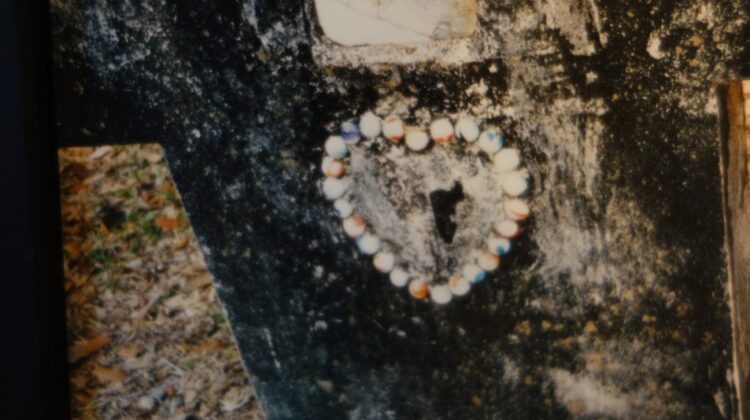
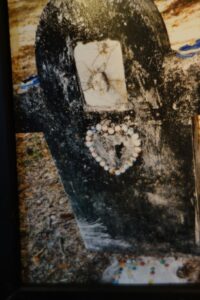
We took the photos of a child’s grave below at a small country church near Kissimmee, Florida. What drew us to it is a heart made with marbles pressed into the cement of the headstone. More marbles have been left at the base of the grave marker and on the child’s foot stone.. The marbles in the heart are ca.1930s and none have been removed. This was an elaborate headstone. Glass vases were mounted into the top of the cross-arms and the broken rectangle at the top was the child’s photograph. Water has stained and ruined the photograph. While we don’t know the child’s name or gender, we presume that it is a boy and his foot stone tells us, again using marbles as markers, that his initials were “RT.”
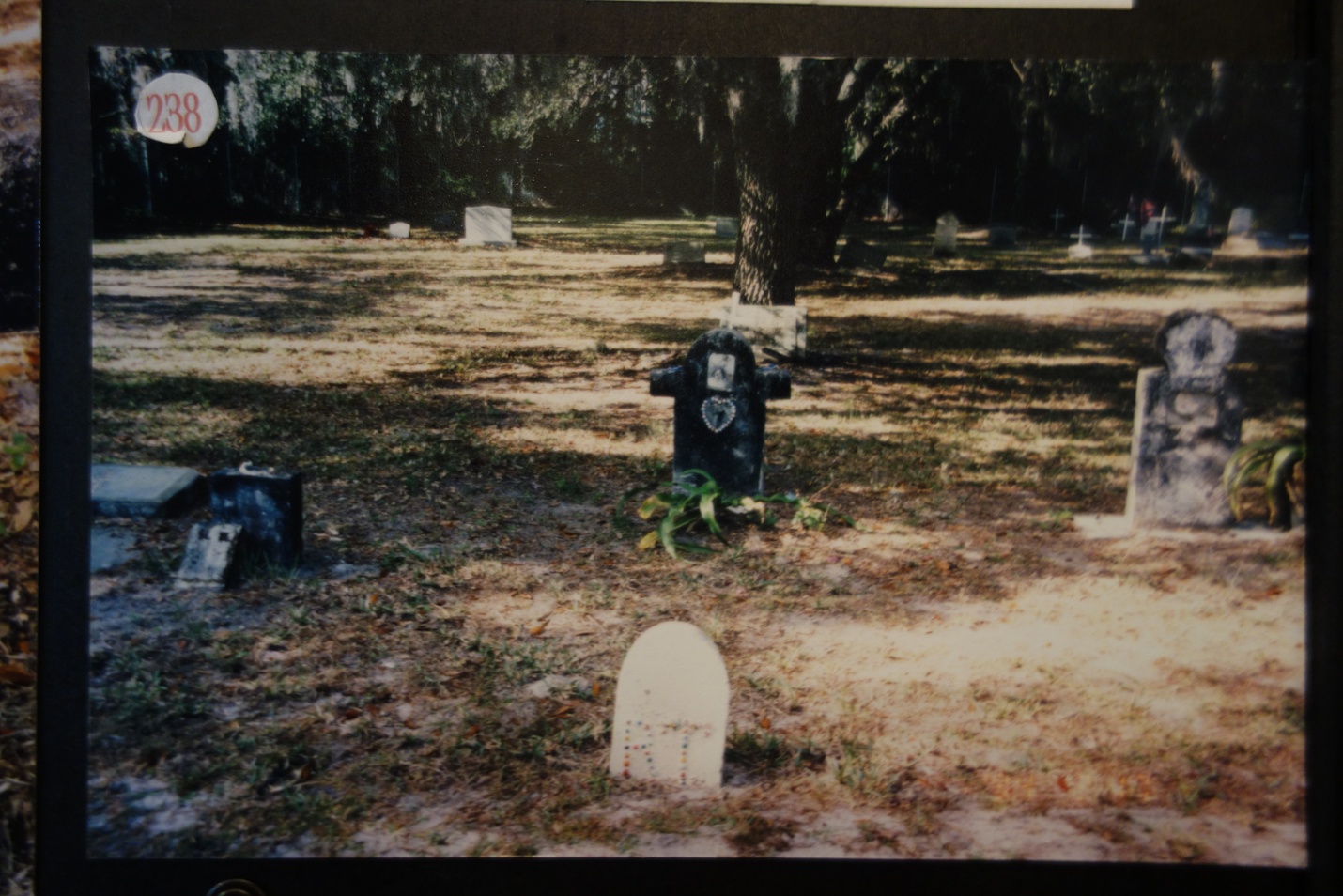
Shingle Creek, where the grave is located, was Osceola County, Florida’s, first church and it was started in 1865 to serve the settlement of Shingle Creek. George Thigpen was buried in the first grave in 1865, while in 1891 the original church building, which also served as the community school, was destroyed by fire. The second structure was also made of wood and it was quickly built on the site. It stood until 1961 when it was replaced by the present structure. Osceola County Historic Driving Tours, Osceola County Historical Society, no date, no page. We were unable to read anything on the old gravestone.
This is where the story begins: how commonly are marbles found in graveyards? This was our first find, but are there others to be found? In addition to research, we explored local graveyards looking for more.
Marbles in the Morgue: The Practical Kind
Before we get to the graveyard we need to stop by the morgue. In this story we are using the word morgue in the very broad context of death culture. Morgue is a French word, originally meaning a place where one looks solemnly at someone or a room for identifying the dead. It comes from the Old French verb morguer, meaning to look solemnly, to stare, to examine closely[1]. Once we know the true meaning of the word, morgue doesn’t sound nearly so morbid.
Although the spherical fillers used in contemporary post‑mortem reconstruction serve a strictly technical purpose, their presence in the mortuary environment creates an unexpected point of comparison with the historical use of marbles as symbolic grave goods[2].
Modern embalmers employ inert glass, acrylic, or polymer spheres to restore anatomical volume and stabilize facial features during preparation, a practice grounded in cosmetic necessity rather than ritual meaning.
By contrast, the marbles placed with children in Southern funerary traditions between the late nineteenth and mid‑twentieth centuries functioned as tokens of identity, memory, or spiritual continuity—objects chosen for their emotional and cultural resonance rather than their physical utility.
This juxtaposition highlights two distinct roles played by small spherical objects in the care of the dead: one pragmatic and reversible, embedded in the technical vocabulary of mortuary science; the other symbolic and permanent, embedded in the social vocabulary of mourning. Together, they illustrate how similar material forms, incidentally both called “marbles”, can occupy radically different conceptual positions within the broader landscape of death practices[3].
Tokens of Memory in Southern Death Culture
Modern morgue practice is completely separate from the Southern folk tradition of placing actual marbles with children in graves. Still, the coincidence is fascinating: in the modern morgue “marbles” play structural, cosmetic, and practical roles while Southern grave marbles offer symbolic, spiritual, identity‑based practices. Two different worlds, same object shape. In many ways, modern practices are strange echos of the older Southern practice of placing real marbles with the dead.
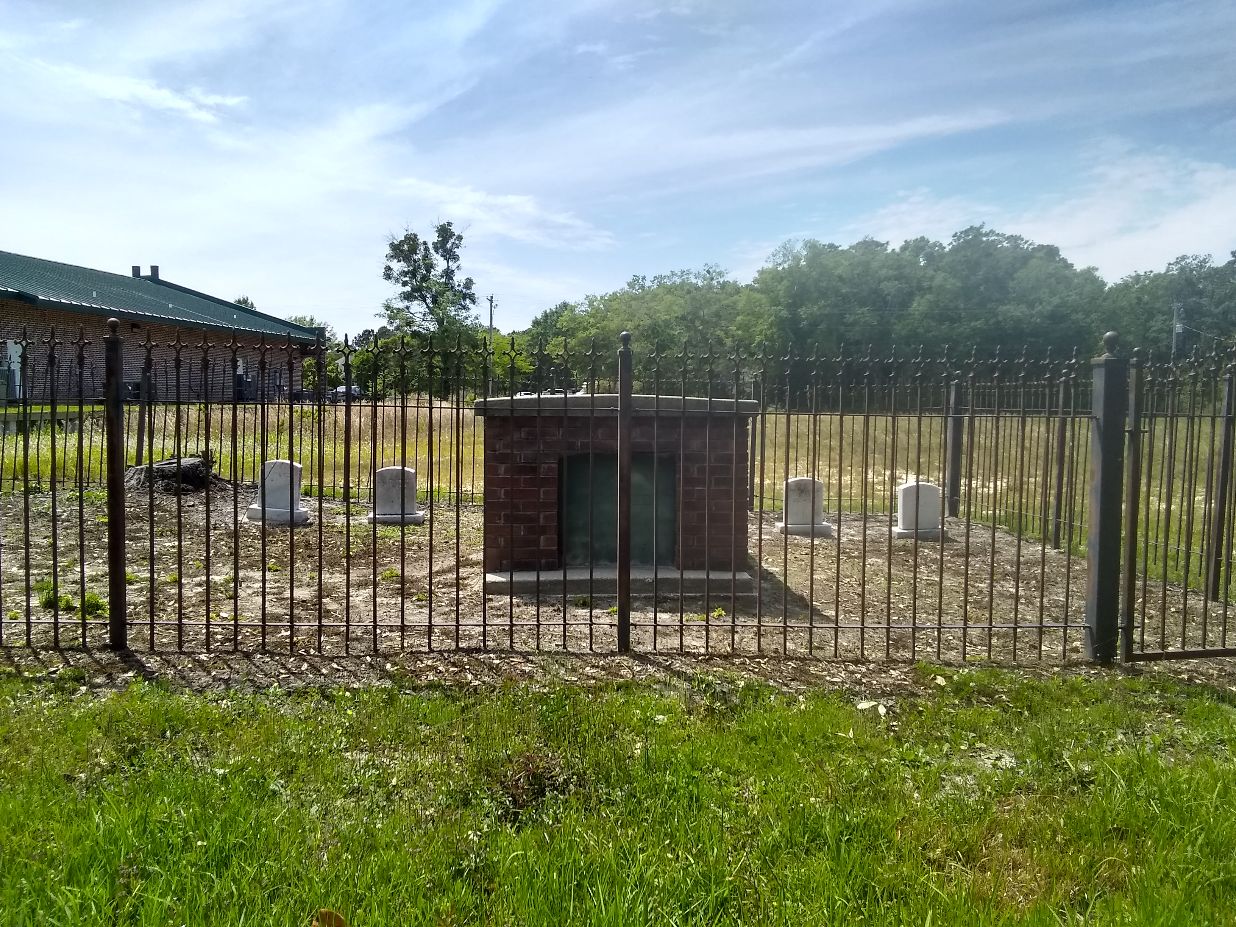
Small family cemetery, Coastal Mississippi. This graveyard is now surrounded by clinics, medical offices and law practices.
Across cultures and time periods, people have placed small, personal, symbolic objects with the dead—especially children. While the sources studied do not explicitly mention marbles in morgues, they do document the broader pattern of grave goods, tokens, and small rounded objects placed with bodies. This gives us the cultural framework into which marbles in Southern graves fit.
The Archaeology of Death
This is the Archaeology of Death, and it is a growing field in the broader fields of Anthropology and Archaeology[4]. Mortuary archaeology is the study of burial practices, funerary rituals, and associated artifacts to understand cultural beliefs, social structures, and historical contexts of past societies. It analyzes how death and the treatment of the dead reflect the values and identities of communities throughout history.[5]
Archaeological research shows that placing small objects with the dead is a deep, ancient, and cross‑cultural practice. One source describes rare chalk objects placed with a child in a prehistoric British burial, emphasizing the symbolic and personal nature of such items.
Objects placed with the dead often reflect identity, memory, or narrative. They may be unique, handmade, or personally meaningful.
Remember, in our opening paragraph we noted that we are using the concept of a morgue in the very broad context of death culture. Well, most homes in the 18th and 19th century South became morgues from time to time. Individuals including children were “laid out” and prepared for burial at home. Household doors were routinely removed from their hinges and used as cooling boards (laying‑out boards) for preparing the dead at home. This is directly documented in historical sources on cooling boards and home‑funeral customs[6].
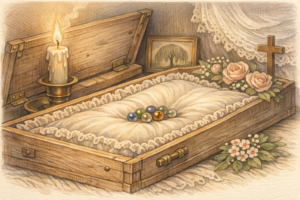
From the imagination of Microsoft Copilot
Bury the Marbles
In the American South—especially between1880–1960—marbles were sometimes placed in children’s hands before burial. They were also slipped into coffin bedding and left in the grave fill or placed on top of the grave and even embedded in the gravestones as tokens.
But the home-based morgue is the liminal moment: this is where the body is washed, prepared, and dressed. In many rural communities, this was done at home, and not in a formal morgue. When marbles were placed with the body, it often happened during washing and preparation, when dressing the child, and when laying the body out for visitation.
This is consistent with the broader archaeological and memorial patterns documented in the sources above and below, even though none of them mention marbles directly.
Marbles & Other Tokens Left at Graves
It was an indirect discussion with a vendor at a flea market in Long Beach, Mississippi, that got us to thinking and recollecting about graveyard marbles. We bought some marbles from a lady and she told us that she first got interested in marbles, not as a collector, but when she and a family member bought some marbles and, time after time, visited her brother’s grave where they covered the grave with marbles. The brother, she said, died at twenty-two.
We have always loved to visit cemeteries both in America and abroad. And we love the history and mystery that graveyards always have on offer.
For example, we loved exploring the underground crypts in Malta. Malta is famous for its underground graves. The most important and best‑documented example is the Ħal Saflieni Hypogeum, a vast subterranean burial complex dating from roughly 4000–2500 BC, which we spent half a day exploring.
Another resource discusses the practice of leaving coins at graves, tracing it back to ancient Greek, Roman, and military traditions. Coins and marbles serve similar symbolic roles: small, durable, personal tokens. Both can signal remembrance, connection, or identity. Both are often left by family members or peers, such as children leaving marbles for children. So, marbles do serve as grave tokens.
One of the most astounding examples of grave tokens that we have ever seen is at Mount Locust Historic House[7], Milepost 15.5, on the Natchez Trace Parkway. Just a short walk behind the House and into the woods is a small slave cemetery. Coins, beads, fresh flowers — the grave was crowded with offerings, each one strange and striking in its own way. No marbles here, but these tokens mark the resting place of a person who lived and died enslaved.
All signs point to a woman of deep authority — a figure whose wisdom guided the enslaved community at Mount Locust and likely touched the surrounding plantations as well. Her reach must have been regional. The tokens left here hint at a life steeped in Hoodoo tradition.
Voodoo and Hoodoo in historic Natchez, Mississippi, were deeply intertwined with the Mississippi River valley’s African diaspora, functioning as secretive, syncretic[8], and protective folk traditions rather than organized religions. These practices combined West African spiritualism with Catholic elements and herbal medicine to provide healing and empowerment to marginalized communities, with practitioners sometimes called “root workers” or “conjure doctors”[9].
We have traveled far and wide across the American South, and we understand a little about conjure practices and the sociopolitical and economic roles that such practices played in plantation culture.
We would expect to find traces of Hoodoo practitioners in nearly every enslaved graveyard across the South. What we did not expect was this: a grave at Mount Locust, more than 160 years after emancipation, is still visited, still honored, and still renewed with offerings. The marker bears no name, but someone remembers her — and believes her power has never faded.
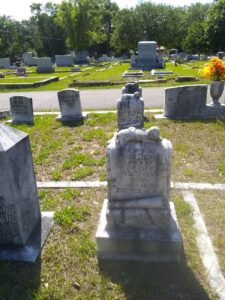
Three Little Lambs, All in A Row
Headstones are rarely just stone; they’re full of symbols. Walk through any graveyard and you’ll see crosses, hands, flowers, anchors, doves — each carrying a meaning. It’s natural to wonder what all those carved signs were meant to say.
We’ll tell you about a few. First up are the lambs and doves. Lambs and doves appear again and again on children’s graves, each carrying a language of innocence.
The lamb, drawn from Christian imagery of the “Lamb of God,” became the most common emblem for a child—pure, gentle, and gathered into divine care. The dove speaks a similar truth in a different register: the soul released, rising toward peace, untouched by the world’s burdens. Together, these symbols formed a tender vocabulary of loss across Southern cemeteries, marking the graves of children with signs of purity, protection, and the hope of a safe passage beyond this life.
A dove at rest speaks of peace rather than passage. Unlike the soaring dove, which symbolizes the soul’s ascent to heaven, a resting dove suggests a child held in calm, divine protection. It embodies innocence preserved, a life stilled too soon but settled gently into eternal peace. On children’s graves, the quiet posture of the dove conveys not movement but comfort — a soft assurance that the child rests safely and is watched over still. We saw examples of both types of doves in Old Biloxi Cemetery.
Coins left on a grave are a sign of remembrance, respect, and continued connection. In military tradition they mark a visitor’s presence; in African American and Hoodoo practice they serve as offerings, payment, or a way to “seal” the grave and keep the spirit at peace. A coin’s weight symbolically holds the soul steady, while its value — however small — acknowledges a debt of gratitude to the dead. On the graves of enslaved people, coins often signal that the person is still honored within the community, still approached for help, and still believed to possess spiritual authority long after death[10].
In modern military tradition, the denomination of a coin left on a service member’s grave carries a specific meaning. For some odd reasons we see fewer coins than any other artifact in cemeteries.
An anchor on a grave is most commonly a Christian symbol of hope, steadfast faith, and a life “held fast” even in death. It can also signal maritime work or, if the chain is broken, the end of life. We are always fascinated to puzzle-out the markings and figures on gravestones. If you are, too, then you might want to follow up by browsing these sites[11].
Marbles as Tokens on Children’s Graves
Marbles recovered from children’s grave sites are best understood as material expressions of memory and identity. Archaeologically, they function as placed objects—items intentionally deposited to mark the child’s presence and to signal continued care by the living.
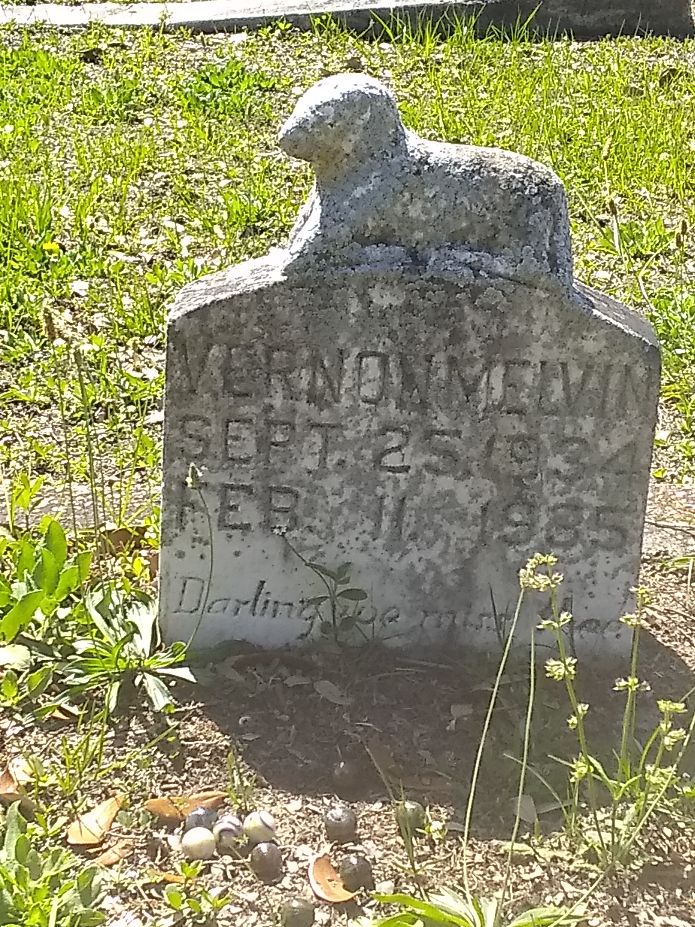
The photograph shows a badly worn lamb atop the gravestone of a five month old child. He also has a clutch of marbles.
Their association with play makes marbles particularly diagnostic: a marble on a grave often reflects the child’s age, social world, or favored possessions. Whether found singly or in small clusters, marbles on a child’s grave represent a durable practice of marking loss through everyday items, transforming a simple toy into a long‑lasting artifact of remembrance.
Marbles often appear in children’s graves as personal belongings or symbolic play items. In the late 19th–early 20th century, marbles were inexpensive and widely available, making them common grave goods. In some cultural contexts, such as the deep South, marbles were placed on graves as ongoing offerings, not just burial inclusions.
Why Marbles in the Graveyard Survive
The Southern graveyards, with their marbles tucked into the grass like small, persistent memories, anchor a tradition shaped by humidity, kinship, and vernacular grief. They behave like artifacts in slow motion: rolling out of eroding soil, slipping on collapsed coffin lids, drifting down slopes after storms and falling from tombstones. Each marble is a data point in a landscape of grief. Archaeologists read them the way we read postholes or pottery shards: as evidence of choices made by families who had little else to give. In the end, the marbles remind us that the South’s grave yards are not static fields of stone but living archives, where even a child’s toy can hold its ground longer than memory.
Across the cemeteries of the South, marbles surface as quiet witnesses to the lives of children whose stories rarely survive in documents. Their materials—clay in the hands of the poor, imported glass in the pockets of the well‑to‑do—trace the same social gradients that shaped houses, neighborhoods, and opportunity. Each marble marks a moment of play interrupted, a childhood remembered, and a family’s attempt to leave something of love behind. In following these small spheres across regions and decades, we see not just toys but the contours of class, culture, and care etched into the very soil.
References
- morgue, n.¹ meanings, etymology and more | Oxford English Dictionary 4/16/2026 ↑
- Before the 1950s, many small‑town funeral homes in the South and Midwest operated with few supplies. Embalmers sometimes improvised with whatever was on hand to support eyelids, weight down gauze, fill small voids under facial tissue, & to stabilize hands or clothing folds. In a handful of oral histories and trade anecdotes, toy marbles were used simply because they were smooth, hard, non‑absorbent, and already in the building since many funeral homes doubled as general stores or family homes. But this use was practical and not symbolic or ritualistic. ↑
- Henry Glassie, Passing the Time in Ballymenone (Bloomington: Indiana University Press, 1982), ethnographic treatment of tokens of memory placed with the dead. This book is current, still in print, and extremely popular so there are few excerpts available online. James M. Davidson, “Children’s Burials in the American South,” Historical Archaeology 42, no. 4 (2008): 1–30, documenting the inclusion of play objects—including marbles—in children’s graves. Davidson highlights marbles as one of the most recurrent objects placed with children—markers of play, personality, and imagined continuity of childhood beyond death. Robert G. Mayer, Embalming: History, Theory, and Practice, 5th ed. (New York: McGraw‑Hill, 2012), discussion of tissue building and the use of non‑absorbent fillers such as plastic and glass beads in restorative procedures. ↑
- For example, see the course syllabus “Archaeology of Death” Spring Semester 2023, Dr. Adrienne Frie, University of Wisconsin, Oaskosh. ↑
- See Dave Tabler, “Put The Corpse in the Barn till Spring.” AppalachianHistory.net @ Put the corpse in the barn till spring – Appalachian History (5/20/2026) & Cooling board – Wikipedia 5/20/2026 ↑
- James A. Brown, “The Search for Meaning in Mortuary Analysis,” Advances in Archaeological Method and Theory 1 (1978): 25–48; Derry Robson Webb, A Material Cultural Approach to Childhood In Antebellum and Postbellum Gulf Coast Plantation Societies Master Thesis @ https://www.academia.edu/93043854/A_Material_Cultural_Approach_to_Childhood_in_Antebellum_and_Postbellum_Gulf_Coast_Plantation_Societies?sm=a&rhid=39388500012 Webb does discuss marbles beginning on page 113 including an German “Indian” found while excavating but not specifically while digging inside a child’s grave.(5/20/2026) Liv Nilsson Stutz, Building Bridges Between Burial Archaeology & The Archaeology of Death Where is The Archaeological Study of the Dead Going. Stutz writes: it must be clarifed that burial archaeology does not equal the archaeology of death . The excavation and analysis of burials and the ar- chaeological sources they constitute relate to research questions extend- ing well beyond the realm of death. In fact, the vast majority of research on materials from grave contexts (be they human remains and/or arte- facts) involves questions having to do more with the living in the past, ranging from population and diet to social identity, social rank and re- lationships, etc., than to issues of death. Only a minority of the archae- ology devoted to burials deals explicitly with death, including the realm of mortuary rituals, the treatment of the cadaver, ontologies, religion, and concepts of the afterlife. @ https://www.academia.edu/80479224/Building_Bridges_Between_Burial_Archaeology_and_the_Archaeology_of_Death_Where_Is_the_Archaeological_Study_of_the_Dead_Going?rhid=39389487561&swp=rr-rw-wc-6481627&nav_from=866e3003-8c26-4620-befd-6ea4754a9d7d 5/20/2026 ↑
- Mount Locust Historic House, Milepost 15.5 (U.S. National Park Service) 4/19/2026 ↑
- “Syncretic” is an odd word, but it is appropriate here. At its core, syncretic refers to the blending of cultures, religions, symbols, or practices into a form that is no longer purely one or the other but a genuine fusion. In this context, we use it to describe religious practice—moments when beliefs from different traditions merge, such as the pairing of Catholic saints with Indigenous or African spiritual figures. ↑
- https://en.wikipedia.org/wiki/Hoodoo_(spirituality)#:~:text=Among%20the%20Gullah%20people%20and,an%20extensive%20cover%20of%20secrecy. 4/21/2026 ↑
- https://legacyheadstones.com 4/22/2026 ↑
- “Headstone Symbols: A Guide to Cemetery Symbols” @ Headstone Symbols and Meanings: 180+ Explained | Memorials.com Info Center (4/23/2026), Patricia Hartley, “The Hidden Meaning of Grave Marker Symbols Explained” @ Grave Marker Symbols: What Do They Really Mean? (4/23/2026) and “Worthless Trash or Cultural Treasure: Burial Artifacts and the Symbolism in African American and Christian Cemeteries.” Photographs, including a half-buried marble, by Judy Yates 4/23/2026. ↑
- The Archaeology of Children in Territorial-era Tucson – Desert Archaeology, Inc. | Full-service Cultural Resources Management 5/16/2026 ↑
- History of Tucson, Arizona – Wikipedia 4/23/2026 ↑
- https://www.loc.gov/resource/g4334tm.g001801886/?sp=5&st=image 4/23/2026 ↑
- If you want to learn more about adobe building methods you might want to visit Heather Schulz, “Adobe Structures in Tucson, Arizona” SBE 498 Senior Capstone Spring 2022, University of Arizona; Context for adobe construction: Schulz 2022; Tucson Historic Preservation Foundation; Arizona Historical Society @ SBE_2022_Capstone_Thesis_Schulz.pdf (4/25/2026) & “Preservation of Historic Adobe Buildings @ Preservation Briefs 5: Preservation of Historic Adobe Buildings (4/25/2026) Territorial Tucson was served by the Southern Pacific Railroad, which reached the city in March 1880 and remained the dominant rail line throughout the territorial period. Tucson, AZ (TUS) – Great American Stations 4/26/2026 ↑
- https://www.britannica.com/art/Rockingham-ware 4/25/2026 ↑
- Library of Congress Geography and Map Division Washington, D.C. 20540-4650 USA @ http://hdl.loc.gov/loc.gmd/g4334tm.g001801886 ↑
- Volume 2. Michael Heilen, Joseph T. Hefner, Mitchell A. Keur, and Marlesa A. Gray, etc.. You might want to check Deathways and lifeways in the American Southwest by Michael Heilen | Open Library (4/27?2026). We have been unable to locate a digital copy of any of the reports. ↑
- Page 312 in the section “Tools and Toys.” ↑