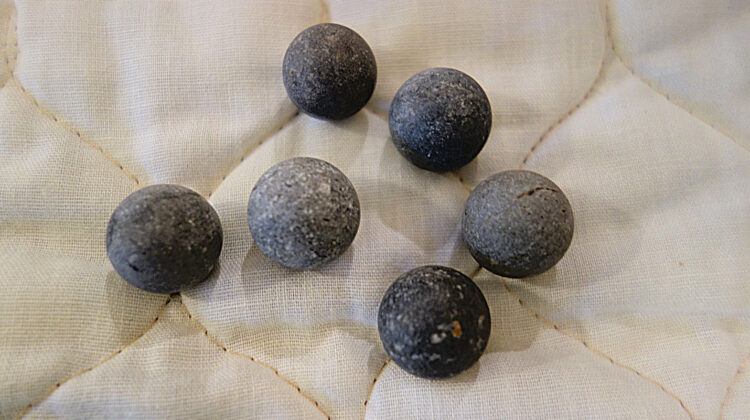
Hand Made Bluestone Marbles from Thiéarchie, France: Photograph by Jo Garrett
Why This Sounds Like An Adventure
We’ll acknowledge it plainly: this story’s title may suggest a misplaced chapter from Raiders of the Lost Ark. The reality, however, is quieter, stranger, more mysterious, and—if one pays attention—far more compelling. For centuries, artisans of the Thiérache region of France shaped its deep blue limestone into everything from church pillars to tools. With chisels, abrasive tools, and turning lathes, they also produced small stone objects—round practice pieces, tokens—objects never intended to travel far from the workbenches where they were formed.
While our marbles weren’t shaped in the so-called “Dark Ages”, but rather in the 1800s, their lineage runs deeper than it seems. The tools that shaped them — the lathe, the abrasive edge, the hand-cranked rhythm — evolved generation by generation into the precise craft we glimpse today. In that sense, each sphere carries not just a regional imprint, but a legacy of invention.
Photograph of Blue Stone offcuts taken at a building site. Wikimedia Commons.[1]
Our marbles weren’t made in that early world of bow‑strings and rough stone, yet the craft that shaped them is a direct descendant of it — a lineage carried forward through centuries of refinement in lathes, tools, and the patient geometry of the hand.
In Thiérache, bluestone is dense, fine‑grained, and beautiful. These offcuts were perfect candidates for being shaped into all sorts of small spheres—the hand-held objects like those that we’re writing about. You can see the fine grains in the stones in this photograph.
Photograph of Blue Stone offcuts taken at a building site. Wikimedia Commons.[1]
Offcuts: Where The Hard Work Of “Smalls” Begins
An offcut in stonework is a piece of stone that gets cut off while shaping something else from larger slabs of stone. It’s the leftover fragment created when a mason cuts a block to size. It can be irregular or roughly shaped, depending on what was being made when it was discarded.
Offcuts can be thought of as the glass cullet marble collectors know about and which has been used historically in the making of glass marbles. Today we collect cullet, swap it, and dig it up at old marble-making sites.
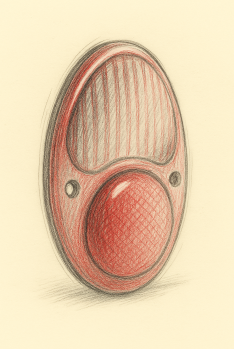
Microsoft Copilot Historical Sketch. We think the taillight may be a “1928 – 1932 Ford Duolamp Tail Light” We are told that they fit both cars and trucks.
Glass cullet is crushed, recycled, or waste glass (often from bottles or manufacturing rejects) used as a vital raw material in glass manufacturing[2]. We once found a complete bright red 1930s Ford taillight in glass cullet at a marble factory yard in West Virginia! In other words, an offcut is the scrap that becomes something else, some type of small object or hand tool when a stone craftsman has imagination, skill, and a tremendous amount of energy.
Marbles aside for the moment. Skilled workers often turned offcuts into small useful objects—wedges, chocks, tokens, or practice pieces which could be roughly spherical. Apprentices especially used offcuts to practice turning, smoothing, or rounding on a lathe or by hand[3].
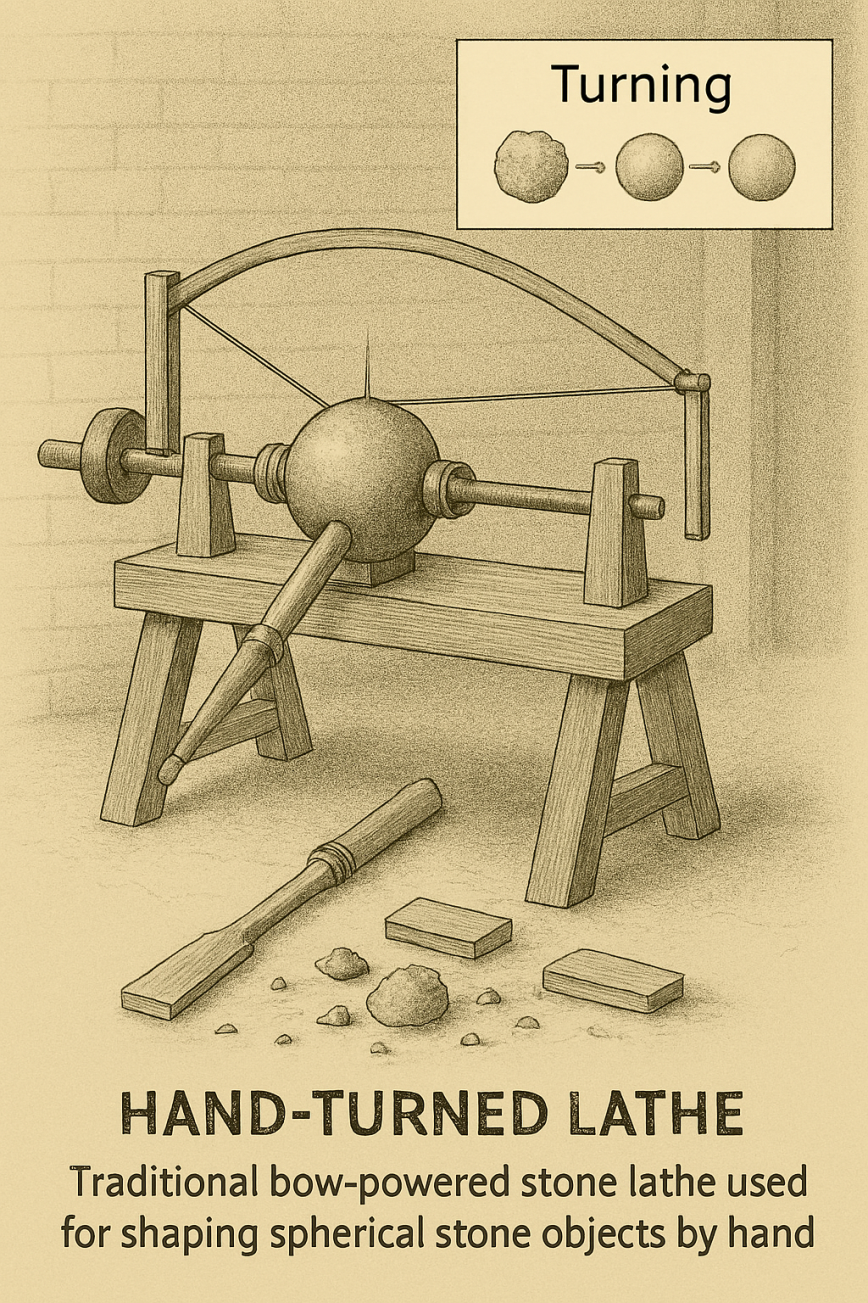
Microsoft Copilot Historically Based Sketch
What Time Is It?
“Small lathes driven by a hand held bow probably provided the earliest form of turning.[4]” The bow-powered lathe increased the energy quotient of the workers dramatically. It didn’t just let a worker turn stone — it multiplied what a single arm could do. By storing and releasing energy with every stroke, the bow transformed uneven human effort into smooth, continuous rotation.
Instead of fighting the stone, the worker borrowed the bow’s spring and rhythm, turning muscle into momentum. It was a small machine, but it raised the energy quotient of the craft, letting one person shape what once took two[5].
Our bluestone marbles, which both primary and secondary evidence shows most likely date to the late 1800s, were made on machines that evolved directly—though slowly—from the hand‑powered lathes of medieval Europe. The core idea (workpiece spinning between centers, tool applied to a rest) never changed. What changed was power, precision, and continuous rotation, culminating in the industrial lathes capable of grinding stone spheres by the thousands. The fundamental concept—the need for more and more power—has never changed.
Here is a schematic of the timeline of the development and harnessing that power over the centuries.
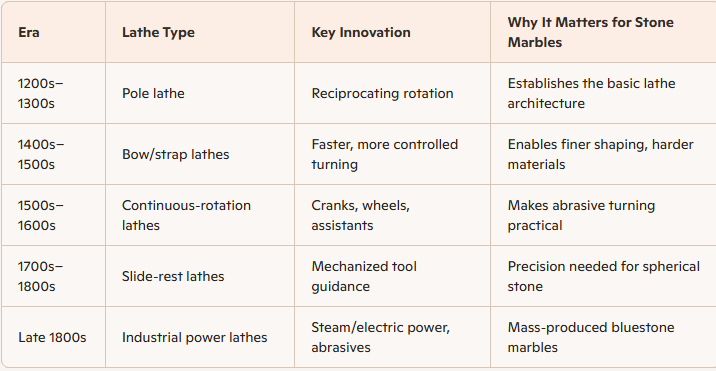
We turn now to an analysis of the turning of offcuts into useful objects in the Late Medieval to Early Renaissance Periods (1400s – 1500s) in France and Belgium (in the Thiéarchie geologic region). Although most woodworkers still used reciprocating lathes, metalworkers and pewterers began adopting continuous‑rotation lathes before 1600. These used cranks, wheels, or assistants to keep the spindle turning in one direction.
This shift was crucial because continuous rotation allows smoother surfaces, it enables higher speeds, and it makes abrasive shaping, critical for stone, far more effective and efficient. While Guild restrictions slowed adoption in cities, rural craftsmen experimented more freely, keeping innovation alive. This innovation in the country side is the historical antecedent of our smooth, round, and fine marbles.
Guilds played a quieter but no less decisive role in this story. Long before marbles were turned with steel tools and steady bearings, the craft that shaped them was being refined inside the disciplined world of medieval and early‑modern guilds. They created structured apprentice programs and apprenticeships in turn preserved techniques, their rules enforced quality, and their networks carried new ideas from one workshop to the next.
Innovations in lathes, abrasives, and tool geometry moved through guild hands, and they were tested, taught, and improved. So while our marbles were not born in that earlier age, the craft behind them was: a lineage carried forward by the very institutions that kept the turning trades alive[6].
The bow-powered stone lathe used for shaping stone artifacts by hand not only kept the innovations in stone-turning alive but it also advanced knowledge and experience in using lathes to increase needed power to shape objects. Developments in the 1500s – 1600s led in a continuous and unbroken line to the 1800s machines which produced our marbles.
By the 1500s, bluestone had become the signature material of the Thiéarchie region, quarried for the fortified churches, civic buildings, thresholds, and carved architectural details that defined its towns. Its density, durability, and fine working qualities made it the stone of choice for foundations and fortifications alike. That same toughness — the very trait that made it indispensable to masons and builders — also shaped the tools and techniques of the craftsmen who worked it, linking the humble turned sphere to the grand structures that still anchor the landscape.
On The Bench: Improved Power & Efficiency
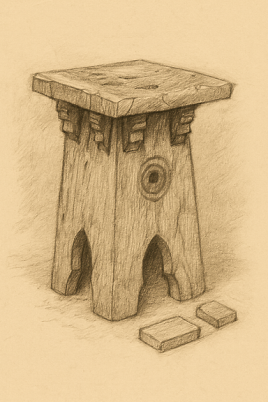
Now to a fundamental guide on how the bow lathe worked. First, you need to use your imagination to see the stool the worker sat on and which was placed in front of the bench. Whatever the stool looked like, you can be assured that it was made for utility and hard use. It had to be robust enough to last generations. We imagine that the stool may have looked something like this. We don’t think there was any kind of cushion on the seat.
The worker sat on the stool in front of the abrasive tool, which rested on a small block of wood which was attached to the bench. While not shown on the sketch, the little rest was attached just where the offcut was tooled into a sphere. A worker held the abrasive tool steady with both hands and pressed it gently against the spinning stone blank which was mounted on the lathe’s spindle.
No, craftsmen did not have three hands. The solution was, of course, a second worker on the lathe to power the hand crank. We have no idea whether or not the man cranking the lathe had a stool. We certainly hope so!
Remember, this is not a marble factory. This was a stone shop which supported bluestone construction or a community in need of smalls such as other tools and objects in support of daily life in the region.
We can imagine that when spheres were turned out the primary goal would have been to train an apprentice in using the bow-powered lathe. The goal would have been to take an offcut and form the sphere and then abrade it to a fine (as fine as could have been accomplished on this lathe) a form as possible. In that case he would sit at the bench while the master stone worker would crank the lathe and instruct the student on exactly how to turn the perfect sphere.
Our research has confirmed that in small rural shops, this was often a solo operation, with the worker alternating between turning and shaping!
We know that a number of sphere makers read our stories. Drop a comment and tell us what you think of this operation!
Working The Lathe: Precision By Hand
A skilled worker using a hand lathe absolutely could work a stone blank down to 1”, especially if the material was fine-grained and the abrasives were well chosen.
The lathe’s spindle holds the blank securely, allowing symmetrical shaping. The abrasive tool — often a file, chisel, or grit-coated stick — is applied with controlled pressure. With practice, a craftsperson could feel the roundness and adjust pressure to maintain diameter. Remember, the goal was to train an apprentice, and not to make toys.
Thiérache bluestone is dense but workable, especially in small fragments. If the blank was pre-chipped to near size, the lathe work was mostly refining and polishing.
What Other “Smalls” Did Stone Workers Routinely Make
A study of the evidence teaches us that many 19th-century spheres — especially stone or ceramic — were under 1”. Remember, by now lathes were using industrial power. Lathes had developed over the long ages and now energy was generated by both steam and electric power.
Workers routinely made game pieces, buttons, and beads, all requiring sub-inch precision. Rural workshops often produced small, uniform spheres for trade or local use.
Buttons were made by hand lathe. They were made of bluestone, other limestones, bone, horn, and slate. Bluestone buttons were especially useful for work clothes and smocks. Beads produced include those for trade; Rosary beads; and decorative beads. Beads under 1” were extremely common. Workers also made drawer pulls and box knobs.
Game pieces were big business; they made tokens, “men” for board games, and small weights for balance games.
“Smalls” were the bread and butter of the stone worker running the lathe. Offcuts were free. A quarry block becomes a slab and then the slab becomes tiles while the scraps become blanks and, finally, the blanks become small saleable objects. Piles of bluestone scrap could be found all over the countryside where a church, courtyard, or paved road had been built. Nothing was wasted. Everything was monetized. Exactly the kind of economy a Thiérache workshop lived on[7].
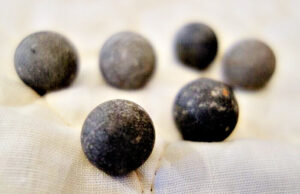
Photograph by Jo Garrett
Bluestone Treasure
We’ve gathered a number of compelling clues that illuminate the story of these marbles. First, in the 1500s – 1600s, working a sphere under 1”—for any reason—was not unusual nor uncommon. Many products made by the skilled and apprenticed stone workers were routinely under 1” in size.
And, second, these marbles weren’t hidden treasure; they were the byproducts of skills development—objects made by apprentices learning the lathe or by craftsmen turning offcuts into something pleasing. Their rarity today comes not from myth but from the simple fact that few people ever thought to save them.
Thiérache’s bluestone marbles were never part of a grand legend. They were treasured by children playing in villages historical cities fortified against centuries of conflict. Their mystery comes not from myth, but from obscurity: a tiny craft tradition tucked into a corner of northern France, nearly forgotten until now.
Long before marbles were made from glass, marbles dominated childhood play. Stonecutters in Thiérache shaped bluestone into small spheres. Some were toys, some were practice exercises, some were simply beautiful scraps given a second life. Today they survive as ghosts—rare, unrecorded, and unexpectedly evocative.
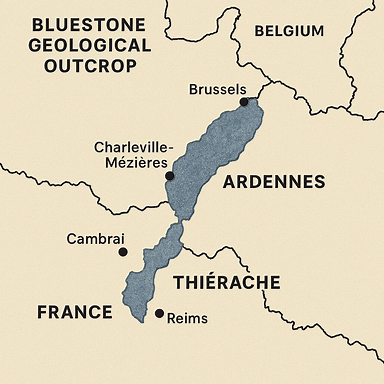
Bluestone Geologic Outcrop (Belgian / Thiérache Crinoidal Limestone)
Sketch by Microsoft Copilot
“Where In The World Is Thiérache?”
Thiérache sits in the quiet, rolling countryside of northern France pressed right up against the Belgian border. It’s a region of fortified brick-with- bluestone churches, hedgerows, and old stonecutters’ villages. The same geological seam that runs beneath Thiérache continues north into Belgium’s Hainaut province — the historic heartland of pierre bleue, the famous blue limestone used in everything from cathedrals to the cobblestones which paved the streets.
“Thiérache is one of those unsung regions of northern France through which travellers often pass but too few stop to explore. …It has rolling hills, gentle valleys and fortified churches ….. This part of the département of Aisne is a comparatively little visited region of the country, stretching north-east of Saint-Quentin. It is a gently rolling landscape grazed by cattle, and traversed by the meandering course of the River Oise, a river that flows generally in a south-westerly direction to join the Seine downstream from Paris.”[8]
The Ardennes, as shown on this map, covers southern Belgium (Wallonia), Luxembourg, northeastern France (Ardennes département), and parts of western Germany. Like Northern France, the Belgian department is characterized by rolling hills, dense forests, river valleys, and rocky plateaus. The Semois, Meuse, and Ourthe rivers flow across the terrain
This cross‑border stone belt is where our marbles’ story begins. French quarries once tapped the same ancient limestone beds as their Belgian neighbors, producing a material rich with crinoid fossils and a distinctive blue‑gray tone. Whether shaped in a village workshop in France or a quarry yard in Belgium, the stone shares a common origin: a 350‑million‑year‑old seabed turned to rock.
To understand a Thiérache bluestone marble, you have to picture this landscape — France and Belgium meeting along a line of ancient stone, where geology ignores borders even when people don’t.
But Wait, Thiérache Isn’t The Only Place Bluestone Outcrops!
Bluestone is not one single rock type. The term refers to a mix of igneous and sedimentary stones, including spotted dolerite, rhyolite, sandstone, and volcanic ash.
Stonehenge, which is located on the Salisbury Plain in Wiltshire, England about two miles west of Amesbury and eight miles north of Salisbury,[9] is made of both sarsen (huge outer stone) and Preseli bluestone (smaller and darker stones inside the circle)[10].
Types of bluestone are found in the United States as well. Pennsylvania Bluestone is a dense, fine-grained sandstone from the Catskill Formation, which is mostly quarried in Pennsylvania and New York. It is used for paving, steps, and architectural stone. Victorian Bluestone is a basalt (volcanic rock) used extensively in Melbourne, Australia, architecture. That “bluestone” is dark gray to blue-black in color. Irish blue is found in Ireland while “bluestone” is also mined in China.
West Virginia does have “bluestone” which occurs primarily in the south. This geologic feature extends into Southwestern Virginia and Eastern Kentucky. It is blue-gray when freshly cut but it turns tan or buff when weathered. The French/Belgian bluestone turns a lighter color of blue-gray. Our marbles are worn and weathered into these paler shades.
West Virginia bluestone is not a limestone, but it is very durable and is used for steps, sills, sidewalks, bridges, and architectural trim. It is not fossil rich, hardly “polishable” like Frnch/Belgian bluestone. But trying to turn WV bluestone on a bow lathe would feel like trying to shape a brick with a butter knife! If there are American bluestone marbles, we have never seen them.
No Bluestone Marbles Before the Late 1800s?
The timeline of tools, materials, and incentives never lines up in a way that would produce bluestone marbles before the late 1800s. When we study the sequence of events, the absence becomes perfectly logical. These marbles are latecomers, not because the craft was young, but because the lathe needed centuries to evolve from a back‑and‑forth bow to the continuous rotation a perfect sphere demands.
First, the lathe wasn’t built for spheres. From the 1500s through the 1700s, the bow‑reciprocal lathe excelled at axial symmetry—spindles, knobs, beads, buttons, finials. But a sphere requires continuous rotation, not the back‑and‑forth motion of a bow. While a bow lathe can shape a bead, it cannot true a perfect marble.
Second, stone was too valuable to waste. This is why even the bluestone offcuts were monetized. Bluestone in the 1500s–1700s was considered a structural material and not a toy material. At the time there was simply no market for bluestone marbles.
Third, bluestone was used for foundations, corner reinforcements, door and window surrounds, steps, thresholds, paving, and carved architectural details. While offcuts could be found at old construction sites, every chip of bluestone had economic value. Beads and buttons had monetary value: turning it into children’s playthings would have been unthinkable because there was no market for bluestone toys.
Fourth, we need to follow up on the lack of a market for bluestone marbles. Before the 1800s, children’s games used clay marbles, some ceramic, baked‑earth “commies,” nuts, seeds, pebbles, and, believe it or not, carved wooden balls! Western Europe has had marble‑like play objects since Roman times[11], but true manufactured marbles don’t appear until the 18th–19th centuries, with industrial glass marbles emerging around 1846. Stone marbles were not a commercial category. There was no demand to justify the labor.
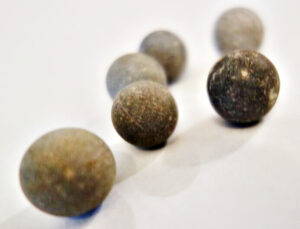
Finally, the first practical devices for making uniform stone spheres—continuous‑rotation lathes, cup‑grinders, and later water‑powered or treadle‑powered machines—don’t appear in rural workshops until the 1800s. Only then does it become feasible to rough a cube, for example, from bluestone offcuts, spin it continuously, grind it into a true sphere, and polish it consistently. That’s when Thiérache bluestone marbles finally become possible.
Those 19th‑century workshops already made beads, buttons, and knobs.
Once continuous rotation and better abrasives arrived, marbles became just another small turned object—but only then.
Our bluestone marbles are not medieval relics, yet their lineage reaches back to the bow‑lathe world that could shape almost anything—except a perfect sphere. These marbles were never products of the ‘dark ages,’ but their ancestry runs through the long evolution of the lathe: from the bow‑driven tools that shaped Europe’s stonework to the continuous‑rotation machines of the 1800s that finally made true spheres possible.
Where Did We Get Our Bluestone Marbles?
Stéphane Balasa, who lives in Osny, France, is a good friend of ours as well as an accomplished polymerist and glass artist. He has contributed to The Secret Life of Marbles twice. Check his stories “French Sparklers: Twin Marbles That Cross Borders” and “Notes From A Gifted Polymerist[12]”
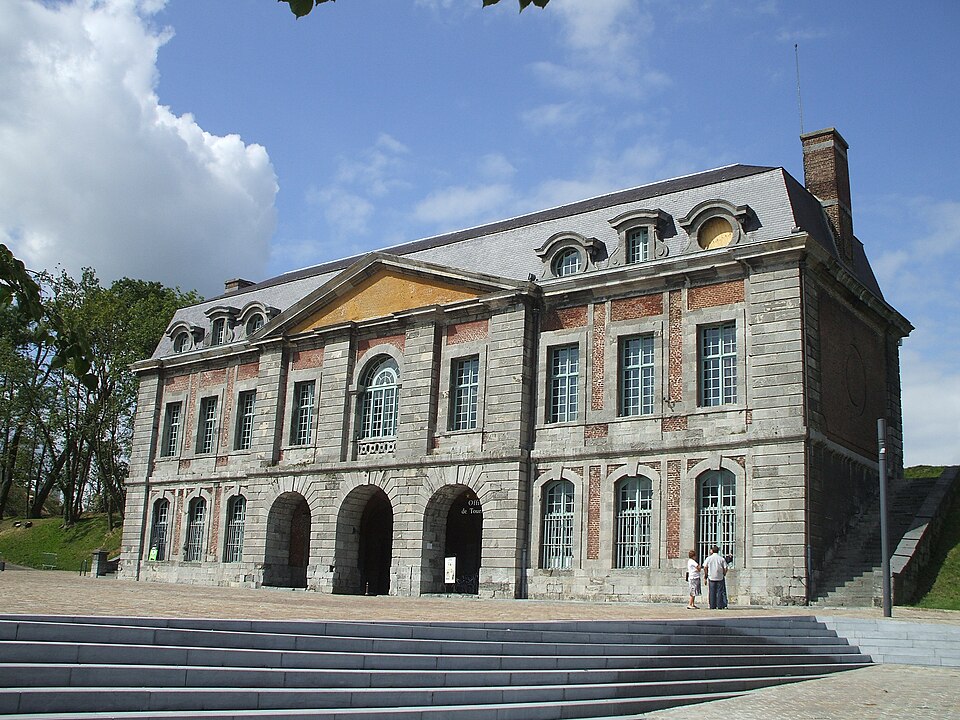
Porte [Gate] de Mons in Maubeuge in the Nord [North] Department of France
Built under Louis XIV by Vauban in 1682 to house a guardhouse, housing and cells. Illustrates a structure built of both bluestone and brick[13].
We recently saw an advertisement on Stéphane’s website. The notation was simple: “Antique Set of 25 Marbles Made of Blue Stone from Thierache.[14]” The original source of the lot of marbles was French eBay. We purchased a few and Stéphane sent this note with the marbles. The note was posted by the original French eBay seller. “These marbles come from my great-grandfather who lived in upper Aisne (02) in Thiérache”. Despite the gray color, he identified them as blue stone of Thiérache.
While it is impossible to know when this seller’s great-grandfather lived, we can gain some insight if we develop inferences. Genealogy Explained tells us that “generations tend to last 25-30 years. The word generation is used rather loosely these days.”
If we assume the seller is about 60 years of age then his great-grandfather would have live about 1840-1900[15]. Although this time line needs to be taken with a grain of salt, these dates would add up nicely to a child acquiring these bluestone marbles very close to the time when they were both available and at least somewhat popular. This would be in late 1800-ca. 1920.
Other Goodies
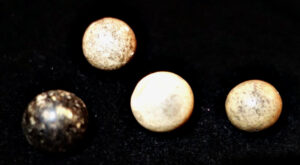
When the packet arrived we discovered that he sent us much more than what we bought! He gifted us with four more stone marbles and he wrote this note about them: “The white/cream stone marbles are the earliest marbles made in France before the adoption of the cement/sand or other agglomeration processes, so they likely date from around 1890-1900. I can’t say for sure about their original quarry or their exact composition.”
While the note is a bit confusing, these marbles are from the approximate time that the bluestone marbles were made. Compare the difference in the two type stone marbles made at roughly the same time in France.
Stéphane also sent five of his gorgeous poly marbles. Three are swirls and two are spotted. They range in size from about 1” to 1¼” (15/16”). He also sent a striking 1 1/8” Cats Eye which he made. It has red, white, yellow, and old gold vanes and some of the vanes look tipped! And, finally, we received an unopened net of clay marbles branded “Bille Brousse”. Stéphane wrote that “the clay marble net comes from a factory that closed in 2015 and was designated as part of France’s artisanal heritage[16].”
The Life of a Bluestone Marble
A few details about bluestone marbles help explain why they mattered so much to the kids who carried them. Understanding what makes a bluestone marble so very different adds another layer to the story.
Bluestone is a sedimentary rock formed over millions of years, shaped by pressure, water, and time. These marbles weren’t molded; they were chipped and ground by hand, each one slightly irregular. That pocket-worn polish and that slight fade to gray on some of the marbles comes not from the quarry but from years of handling, rolling, and worry-stoning.
Different quarries produced subtly different hues: slate-gray, storm-blue, or almost lavender. Unlike glass, these marbles rarely chip. They outlast the pockets that carried them. They are heavier than glass, which changes the way they roll and strike.
A closer look at the stones themselves and their production history reveals why they became favorites in so many pockets.
“There is no real ending. It’s just the place where you stop the story.”
Frank Herbert
References
- Commons.wikimedia.org/Wikimedia.org/wiki/Blue_stonrd.jpg. Attribution-ShareAlike 4.0 International Deed @ creativecommons.org/licenses/by-sa/4.0/ 2/16/2026 ↑
- https://www.guardianglass.com/us/en/who-we-are/stewardship/environmental-stewardship/life-cycle-of-glass/raw-materials/use-of-cullet-to-reduce-raw-materials-and-energy-consumption 2/13/2026 ↑
- https://stuartking.co.uk/history-of-the-lathe-part-one-reciprocal-motion/ 2/25/2025 ↑
- Ibid. ↑
- See R.J. Forbes. Studies In Ancient Technology, Vol. III (3rd Ed.) Leiden, Netherlands, E.J. Brill, 1993. Technology and Culture, Vol. I (1959) to current. Online @ https://muse.jhu.edu/journal/194 — (2/25/2026). This journal’s publication is a project of Project MUSE which promotes dissemination of essential humanities & social studies through collaboration with libraries, publishers, and scholars worldwide. There are dozens if not hundreds of articles in digital format, and the entire journal may be online! You also might want to explore Early Lathes and The Gramercy Tools Treadle Lathe – A Time To Turn 2/25/2026 ↑
- Reference: Craft Guilds, Apprenticeship, and Technological Change in Preindustrial Europe | The Journal of Economic History | Cambridge Core; Guilds and Craft Production | European History – 1000 to…; Craft Guilds, Apprenticeship, and Technological Change in Preindustrial Europe | The Journal of Economic History | Cambridge Core; Guilds and Craft Production | European History – 1000 to…; & WP282.pdf 2/25/2026 ↑
- If you want to read more about lathes then we recommend that you see Grace’s Guide to British Industrial History, “Early Lathes” @ https://www.gracesguide.co.uk/Early_Lathes?utm_source=copilot.com (2/23/2026); “Lathes Part 1: About Medieval & Renaissance Lathes” @ https://bloodandsawdust.com/Blood_and_Sawdust/Lathes_Part_1__About_Medieval_and_Renaissance_Lathes.html?utm_source=copilot.com (2/23/2026) & Joel’s Blog “Early Lathes and The Gramercy Tools Treadle Tools A Time to Turn @ Early Lathes and The Gramercy Tools Treadle Lathe – A Time To Turn 2/23/2026 ↑
- Rudolf Abraham. “Thiérache: A Hidden Corner of Northern France.” @ https://www.hiddeneurope.eu/the-magazine/issues/hidden-europe-68/thierache-a-hidden-corner-of-northern-france/ 2/16/2026 ↑
- “Stonehenge stone circle, near Amesbury, Wiltshire, England” @ https://www2.stetson.edu/neolithic-studies/stone-circles/stonehenge-stone-circle-near-amesbury-wiltshire-england/ 2/23/2026
- History Hit (2/23/2026) & “History and Stories: Stonehenge” @ https://www.english-heritage.org.uk/visit/places/stonehenge/history-and-stories/ 2/23/2026
- Chris Cooper, “The Origins of The Game of Marbles” The Museum of American Glass in West Virginia @ The Origin of the Game of Marbles – The Museum of American Glass in West Virginia (2/26/2026); Joanna Jana Laznicka, “Clay Marbles in History and Archaeology: How to Identify and Date Them @ Clay Marbles in History and Archaeology: How to Identify and Date Them (2/26/2026) & “History of Marbles @ The History of Marbles Games – (the world’s oldest game) 2/26/2026
- https://thesecretlifeofmarbles.com/?s=Stephane. Check his website @ https://www.facebook.com/artbillescollection 2/27/2026 ↑
- Wikipedia Commons.@ https://fr.wikipedia.org/wiki/Fichier:Porte_de_mons_maubeuge.JPG#globalusage. Usage see https://fr.wikipedia.org/wiki/Domaine_public_(propri%C3%A9t%C3%A9_intellectuelle) (2/28/2026). Port of my maubeuge.JPG↑
- https://www.ebay.fr/itm/317839879323?mkcid=16&mkevt=1&mkrid=709-127639-2357-0&ssspo=zq-FIlC-S36&sssrc=4429486&ssuid=DpSWxk–
- See Great GQDm&stype=1&var=&widget_ver=artemis&media=FB_MSG 2/27/2026 ↑reat – Generations and Time – Discover Family ↑
- “Artisanal” is a word we keep hearing more and more. Seeing it tagged to “heritage” made us realize that we aren’t certain that we know what it means. Do you? Here is some clarification. Artisanal heritage basically means the traditional skills, crafts, and know‑how that people pass down through generations. This heritage includes handmade crafts (pottery, weaving, woodworking, metalwork); traditional techniques (how something is made, not just the final product); cultural knowledge tied to a community or region; and, finally, The pride and identity connected to those crafts. “Artisanal heritage” is the old, skilled, hands‑on ways of making things that a community has kept alive over time. We are proud that marbles of all types—glass, stone, clay or ceramic—are included in the artisanal heritage of France, the United States, Germany, and so many other cultures world-wide. ↑