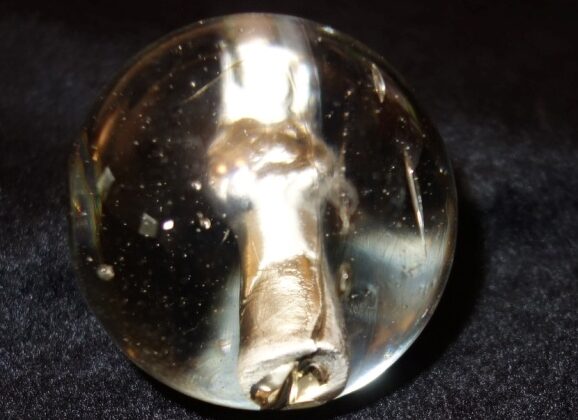
A Kate Greenaway sulfide marble is a rare Victorian-era collectible, prized for both its delicate artistry and for the strange folklore that clings to it. Inside each clear glass sphere sits a tiny white porcelain cameo—usually a child in Greenaway’s signature style: pinafores, bonnets, soft postures, and faraway expressions. These figures were cast in sulfide, a ceramic material that gives them their ghostly, milky glow.
We may have had a Greenaway sulfide[1] for years but we didn’t know it! In fact, neither of our recollections are totally clear on who we got it from—or when and where we got it. However, we are confident that we got it in West Virginia and that the sulfide didn’t cost us a dime!
We do remember thinking at the time that the figure inside is an Angel, but we can’t see any wings. We are still old school in many ways and when we got home we checked first Paul Baumann’s Collecting Antique Marbles Identification and Price Guide, 4th edition, pages 96 – 111. We have used Baumann so much that the pages are falling out!
Next we checked Everett Grist’s Antique & Collectible Marbles Identification & Values, 3rd edition pages 45 – 66. She might have been in Grist on page 46 in the section “Children and figures,” but if she is there he does not identify her. And, of course, we searched the Internet but without luck.
With no identification and nothing more to go on, we placed her back on a shelf with our other sulfides and we went on with other projects. Not only did we not know yet who she is, but we also didn’t know if she was old or made more recently in the “old world” style.
Still, every time we looked at her we wondered who she was.

The Unknowns Of Making A “Modern Antique” Sulfide
Around the time that we were so puzzled with the sulfide—is she 19th century or some kind of modern cameo made skillfully and carefully in Bavaria’s glass making heritage—we visited Weston, West Virginia, home of The Museum Of American Glass in West Virginia[2].
While in town we walked around and we looked for antique shops. That’s when we found the Old Marble Nut, Scott Meyer at play in his glass studio. Our encounter with him is described in some detail in our story “Contemporary Figural Marbles” in our online eMagazine The Secret Life of Marbles. We had never met the gentleman before and we knew nothing about his past nor about his work.
We featured a photograph of our mystery sulfide in that story because at this point we were focusing our research on exactly how anyone could judge with any degree of certainty the differences between two sulfide marbles, one made by hand in the 19th century in the cottage industry in Eastern Bavaria or in Germany, from a similar marble made by hand in the cottage industry in the United States in the 20th century.
Using Antique Tools
As we wrote in our story mentioned above, Scott Meyer is a gifted contemporary glass artist. His marbles are gorgeous. But to us the real story was his tools! In our story we report that
“…he makes glass marbles in the 19th century German glashütte tradition. … Scott used authentic antique German tools to make a marble for us!
“He had a friend who brought the tools from Germany for him. Now he has a collection of such old tools in his shop and he uses them often.”
Like contemporary art marbles, contemporary figural marbles could be made with antique tools and methods. He used mica which he dug himself. We did not ask him to, but Scott demonstrated how he can make contemporary marbles in an antique manner. He worked the glass the same way it was worked in 19th century Lauscha Germany. It was thrilling to see his skill, imagination, and artisanship.”
We had never even considered this as part of the equation: What would the use of genuine antique German tools do to the appearance of a modern sulfide? We have no idea since to our knowledge we have never seen one made this way. Scott was not making sulfides; he was using old processes to make contemporary art glass marbles.
We still have the question of the cameo. What type material was it made of in the 1800s? Could the chemical composition of that material be replicated today? What about the carving and mold production? Could that be matched today?
The Actual Problem In 20 Seconds
In our story about contemporary cameo marbles we write about the essay “Sulphide Marbles” by Mark Chervenka[3]. If you are at all interested in the idea of old and new “antique” sulfides, then we highly recommend that you spend some time studying the Chervenka story.
The researcher tested marbles from two groups of sulfides which “surfaced,” with a credible backstory, in the marble market in the early 1990s and which were purported to be antique Germans. These were sulfides which no one had ever seen before. He writes: “…there is no test to measure the age of glass itself. [Emphasis added] Tests like carbon-14 dating can estimate the age of certain materials but no such test exists for glass. The best test for glass is to compare specific features–such as glass chemistry, technique of manufacturer, tools used, mold marks, patterns–of known originals to the test or suspect pieces.”
We have a question which Chervenka does not address here. What if someone could make an “old” sulfide with real antique German tools which, we can only imagine, leave “real” tool, mold marks, and patterns!
A scanning electron microscope (SEM) recorded the primary elements in the marbles tested in this article. … The UF and UC marbles [the two suspect 1990s samples] were made by the same source and are substantially different from known originals. Any sulfide with hair-like lines, large rough pontils, clouds of bubbles, swirled surfaces and dull spots across the entire surface caused by broken bubbles should be approached with extreme caution if a purchase is being considered. Get the advice of experts before you make a decision to buy and if you buy, insist on a written guarantee which includes the general date or period of manufacture.
A New Question
We wonder: How many sulfide marbles were ever made in Germany using the glashütte tradition? How many reached the United States? How many still exist? Are some still in estate holdings or private collections and which have never been opened to the collector market. There is no practical way to determine by just looking at the glass—even with a 10X loop—whether or not a sulfide is a new or old antique.
We don’t believe that enough attention has been given to dating he cameo itself. This may be because to test the figure the glass would have to be destroyed. But we know for a fact that if a determined individual is skilled enough to carve a cameo with antique tools and place it inside layers of clear glass using old tools and techniques then it can prove impossible to ever determine old from new!
Show and Tell
OK. We cannot tell with absolute certainty who is in our blown‑glass sphere. But can we at least approach the answer of age by learning who she is? We decided this was our next best way to go about it: Find out who she is— that is, is she known to collectors or not—and this should also lead us to a more determined understanding of her age and authenticity.
We decided to ask the readers of the online forum “Antique German Marbles” to help us identify her. We believed that if we could identify her then we may be able to roughly date her at the same time. The response from six readers was quick and decisive.
The cameo was identified by the respondents as a fictional character created by Kate Greenaway. One reader added: “Kate Greenaway (1846–1901) was a renowned Victorian-era English artist and writer, celebrated for her charming, nostalgic illustrations of children in Regency-style clothing. Her 1879 bestseller, Under the Window[4], revolutionized children’s book illustration. She heavily influenced children’s fashion and literature, with her legacy honored by the prestigious.” We were gobsmacked!
Confusing
When we read “Kate Greenaway” in the post we thought that the figure in the marble must be a representation of the artist and author. Finally, after a bit of focused research we realized that the cameo may be one of Greenaway’s illustrations—a child representing Greenaway’s characters.
To say the least, our curiosity was piqued. But we were again “wallowing” in the water and we were making no forward progress. So, next we decided to study the glass and the cameo more carefully. Just maybe we could rule out, if not in, that the marble is old.
Yo! The Figure Don’t Fit!
Our marble is 2” and still the figure is too large for the glass! And, the cameo is set a bit back in the glass; her head touches the top! Two inches is a bit large for a German sulfide marble. And we wondered how the cameo ended up so tall! That part still does not make sense to us. The glass is bright and shiny and there are only a few air bubbles in the glass. We do believe that the glass is old because it fluoresces a light yellowish under black light[5].
We only have a half dozen sulfides, both old and contemporary, so we are no authority on the details of how these marbles were made. We understood our search on this marble as an opportunity to deepen our understanding of sulfides, and we hope our findings offer you new insights as well. To that end, we will explore several concepts that are new to us.
Pontils & Folds
One of the more unusual things about this marble is the single pontil. While the pontils on the other sulfides are either left rough or polished, this one has what Jo calls a “divot” pontil. It is an exact round hole polished smooth all around. You can see it in our lead photograph and in the photograph above.
Collectors generally call Jo’s “divot” a faceted pontil. All antique sulphides have an individually handmade single pontil. Our pontil is on the bottom of the marble, but some were actually on the figure’s back. In fact, they have been found everywhere on a sulfide marble. But always and only one single pontil. When a glass marble is shaped by hand, it’s held on a punty rod—a metal pole used to gather and manipulate molten glass.
Once the marble is shaped, it’s snapped off the rod, leaving a small scar or mark called a pontil[6]. Have you ever seen a “donut hole pontil”? Well, some sulfides have an intentional hole all the way through the middle of the marble! It is uncommon, and we have never seen one. Collectors pay a premium for them. We have no idea why a sulfide would have a bead-like hole through and through[7]!
Details & The Pontil On Our Cameo
Over and over in our research we returned to the cameo inside our mystery marble. Yes, the glass is fascinating and it can tell us a lot. And researchers cannot test the figure without destroying the glass. But can we tell a lot about the cameo, and thus determine with some certainty the figure’s age by examination. We were determined to find out.
For now we don’t know how the cameo was made nor how it was placed inside the solid glob of glass which becomes the marble. But we can make the following observations and then research why certain things seem obvious.
First, our cameo is bright silver and white and not ceramic. It’s likely electroformed silver or pressed silver foil over a core. Electroforming (originally called electrotyping or galvanoplasty) was invented in 1838 by Moritz von Jacobi in Saint Petersburg, Russia. This is the first clear, documented appearance of the technology, and it was immediately adopted for printing, art reproduction, and small sculptural work[8].
Second, We know from research that silver sulfide cameos were produced primarily in England (Birmingham silversmiths), Bohemia/Germany, and, far less commonly, in France. We also know that they appear after 1850, with most production between 1860–1900. This is our first real assurance that our marble must really be old.
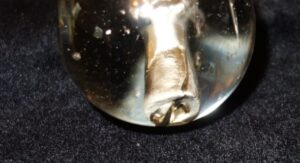
Third, the rim on our cameo is irregular and very thin (see photo above). When collectors and historians talk about an irregular rim, they’re referring to the uneven, hand‑molded perimeter of the cameo insert — the edge where the cast figure meets the background wafer. This is a diagnostic feature of antique sulfide inserts[9].
Next—our sulfide has high relief. We know that this is typical of later 19th century work and have read that it is associative with religious subjects common in Bohemian and German production.
Given the silvery material, high relief, irregular rim on the cameo, and large hollow back, we are confident that our marble is 19th century and most likely a German silvered cameo made between 1860 – 1890.
Our Figure’s Backside
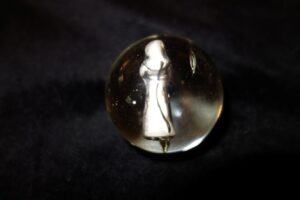
Now look carefully up the back of our figure.
There is a long curved line from the back hem of the figure’s drapery starting at the pontil. This line is inside the marble and deep under the second layer of glass. The marble is perfectly smooth. Sulfide marbles are solid glass—there is no hollow inside.
We have never seen such an internal line on a sulfide. It is not a pontil mark of any kind. Rather, it happened during one of the many-step processes of placing the figure inside the glob of glass. The line was left when more molten glass was added to fully encase the figure. This second gather of clear glass is added over the first to seal the figurine inside. The glass worker rotates and shapes the mass to remove bubbles and folds but some folds do remain—this is the “internal fold” that collectors sometimes see and which is so evident in this marble. So this fold or seam is a glass‑flow mark and not a pontil.
Molded Not Carved
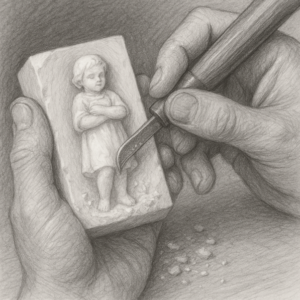
This is Microsoft AI Copilot’s Ideation of a skilled craftsman carving a “master sulfide figure” (or meister cameo) which will then be used to make a mold so that dozens, and perhaps hundreds, of figures can be produced quickly and efficiently. The Size of the figure is exaggerated here to show detail in the carving.
Every legitimate antique sulfide marble from the German workshops (circa 1860–1910) used pressed ceramic figurines made in two‑part molds and fired in a kiln before being encased in glass.
Remember, these workshops were production environments, not art studios, with those mid‑20th‑century American figures carved individually for each marble. The German artisans needed consistency, speed, and repeatability. A single mold could produce hundreds of identical figurines. Carving each one by hand would have been economically impossible because it would destroy the profit margin.
In addition to the long internal fold on our marble, there are several internal marks in the glass which are almost certainly glass-tool marks. The size of the marble made the workers job harder and then the size of the cameo must have made the job harder still.

Modern Cameo Marble
We are not saying that contemporary or modern sulfides are not “real” since their cameos are carved instead of molded. They are real. But they aren’t antique German sulfides. A sulfide marble already required multiple gathers, precise heating, and slow shaping. Adding hand‑carved figures would make them Victorian luxury art objects, not production marbles. And the German workshops were in the business of selling toys, not museum pieces.
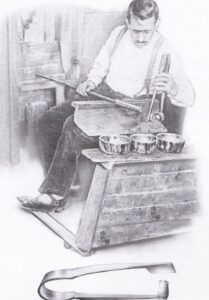
Image courtesy Dr.-Ing Gerhard Griener-Bär
Momma You Made The Pants Too Short!
We kept the 2” sulfide on our computer desk while we did our online and reference book research for this story.
Days of research turned into weeks, and we grew more and more unsure of what we had been told at the online forum about Kate Greenaway. Certainly, she is a 19th century sulfide, but too many things just were not coming together with her.
We were haunted by a number of things: our cameo had no bonnet. Rather, she wore a veil over her head and down her back. The veil represents consecration to God and it conceals worldly beauty. There also appears to be a wimple[10] around her neck. A wimple wraps around the neck and chin and it frames the face while it symbolizes humility and modesty. Finally, she is rendered in the solemn devotional style common to late‑nineteenth‑century German sulfides.
But wait a minute! The German craftsmen were working hard in a hot glass works like the one shown in Gerhard’s image above. They worked both hard and fast. And the bottom line was just that—the bottom line was profit.
We cannot imagine that a penitent nun could be popular with Victorian collectors. Certainly, the works that the German craftsmen produced were exported to the United States and to the Continent although today we don’t know in what quantities. But what kind of market could be found, even in predominantly Catholic France, which had been Catholic for over 1,500 years, (dating back to the baptism of King Clovis I in 496) [11]?
Mary Magdalene?
Now totally confused, we decided that she is old but she is not a Greenaway! But is she a nun as she appears? We consulted with Dr.-Ing Gerhard Griener-Bär[12] We wrote back and forth March 19th – 23rd. Here is what Dr. Griener- Bär told us after looking at all the photographs we sent him: “The figure obviously depicts a saint. I suspect it could be Mary Magdalene[13], the companion of Jesus.”
What? At first, this suggestion seemed very unlikely to us and so we continued to study. However, we slowly came to realize that the draped figure may well be Mary Magdalene. The cameo is rendered in the solemn devotional style common to late‑nineteenth century German sulphides. You might remember that the word “drape” has already leaked into our observations above. So, even before we worked with Dr. Griener- Bär, we had begun to agree that she is not a Greenaway at all but that she is something very special.
After all, the figure is a tall (called columnar by some collectors) hooded and contemplative figure. This echoes the Penitent Magdalene, a familiar devotional form in the sulfides of the late Victorian era. Whether nun or saint, the figure does carry that quiet gravity of the Penitent Magdalene. She a subject widely known and venerated during the period when the marble was made.
Could The Figure In The Marble Really Be Mary Magdalene?
The short answer is “yes.” Based on the figure’s style, the drapery, the Continental religious subject, and the typical German production traits, our marble leans strongly toward an authentic late‑19th‑century German sulfide. Taken together — the silvery surface, the irregular cameo base, the large 2‑inch marble size, and the contemplative cloaked figure — the typology leans strongly toward a Mary Magdalene interpretation. It probably dates to the late Victorian window of 1860–1910.
How She Lines Up With Known Religious/Angelic/Saint Figures
Our sulfide was made in Germany where sulfide marbles formed a niche in the German export market between 1850 – 1900. Within Germany’s booming marble export trade of 1850–1900, sulfide marbles occupied only the smallest corner of the market.
While millions of “ordinary” handmade glass marbles flowed out of Thuringia, sulfides were produced in cottage workshops in limited numbers, each requiring a molded figure, careful heating, and skilled insertion into glass. Their labor‑intensive process, high failure rate [of course, some broke in transport], and niche appeal kept them a specialty curiosity rather than a mass‑market export, a rare byproduct of an industry otherwise driven by volume.
We can’t imagine why we have never seen a French sulfide marble. Both France and Germany produced sulfides. And Continental sulfide marbles often include religious or allegorical figures—angels, virtues, saints, mourning figures—alongside animals and historical busts[14].
Our figure’s upright, columnar stance and long robe are consistent with: angel/saint figures used in mourning or remembrance marbles; allegorical “virtue” figures (Hope, Faith, Charity); and drapery. The specialized use of the term drapery here refers to the heavy, continuous fall of the garment and hooded/cowled head which are both closer to Continental devotional statuary than to English “Kate Greenaway” children. So in typological terms, our marble fits best in the religious–allegorical Continental sulfide lane, not the English “storybook child” lane.
While both France and Germany did produce sulfides, as noted, the marble world’s consensus is that the classic sulfide marbles—single gather, single pontil, clear glass with a white “chalk-like” figure—are fundamentally a German specialty, even when the subject matter feels French or Catholic[15].
Key points: Human, religious, and allegorical figures (including angels and mourning types) are documented within this German production stream[16]. Also, many religious motifs (nuns, saints, cloaked figures) are stylistically Catholic/Continental, but that doesn’t require French glass.
German makers freely used such imagery for export markets. So, most likely, this is a German-made sulfide with a religious/allegorical figure, using a Catholic/Continental visual vocabulary rather than an English one.
No Real Ending
Greenaway? No, not a chance. Old? Without question. Mary Magdalene? According to our dear friend in Germany — number seven of seven generations of Greiner and Bär glass makers, descended from the inventor of the glass scissors — yes. And honestly, when a man with that lineage leans in and says, ‘Magdalene,’ you don’t correct him. You buy him a pint and pretend you knew it all along.
References
- The figure inside a sulfide marble is made from a white clay-like kaolin-based material, not carved stone. It only looks like carved figure called a cameo because of how light refracts around it. The clay turns white and matte when fired. Air trapped around the figure gives it a silver sheen, making it look like polished stone. The glass magnifies the figure, enhancing the illusion of carved detail.↑
- Image Retrieved from: https://www. commons.wikimedia.org/windex.php?title=File:Weston_WV_downtown.jpg&oldid=1187015856 3/30/2026 ↑
- Mark Chervenka. “Sulphide Marble.” Real or Repo. https://www.realorrepo.com/article 3/31/2026 ↑
- Full title: Under the Window: Pictures & Rhymes for Children. This is a 64 page “toy book” which combines short verses with full-color illustrations also by Greenaway. It was first published in 1879 and it is one of the earliest examples of a designer picture book. Needless to say, it has been widely imitated. The book sold a remarkable 100,000 copies! It contributed to a cultural moment often called the “Greenaway vogue,” marked by soft colors, idyllic English gardens, and children in quaint, stylized clothing. Greenaway illustrated more than 150 books, but this is one of only two she both wrote and illustrated (the other is Marigold Garden, 1885). You can read the entire : Under the Window book @ The Project Gutenberg eBook of Under the Window, by Kate Greenaway (3/16/2026) The book is delightful, and we recommend that you check it out! ↑
- Sulphide Archives – Old Rare Marbles 3/16/2026 ↑
- See “Everything You Always Wanted To Know About Pontil Scars (But Were Afraid To Ask)?” – WorthPoint (3/19/2026); Pontil Scars (3/19/2026). Some of these old marbles are polished by owners or people collectors hire to do the job. We do not believe this one was polished other than when the craftsman originally made it. You might want to check “Polishing Marbles in a Rock Tumbler” @ https://rocktumbler.com/blog/polishing-marbles/ 3/22/2026
- Sulphide Archives – Old Rare Marbles 3/16/2026 ↑
- “Electrotyping” @ Electrotyping – Wikipedia (4/1/2026); “Electrotyping” @ Electrotyping | Metal Casting, Copper Plating & Printing | Britannica 4/1/2026 ↑
- “Cameo Incrustation: The Art of Porcelain & Glass through time.” The Corning Museum of Glass @ Cameo Incrustation: A Fusion of Glass and Porcelain Craft (4/1/2026) & Jokelson, Paul. Sulphides The Art of Cameo Incrustation. NY: Galahad Books, December 31, 1999, Reprint. ↑
- A wimple is a distinctive medieval head covering worn by women, especially from the 12th to 14th centuries, and still used today by some nuns. It’s both a fashion artifact and a cultural symbol, so it carries a surprisingly rich history. ↑
- History of the Catholic Church in France – Wikipedia 6/25/2026↑
- See footnote #6. ↑
- Mary Magdalene was a prominent follower of Jesus in the New Testament, best known for witnessing his crucifixion and being the first to see him after the resurrection. She is honored as a saint across many Christian traditions and she is often called the “apostle to the apostles.” By the late 19th century, Mary Magdalene had been venerated as a saint in Western Christianity for well over a thousand years. Her feast day (July 22) was firmly established, and she was one of the most widely depicted female saints in Catholic devotional art. So in the period 1860–1910, when our marble was most likely made, she was not only considered a saint — she was one of the most popular saints for small devotional objects, statues, holy cards, and household altars. Mary Magdalene – Wikipedia 3/25/2026 ↑
- https://www.marblecollecting.com/marble-reference/online-marble-id-guide/sulphides/ 3/27/2026 ↑
- https://oldraremarbles.com/product-category/sulphide/ (3/27/2026) ↑
- https://www.marblecollecting.com/marble-reference/online-marble-id-guide/sulphides/ 3/27/2026 ↑