Children in Adult Landscapes
This story begins with a simple truth: wherever adults carved out hard places—mines, forts on the far frontier, sawmill towns that rose and fell with the timber, arsenals humming with danger—children found their way in. They slipped between the rules, into the gaps of adult attention, leaving behind faint but durable evidence of their passing. A single marble in compacted soil, a toy soldier lost beneath a barracks step, a scratched game board on a porch plank: each is a reminder that childhood persisted even where it had no sanctioned place. These traces are small, and sometimes overlooked, but they widen the story.
Small Footprints in Hard Places is not a story about invisible children1or the lament that archaeologists have overlooked them for too long. The children in these pages were never invisible; their traces were simply small. They were not erased by neglect or time but by scale—tiny artifacts in vast adult landscapes, easily missed unless one knows how to read them. And learning to read them is not always easy.
This story does not argue for their recovery from obscurity. Instead, it recognizes that they were never obscure but always present, always leaving material signatures in mines, forts, timber camps, arsenals, and work sites. The task here is not to rescue forgotten children from the margins of the record, but to interpret the evidence they left with the seriousness it deserves.
Children in the Mines
Nikita Werner’s Master’s Thesis “Minors in the Mines” is a remarkable mortuary study of children working in the mines in Prehistoric Europe.[2] Werner focuses on the early Iron Age in the area of Hallstatt in Austria. The European early Iron Age dates to about c. 800–450 BCE, though the exact dates vary by region.
“By letting go of the notions that children are blissfully unaware of the harsh realities of life and therefore need to be sheltered, protected, and kept pure, the possibility that life in European prehistory did not reflect the moral values of today can be accepted and archaeologists can move forward with greater objectivity. As evidence of children in prehistoric labor contexts is more actively investigated, an array of different childhood experiences will be illuminated.” (page 24)
Iron was one of the principle ores mined in prehistoric Europe, but miners and their children also worked to extract copper, salt, flint, lead, silver, gold, and a wide range of stones depending on region and, of course, geology.
These dirty European mines were not only dangerous, they could be deadly. They were, by far, some of the hardest places on earth at the time. And yet children were there and not only as observers, so that they could learn to use the tools and settle into the patterns of effective extraction, but also as active miners whom others depended on.
Werner describes some of the physical evidence of children in the mines: “At Hallstatt, the material evidence found inside the mines includes shoes described as child-sized, a baby’s hat, a child sized leather cap, and a collection of very small mining picks…” (Page 89). Children needed smaller tools, of course, and since they often mined pockets too small for adults to even enter, their tools also had to be smaller to accommodate the limited space.
Children in prehistoric Europe were not bystanders to history; they were woven into the daily work of their communities. They carried water, tended fires, sorted ore, hauled baskets, gathered fuel, tended tapers for light, and learned the rhythms of mining and craft production by doing, not by watching.
Their labor was scaled to their bodies, but it was real, consequential, and visible in the archaeological record. When we acknowledge that children were active participants in the mines and in the life of the settlement, the prehistoric landscape becomes clearer: a place where learning, labor, and community were shared across all ages.
Child Miners Paid an Adult Price
“Beyond the indicators of osteoarthritis in the appendicular[3] skeletal remains of the Hallstatt children, the presence of vertebral wear and traumatic skull injury in this population suggests labor activities that included children carrying heavy loads on or using their heads…. Skull fractures and healed cranial dents in a small sample of children are similar to those sustained by children carrying bricks on their heads in areas of India and Pakistan…
While children could have been carrying materials such as wood, salt plaques, water, or baskets of other goods in this way, some of these injuries could be the result of working in poorly lit mine shafts, and of living in a rugged, mountainous landscape. Page 90
Children in mining communities—prehistoric or historic—were vulnerable to osteoporosis because darkness, malnutrition, heavy labor, chronic inflammation, and stunted growth all combined to prevent them from ever building the strong bone mass that protects healthy adults.
From Prehistoric Pits to Powder and Payrolls
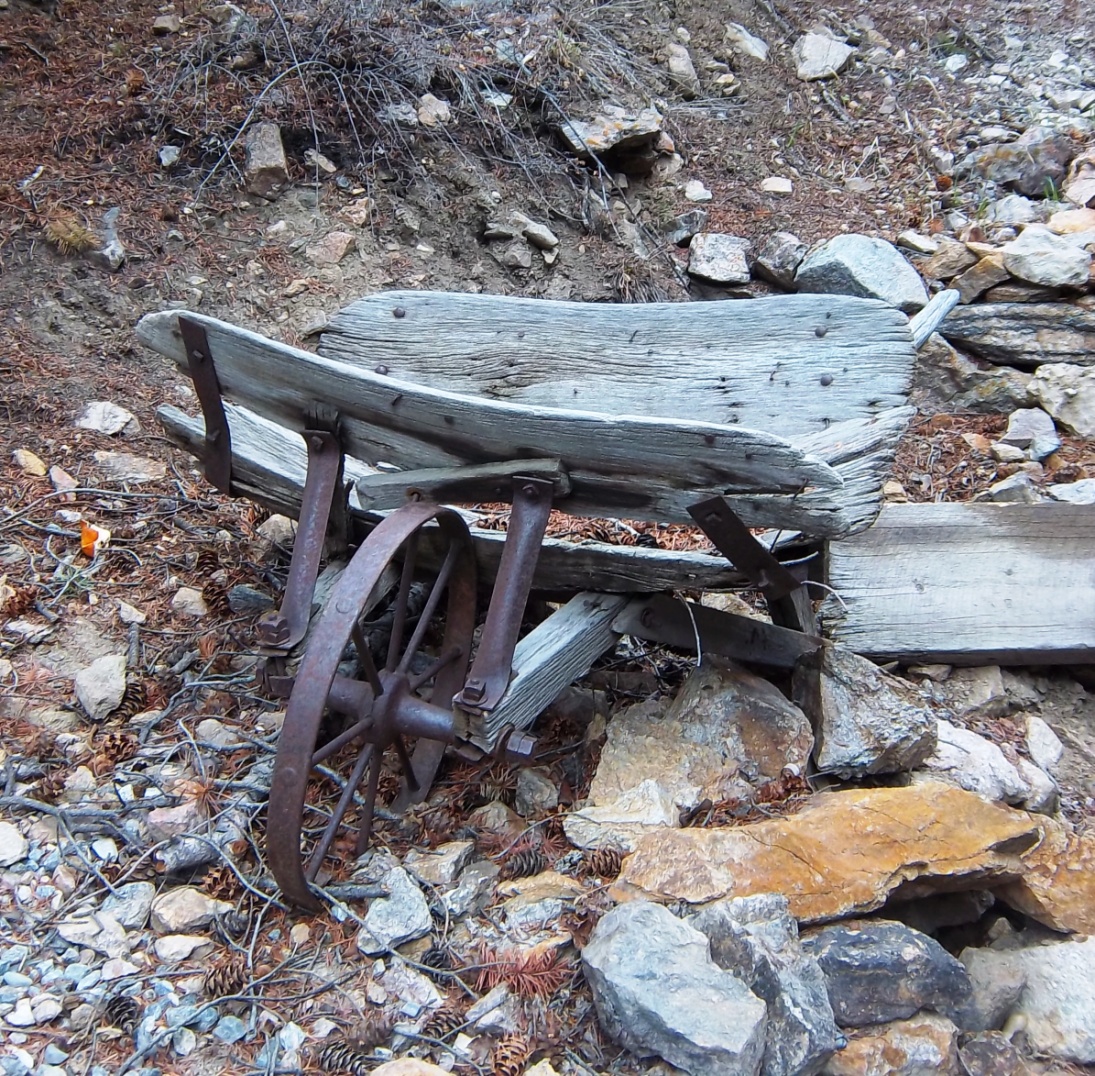
Mining Wheelbarrow outside the Capital Prize Mine, in the Georgetown–Silver Plume district, Colorado Photograph by Jo Garrett
Across continents and millennia, mining begins with the same gesture: a child entering a confined space to reach what adults cannot. In prehistoric Europe, children squeezed into small passages and narrow extraction pits, their size making them indispensable to early mining communities.
The archaeological record preserves their presence in pockets and crawl‑spaces where ochre, flint, silver, gold, and copper were pried from the earth. Thousands of years later, in the American West, the pattern reappears in a new industrial vocabulary.
Mining company ledgers list “nippers” and “trammers[4]”, their wages forming a faint secondary layer beneath the adult workforce. What changes is the technology—blasting powder instead of iron picks—but not the underlying logic. Whether in a Neolithic gallery or a 19th century silver mine, childhood remains were woven into the extractive landscape, its traces preserved in bone, soot, and ink.
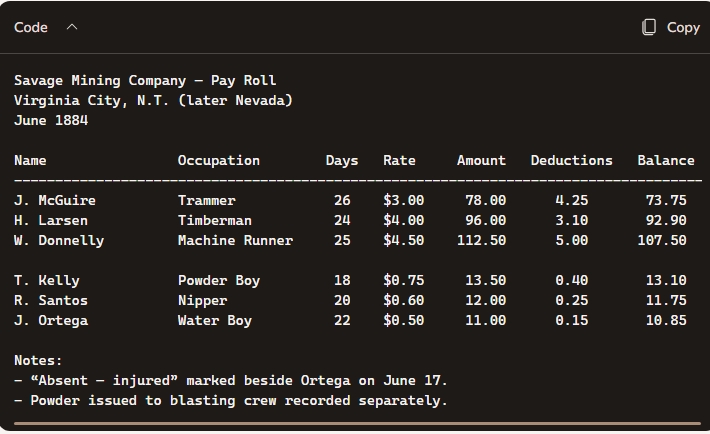
This is a faithful facsimile based on the structure of the actual Savage payrolls. Microsoft Copilot.
When we explored the Silver Plume mining district near Georgetown, Colorado, we also toured the Capital Prize Mine. We learned that some of the small boys were called powder monkeys. Their job was to carry black powder and, somewhat later, dynamite into the mine shafts. Black powder was smoky and unstable; dynamite was shock‑sensitive and deadly in a different way. The boys were often covered in powder and, in the Georgetown mines, were called powder monkeys.
As a rule, the actual mine payrolls were a bit more kind with their job names and these “powder monkeys” were called powder boys. They carried not only powder and dynamite in kegs or boxes but also tamping rods, fuse coils, primer caps, and water for “mudding” the charge. Mudding was a critical, necessary, and technical job. Wet clay or mud was packed into the blast hole after the black powder (or later, dynamite) and fuse were inserted. The powder boys often worked right up to the blast line.
One thing we learned at the silver mine near Georgetown is that these boys were also responsible for carrying human waste from the mine. They accomplished this by using the same dynamite boxes or kegs which they had lugged into the mine earlier!
The June 1884 Savage facsimile payroll sheet[5] is a perfect example of the jobs small children were responsible for in the mines. The Savage Mine was one of the core silver producing properties of the Comstock Lode in Virginia City, Nevada
This payroll notes that the adults—in this case the trammers, timber men, and machine runners—made far more money than the children. Payments to the boys appear as secondary, scattered entries that feel almost intrusive: powder boy, 75¢, a day; nipper[6], 60¢, a day; and water boy, 50¢. a day. The ink is fainter, the script smaller. Aldo noted is that water boy Ortega was absent due to injury or simply absent for one day on June 17th.
Hard Places, New Horizons
The mines were one kind of hard place—powder smoke, tight drifts, and boys running tools and messages through the dark. But the American frontier held another hard place. Step out of the shaft and you find children again, this time inside the stockade walls of frontier forts, hauling water, chopping wood, and learning the rhythms of garrison life. Different landscape, same expectation: small bodies doing necessary work in places built for survival, not childhood.
On the frontier forts, children lived inside the geometry of blockhouses and parade grounds, learning the routines of garrison life instead of the blasting cycle. They absorbed the discipline of military spaces. Different landscapes, same expectation: young bodies folded into adult work because the environment demanded it.
Whether underground or behind palisades, childhood in the West was shaped less by age than by the hard places that needed tending. And yet, children played. They found time or made time to play with marbles.
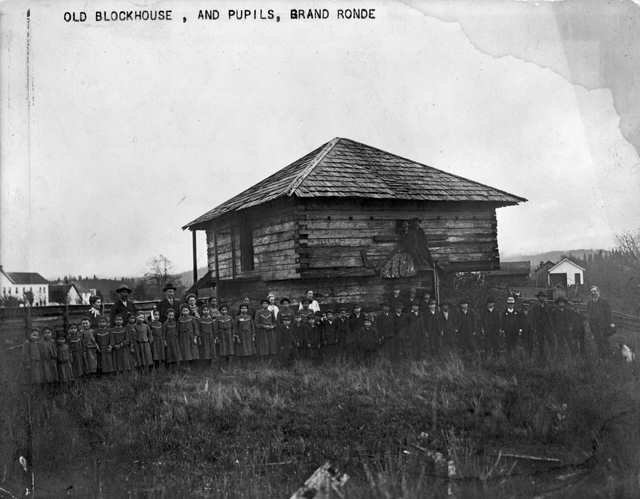
Oregon Historical Society OrHi 96780[7]
The Story Of Fort Yamhill, Oregon
The assumption that children in past societies were passive dependents must be set aside. As scholars have noted, “Children have not always been considered helpless and incapable, nor has child labour always been considered a crime against innocence. Children’s labour has played, and continues to play, a significant role in both traditional and contemporary cultures.[8]”
That same pattern—children working, contributing, improvising within adult spaces—carries directly from the mining camps of Medieval Europe into the American West and into the military landscapes of the Pacific Northwest.
At Fort Yamhill, children were not marginal figures orbiting the garrison; they were woven into its daily rhythms. They tended the animals, gathered fuel, carried messages, and moved through parade grounds, workshops, kitchens, and blockhouses with the same informal permission seen in mining towns.
Their toys, losses, and small improvisations—marbles, buttons, slate pencils, carved sticks—surface in the fort’s archaeological record as quiet counterpoints to the official military archive. In shifting from the mines to the fort, the through-line remains clear: children were not spectators to frontier life but participants whose labor, play, and presence shaped the very landscapes adults believed they controlled.
Fort Yamhill was named for the Yamhill River, specifically the South Fork of the Yamhill River, which flows just east of the fort site. This naming is explicitly documented in multiple historical sources, including Fort Wiki[9] and the City of Dayton, Oregon, historical materials. Dayton is about 25 miles from Grand Ronde.
Established in 1856 on the ridge above the newly created Grand Ronde Reservation in Oregon’s Coast Range, it was one of a chain of small U.S. Army posts built to enforce federal Indian policy during the turbulent years following the Rogue River Wars[10]. The fort’s placement—overlooking the reservation road and agency buildings—made it both a surveillance point and a symbolic boundary between military authority and Tribal life.
Grand Ronde
The Confederated Tribes of Grand Ronde today represent a union of more than 30 tribes and bands who were forcibly removed from their homelands in western Oregon, southwest Washington, and northern California during the 1850s removals.
These included major groups such as the Kalapuya, Molalla, Umpqua, Rogue River/Takelma, Chasta, Chinook, and Tillamook, among others. The confederation was established on the Grand Ronde Reservation in 1856, where roughly 2,000 people from at least 27–30 distinct tribes and bands were resettled. Today the Tribe maintains an 11,000+ acre reservation in Yamhill County and has about 5,400 enrolled members, preserving a cultural legacy that spans multiple language families and ancestral regions.[11]
Garrison Life
Garrisoned primarily by companies of the 4th U.S. Infantry, the fort operated as a spare but strategically positioned post. Its duties included monitoring reservation traffic, escorting officials, mediating disputes, and projecting the Federal presence in a region undergoing rapid settler expansion. Daily life was a mix of drill, patrols, carpentry, gardening, and the constant maintenance required to keep a frontier post functional.
In 1860, command passed to Captain Christopher C. Augur, whose orderly books and correspondence provide some of the clearest surviving documentation of the fort’s operations. The post also briefly hosted Brevet Lieutenant Philip H. Sheridan, whose later fame retroactively elevated Fort Yamhill’s profile in military histories.
The fort never saw major combat. Its significance lay instead in its administrative and supervisory role, shaping the early decades of the Grand Ronde Reservation and influencing the lived experience of Tribal families. Soldiers, officers’ families, Tribal communities, and civilian workers formed a shared social landscape—one in which children moved freely, worked hard, played, and left behind the small artifacts that now anchor the archaeological record.
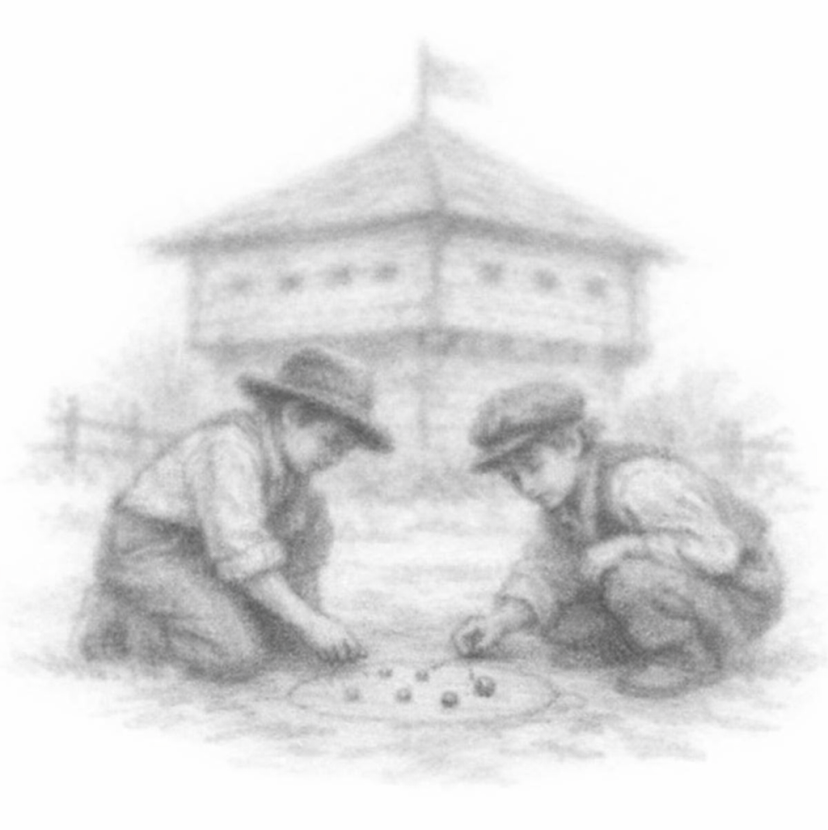
From The Imagination of Microsoft Copilot
Fort Yamhill was decommissioned in 1866 as federal priorities shifted. The Civil War had drawn manpower eastward. Most buildings were dismantled or repurposed; the blockhouse, shown in the photograph above and in this sketch, was moved to Dayton, Oregon where it still stands.
We don’t know for certain where the blockhouse was when the photograph was taken—whether it was still on the Reservation or in Dayton. But notice that part of its annotation on the photograph is the Reservation Grand Ronde. The original site is now preserved as Fort Yamhill State Heritage Area, with ongoing archaeological work illuminating the intertwined histories of the fort and the reservation[12].
Dr. David G. Lewis
Lewis is an Oregon State University anthropologist and Tribal historian. He writes deeply researched, narrative driven histories of the Willamette Valley Tribes, including the Grand Ronde community adjacent to Fort Yamhill. He is an esteemed authority on all topics concerning Fort Yamhill.
In his resume Lewis writes in part: “I am a member of the Confederated Tribes of Grand Ronde, a descendent of the Santiam, Chinook, Molalla, and Takeima Peoples of Western Oregon, and a former Cultural Manager of the tribe who planned and designed the tribal museum….”

From The Imagination of Microsoft Copilot
Material Expression of Class, Status & Authority
Justin E. Eichelberger’s Ph.D. Dissertation,[13] at over 650 pages, is one of the clearest graduate level treatments of how objects encode social hierarchy in nineteenth-century domestic and institutional spaces. Working from archaeological assemblages in the Pacific Northwest, he demonstrates that class and authority are not abstract social categories—they are materially visible in the everyday things people used, displayed, repaired, or discarded.
Eichelberger’s framework is especially valuable for interpreting small finds—ceramics, toys, including marbles, architectural hardware, curetted heirlooms, and personal effects—because it shows how even modest artifacts participate in status signaling.
Thumbnail Sketch: Fort Hoskins
Since Eichelberger’s Dissertation intertwines his analysis of material expression interchangeably between Fort’s Yamhill and Hoskins, we will simply provide a sketch of Hoskins.
Fort Hoskins and Fort Yamhill were sister posts—built the same summer (1856), staffed by many of the same officers, and positioned to guard the approaches to the newly created Coast / Grand Ronde Reservation. While not close neighbors, they formed a coordinated arc of federal presence across the Coast Range.
Fort Hoskins was established on the Luckiamute River in what is now Benton County, Oregon. It is about 18 miles from Yamhill. A horse ridden at a trot can cover 8 to 12 miles in an hour, so we see that the forts were not so far apart in the 1850s and 1860s.
Fort Yamhill guarded the eastern gateway of the Grand Ronde Valley; Fort Hoskins guarded the western outlet toward the Pacific Coast. Together they formed a containment corridor, ensuring controlled access to and from the reservation during the turbulent 1850s.
Hoskins was a quiet post. It was also a damp, isolated post—soldiers’ journals describe boredom more than conflict. The Fort was abandoned in 1865 and today it is preserved as Fort Hoskins Historic Park[14].
Marbles, Games, & Music At The Forts
Eichelberger tells us (Pages 372-373) that:
“Beyond [a] difference in total quantity and variation of items recovered little meaningful difference is observed within the toys, games and musical instrument assemblages with the exception of the marble assemblages recovered from each post. At both Fort Yamhill and Fort Hoskins more marbles were recovered from the captains’ quarters …than were recovered from the subaltern [commissioned officer: i.e. second lieutenant] officers’ quarters ….at each post. In addition the quality of the marbles varies considerably between the officers’ quarters. At Fort Yamhill the marble assemblage recovered from the captains’ quarters … is comprised of two glass marbles and one glazed porcelain marble while the assemblage recovered from the subaltern officers’ quarters … is comprised of a single glazed porcelain marble. A similar pattern is observed at Fort Hoskins where the marble assemblage recovered from the captains’ quarters … is comprised of three glass marbles and two unglazed porcelain marbles while the assemblage recovered from the subaltern officers’ quarters … is comprised of a single Bennington-type crockery marble. During the 19th century glass marbles were the most expensive marble type available, followed by porcelain (glazed and unglazed) and lastly by ‘crockery’ marbles (Baumann 1970:30, 66). The greater quantities of marbles and the higher quality (i.e., cost) of those marbles clearly indicates that higher status marble assemblages were recovered from the captains’ quarters … than were recovered from the subaltern officers’ quarters ….”
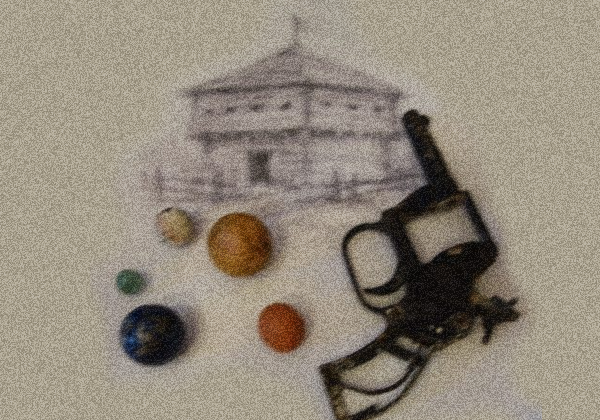
We were surprised at the total number of marbles recovered from the two 1850s-1860s forts. We studied Figure D.34 Toys, Games and Music Artifacts, Representative Sample on Page 613 for some time. The original figure, which is a photograph, shows six marbles along with toy musical instruments, and other toys.

Microsoft Copilot Based on Information From Eichelberger’s Description & Photograph
We wanted permission to publish the photograph here, and when we were unable to locate Eichelberger we contacted Oregon State University, where the thesis was published, and we were told by staff there that “It is under copyright, and those rights are held by the creator.” We wrote Eichelberger but we have received no response. So we will provide more detail from the text about the marbles. We recommend that you download the thesis as PDF to see the figure.
Recovered Marbles
Ten … marbles were recovered. Five marbles were made of glass…, four marbles were made of porcelain …and one marble was made of crockery …. Four glass marbles are made in an onionskin swirl pattern with a colorless glass body and colored swirls. One … onionskin swirl marble measures 1.00 inches (25.40 mm) in diameter and has red, white and blue swirls. Two … onionskin swirl marbles measures 0.86 inches (21.90 mm) in diameter. One …has red and blue swirls. One has red, white and blue swirls. One … onionskin swirl marble is represented by a fragment and has red and yellow swirls. Onionskin swirl marbles date between 1850 and 1920 (Baumann 1970:66). One … glass marble is solid blue in color. The marble measures 0.82 inches (20.80 mm) in diameter and is heavily chipped. Four) porcelain marbles were recovered.
One … porcelain marble is glazed and decorated with a hand-painted floral design of pink flowers with green foliage over the glaze. The marble measures 0.73 inches (18.54 mm) in diameter and has three “eyes” (small spots without glaze) in a triangular configuration where the marble was supported while the glaze was being fired. Three …porcelain marbles are unglazed. One … marble measures 0.73 inches (18.60 mm) in diameter. The marble is decorated with a hand-painted floral design of pink flowers with green foliage and a band of three black lines around the circumference of the marble. Two … marbles are decorated with a hand painted geometric design comprised three sets of four colored lines (red, green and black) around the circumference of the marble. Each set of lines are set at 90º to the others. One …marble measures 0.69 inches (17.70 mm) in diameter. One … marble measures 0.73 inches (18.70 mm) in diameter. Bauman (1970) calls these marbles ‘Chinas’”. [Emphasis added.] Eichelberger (Pages 372-373)
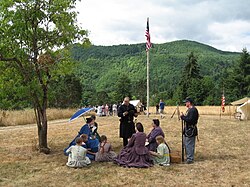
Fort Hoskins 150th Celebration February 23rd 2026[15]
Wives & Children At The Forts
One problem that we continued to have with the Eichelberger dissertation is its sheer volume. We found it difficult to move around and to locate specific data. Still, we did learn something about the wives and children of the officers at the forts.
Army regulations technically discouraged dependents at remote posts, like Hoskins and Yamhill, but in practice, married Officers brought their wives if they wanted to, and enlisted men were allowed to bring their families if housing and rations permitted for them. These families lived in civilian quarters or temporary cabins near the fort perimeter, often listed in post returns as “laundresses” or “civilians attached to the post.”
Post returns were the official monthly report that every U.S. Army fort or post submitted to the War Department. It’s essentially the fort’s ledger of life — a bureaucratic snapshot of who was there and what happened.
Children were common — they appear in Grand Ronde Reservation censuses and regional memoirs, and soldiers’ diaries mention schooling, play, and illness among their families.
Dependents typically lived in civilian cabins, laundress quarters, or informal housing clusters near the parade ground. Their labor — washing, sewing, cooking, and nursing— formed the domestic infrastructure of the forts. Children appear indirectly in returns and directly in regional censuses, diaries, and memoirs, showing that the forts functioned as mixed military‑domestic communities rather than purely martial outposts.
We cannot give a precise headcount of children at Fort Yamhill or Fort Hoskins from 1856–1866 because post returns did not list children by name or number. But using post returns, laundress quotas, company sizes, regional censuses, and officers’ letters, we can produce a reliable, defensible estimate.
The fact is there were children afoot. At work and at play. And we know with certainty that they play with clay and expensive imported German glass Swirls. Across the decade of occupation Fort Yamhill had 10–20 children present at any given time, depending on company strength and season. Peaks occurred when two companies overlapped or when officers’ families wintered at the post.
Fort Hoskins had slightly fewer “younguns;” typically 6–12 children at any given time, rising to ~15 during construction years (1856–1858) when more civilian laborers and families were present.
Across the 1856–1866 period, the two forts together likely housed ≈ 16–32 children at any given moment, ≈ 60–80 total individual children across the decade (counting turnover, births, and transfers). Yes, babies were born on base[16].
What the Small Things Remember

There is so much more that we could say about children in the mines, in the western forts, and in industrializing Europe and America when children stood alongside the adults to carry the hard work forward. But we have made one singular point: all across history, recorded and unrecorded, children have walked the hard places beside adults. They were not visitors: they were participants who contributed needed labor and who generated income to help families get by. And they always paid an adult price for their participation—-in their lungs, their blood, and bones.
Even when the names are lost, and the children become roster numbers, the objects they played with remember. A single marble—rolled into a crack in an old fort’s parade ground, dropped beside a miner’s bunk, or buried with a child in a country cemetery—carries the same quiet message: children lived here and children played here.
Archaeologists call these “small finds,” but their meaning is anything but small. They mark the presence of families in places history paints as strictly military or industrial. They remind us that frontier forts were not just outposts of power but homes, with laughter, quarrels, and games played in the dust. In the end, these tiny spheres become the most honest witnesses we have: bright, durable, and stubbornly unwilling to disappear.
In the end, the marbles tell the story better than any ledger or muster roll. They surface where no one expects them—at forts, in mining camps, in graveyards where the stones lean and the names fade. Each one is a small footprint in a hard place, a reminder that childhood threaded itself through every corner of the American past, even the rough ones. Soldiers marched, officers quarreled, and the frontier shifted like a restless tide, but the children played anyway. And when their marbles slipped from their pockets and settled into the soil, they left behind the one thing history rarely grants them: a trace that endures.
Suggested Readings
We almost never offer further readings in our stories, but this one demands it. If you are interested in this topic as we are, you might want to scan this list to see if you would like to visit additional “hard places” which we know about but did not include in this story,
Fort Vancouver, Vancouver, WA
Fort Vancouver is unique among U.S. forts because it was a multi‑ethnic, multi‑family settlement, not just a military post. The Village housed 600–1,000 people in the 1820s–1840s, including families, laborers, and children. The marbles provide direct evidence of children in a site often interpreted through adult, military, or economic lenses, and they serve as chronological markers—porcelain marbles can be seriated using Carskadden & Gartley’s typology. The Village’s finds reinforce our broader thesis: Children leave the most durable traces in the smallest objects. Fort Vancouver, “Archaeology”, @ Archaeology – Fort Vancouver National Historic Site (U.S. National Park Service) (5/20/2026); Jeff Carskadden & Richard Gartley “A Preliminary Seriation of 19th-Century Decorated Porcelain Marbles” Historical Archaeology Vol. 24, No. 2 (1990), pp. 55-69 (15 pages) @ A Preliminary Seriation of 19th-Century Decorated Porcelain Marbles on JSTOR 5/20/2026
Ronal M. James. “Drunks, Fools, and Lunitics: History and Folklore of the early Comstock.” Nevade Historical Quarterly, 35.4 (Winter 1992), pps. 215 – 269.
Chelsea Rose. “’A Sound of Revelry By Night’ Archaeology, History, and Myth of the Mining Camp Kanaka Flat, Oregon.” Master of Arts Thesis, Sonoma State University, Rohnert Park, CA, 2009. PDF.
Fort Stanwix, Rome, NY
What was found: Glass marbles and other children’s toys (toy gun, toy train).
Contexts: Privies & Domestic refuse areas.
Why it matters:
Direct evidence of children’s presence in an 18th–19th‑century military landscape, paralleling Fort Vancouver’s pattern.
Citations:
NPS reporting on children’s toys at Fort Stanwix (from prior sourced leads). home.nps.gov
References
- “Invisible children” is a long‑standing archaeological shorthand for the way children often seem to vanish from the material and written record. Historical documents privilege adults—soldiers, laborers, officials, landowners—while the small, fragile, or ephemeral objects of childhood rarely survive in obvious forms. As a result, early archaeological narratives treated sites as if only adults occupied them, assuming that children were absent simply because their traces were faint. Often, they were treated in the literature as small adults. The concept of invisible children emerged to critique this bias: it argues that children were always present, but their material signatures were overlooked, misidentified, or dismissed as insignificant. You might want to read: Garrett, Jo & Larry, “Invisible Children” @ https://thesecretlifeofmarbles.com/invisible-children/; Lillehammer, Grete. “Archaeology of Children.” Complutum, vol. 20, 2009, pp. 15–45; Lillehammer, Grete. “Travels into Thirdspace: The Archaeological Heritage of Children’s Spaces. A View from Beyond.” Childhood in the Past, vol. 5, no. 1, 2012, pp. 7–19, & many other works; Shea, John J., “Child’s Play: Reflections on the Invisibility of Children in the Paleolithic Record” Evolutionary Anthropology 15:212–216 (2006) @ Child’s play: Reflections on the invisibility of children in the paleolithic record – Shea – 2006 – Evolutionary Anthropology: Issues, News, and Reviews – Wiley Online Library (5/13/2026), among many other examples. ↑
- Werner, Nikita K., “Minors in the Mines: Archaeological Indicators of Child Labor in Prehistoric Mining Contexts in Europe” (2019). Theses and Dissertations. 2140. https://dc.uwm.edu/etd/2140 5/13/2026 ↑
- The appendicular skeleton — the bones of the limbs and girdles (arms, legs, shoulders, pelvis). ↑
- Trammers moved the ore inside & outside the mine as needed using wheelbarrows & trams; Powder boys fed the blasting cycle; Nippers carried tools and messages; Water boys kept everything cool and functional ; Pick boys cleaned and sorted the ore; and Mill boys processed the ore into value. ↑
- To see some original payrolls you can check the Savage Mining Company& Associated Records, 1858–1959 https://archives.yale.edu/repositories/11/resources/10038/ 5/14/2026 ↑
- A nipper in a 19th‑century mine was a boy who served as a runner and helper, carrying tools, messages, and supplies to the miners working underground. See Work at the Colliery – Not just mining – Glamorgan Archives 5/15/2026 ↑
- https://ndnhistoryresearch.com/2025/12/30/beginnings-of-fort-yamhill/ ↑
- Ruttle, A. “Neither Seen Nor Heard: Looking for Children in Northwest Coast Archaeology.” https://doi.org/10.2307/41103682 PDF ↑
- Fort Yamhill – FortWiki Historic U.S. and Canadian Forts 5/18/2026 ↑
- The Rogue River Wars were a concentrated, brutal cycle of conflicts in southwestern Oregon, peaking between 1855–1856, in which U.S. Army troops, Oregon volunteer militias, and settler vigilantes fought against the Takelma, Shasta, Tututni, and other Athabaskan-speaking peoples of the Rogue River Valley. At their core, the wars were driven by gold‑rush settlement pressure, resource competition, and settler violence, culminating in the forced removal of nearly all Native survivors to the Grand Ronde and Siletz reservations. You might want to check Cow Creek Umpqua Tribe, Rogue River War of 1855-1856, & Rogue River Wars – Wikipedia ↑
- https://www.grandronde.org/culture-history/our-homelands/ 5/18/2026 ↑
- Note: ↑
- Justin E. Eichelberger, Material Expression of Class, Status and Authority amongst Commissioned Officers at Fort Yamhill and Fort Hoskins, Oregon, 1856-1866. for the degree of Doctor of Philosophy in Applied Anthropology presented on March 11, 2019. PDF. ↑
- “Fort Hoskins And Yamhill—White Eyes Turned To The Coast” March 20, 2021 @ FORT HOSKINS AND YAMHILL – WHITE EYES TURNED TO THE COAST – Meandering through the PrologueMeandering through the Prologue (5/18/2026) Very informative with a painting of painting of Fort Hoskins, 1860 – 1861, photograph of the Hoskins site, maps, and a sketch of Hoskins layout and. Find a Park – Oregon State Parks 5/18/2026. ↑
- Fort Hoskins, Oregon, 150th Anniversary Celebration, Vintage Family on the Parade Ground, John Stanton, 29 Jul 2006 ; Creative Commons Attribution-Share Alike 3.0 @ Deed – Attribution-ShareAlike 3.0 Unported – Creative Commons [[File:Fort Hoskins 150th – 51.jpg|Fort_Hoskins_150th_-_51]] 5/19/2026 ↑
- See: “U.S. Returns from Military Posts, 1806 – 1916” @ U.S., Returns from Military Posts, 1806-1916 – Ancestry; MacInnes, Mairee. Differing Sources: Comparing the Historical and Archaeological Data of Fort Hoskins and Fort Yamhill. University of Idaho, 2023. PDF; Eichelberger, Justin E. The Archaeology of Class, Status and Authority Within Mid‑19th Century U.S. Army Commissioned Officers: Examples from Fort Yamhill and Fort Hoskins, Oregon 1856–1866. Society for Historical Archaeology, 2015. ↑