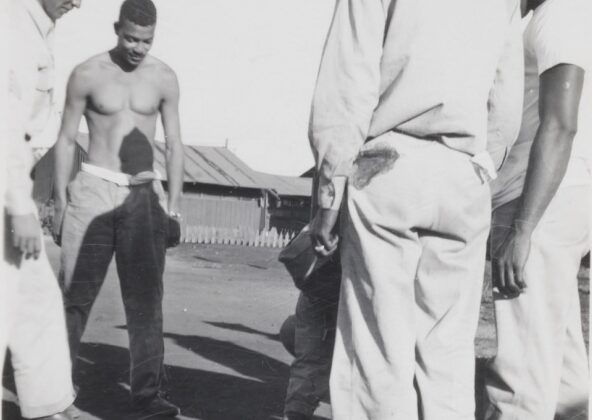
Untitled (African-American Soldiers Playing Marbles) Saint Louis Art Museum Gift of Peter J. Cohen in honor of Laura T. Cohen; Object Number 219:2018
Pocket Toys, Pocket Time
Marbles appear in military photographs far less often than they are dug from the ground by hobbyist or professional archaeologists. If you or your family own a photograph, from any era, of soldiers playing marbles, then you own a treasure and we welcome your comments.
We have searched for a “soldier photo” about twenty years. When we lived in Kissimmee, Florida, he had a friend who owned a photograph of a soldier in uniform dismounted from a horse and playing marbles alone. No provenience, and, since it is a family photo, our friend would not allow us to use the image nor copy it. That one time is the first and last time we have seen a “soldier” photograph.
Excavations of camps and barracks routinely turn up single shooters, glass alleys, and clay marbles dropped in the same way a coin, a die, or button slips from a pocket. The photograph in this story shows the same kind of moment those artifacts point to: men crouched around a small ring scratched into the dirt, a handful of marbles bright against the ground.
Nothing in the image is staged or symbolic — it’s simply a record of how soldiers passed a few minutes with whatever they carried. The marbles in the circle match the ones archaeologists recover: small, ordinary objects that survive because they fall, roll, and stay put.
A soldier’s pockets were more than storage — they were a private ledger of what kept a man steady[1]. Archaeologists know this because the ground keeps telling on them: dice worn smooth from habit, carved bone tokens, a lucky coin rubbed nearly flat, and now and then a single marble.
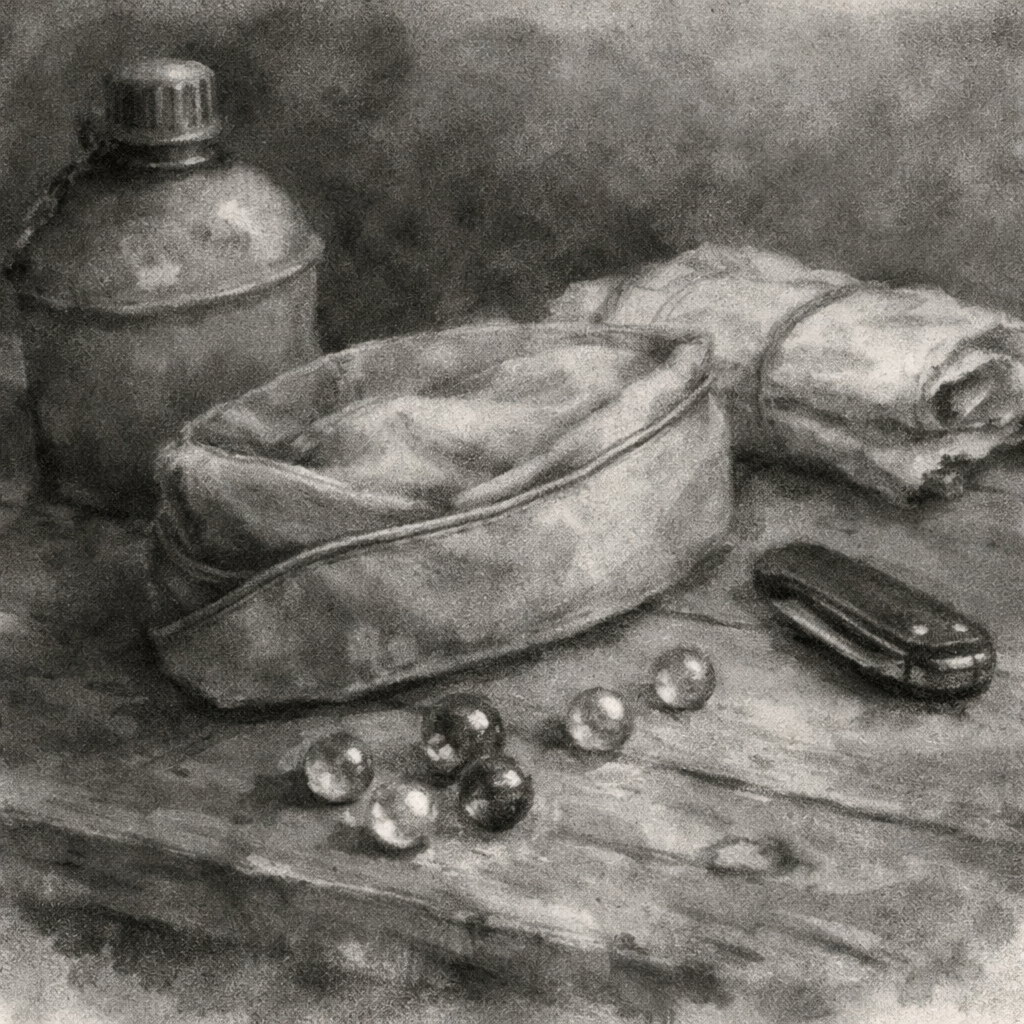
From The Imagination of Microsoft Copilot
These things weren’t luxuries. They were time management tools in a world that refused to give time freely. A few minutes of play could reset a man’s nerves, mark the end of a march, or hold back the weight of the next order. When a marble turns up in a camp trench or a barracks floorboard, it isn’t a child’s toy out of place. It’s evidence of how soldiers carved out small, stubborn pockets of time in landscapes that offered none.
The Overseas Cap: A WWII Standard
While we were delighted to locate our lead photograph, it is both mysterious and compelling to look at. There are five soldiers in the group. The title of the photograph is “Untitled….” The date it was taken was about 1945.
That and the name Peter J. Cohen who contributed the image to the Saint Louis Art Museum are all we really know about the print.
So, we examined the print for clues. There are five soldiers playing marbles. Oddly, there is no marble ring.
Only two of the men are in full uniform. Still, we checked the clothes for clues. First we checked the caps carefully. The soft, foldable cap worn by the soldiers in this photograph is the U.S.Army overseas cap, the standard item of everyday headgear during World War II.
It was issued to enlisted men and to officers alike and used for routine duties on post, in camp, and while traveling. The design was simple and practical: a single piece of cloth, easily folded flat, with branch colored piping that identified the wearer’s service arm.
Unlike the Vietnam Era distinction between “travel caps” and “saucer caps,” WWII regulations made no such separation. The overseas cap served as the default working cap for soldiers in field uniforms, which is exactly what the photograph records.
So, the image is absolutely World War II vintage.
“Service Shoes” — The Army’s Low Quarters, 1941–45
In WWII Quartermaster language, the low‑cut footwear seen in our photograph were officially Service Shoes—not “dress shoes,” and not “oxfords.”
They were issued in Type I (leather sole) and Type II (composition sole), these russet brown lace ups were the Army’s standard garrison and walking out shoes for enlisted men. Their appearance in vernacular photographs is a reliable indicator of stateside or rear area conditions, where soldiers were out of the mud, out of the field, and briefly back in the rhythms of ordinary life. The shoes are all shined in the photograph.
For African American units—often documented only in formal, labor, or parade contexts—the presence of Service Shoes in a leisure scene adds a layer of authenticity. The shoes help date the image to ca. 1943–45, when buckle boots and “roughouts”[2] dominated field wear but low quarters remained common in camp. In this photograph, the footwear quietly anchors the moment: soldiers at ease, off duty, reclaiming a childhood game in the margins of a segregated Army.
While we still have no idea where nor why the photograph was taken, we do know that they are in garrison and that they may be overseas before or shortly after WWII ended.
Wood‑and‑Canvas Barracks — The Army’s “Half‑and‑Half” Huts
Behind the soldiers are what look like structures with canvas walls, a canvas roof, and wood lower walls and a wood platform.
These are almost certainly tent frame barracks or a Theater of Operations Barracks, both of which were standard for stateside training camps in 1943–45. This aligns perfectly with the Service Shoes and garrison cap.
The Photograph With Few Footnotes
I keep returning to the photograph, not because it tells me everything, but because it refuses to. The soldiers, the marbles, the patch of ground — they hold their silence. I admire the image, yet I can’t help wondering about the life just outside the frame: their names, the place, the unknown person who cared enough to take the picture.
Maybe those answers are gone for good. Or maybe the photograph is doing exactly what it was meant to do — leaving me with a small, persistent pull to know more.
Oh, as Detective Columbo would say, “Just one more thing.” If you enlarge the photograph then you will see something in the left rear pocket of the soldier with has back to us. He is looking down at the shooter’s marble set up. What is that in this soldier’s back pocket? If you know or even guess then drop us a comment and let us know.
References
- You might want to check out Tim O’Brien’s The Things They Carried. New York: Mariner Books, 2009. ↑
- Roughouts are a style of leather boot where the rough, suede‑like flesh side of the hide faces outward, and the smooth grain side faces inward. They look like suede, but they’re not suede — they’re full‑grain leather worn “inside‑out.” ↑