A Remarkably Lucky Find in D’Iberville, Mississippi
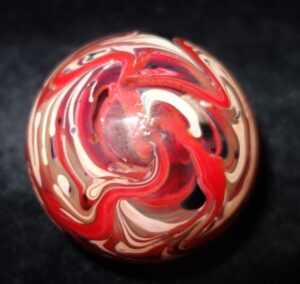
There is a nice antique shop in D’Iberville near our home in Biloxi. While we were browsing there we saw a woman pick up a giant vortex marble. We could see the vortex was clean and sharp, and the marble looked remarkably near 3” in diameter!
It reminded us that we were told once by Sam Hogue, while he was in a light-hearted mood, that “…3” is the size limit for a marble!” We felt he could have added that after that it becomes a bowling ball. Coincidentally, 3” is the largest size Sam makes and we have at least one of these.
We were amazed and frozen in place in the D’Iberville shop. And here Larry stood looking back at the marble! He missed it! It was not on display but in a non-descript ceramic dish!
Frozen in place, Larry waited for whatever came next. The lady looked at the marble, mentioned the vortex to her companion, and put it back! Obviously, she did not know marbles! And when Larry “casually” picked up the marble and looked at the price he was even more astounded! The marble cost $35.00!
Takayama Kane and The Ocean‑Palette School of Hawai‘i
When we got it home we found that the marble is signed in a crisp fashion by “Kane” and “HI”. We have a small collection of contemporary glass art marbles, and we have always made a hobby of acquiring local artists’ work whenever we can.
But we had never heard of Kane, and we immediately learned that it is very difficult to find information about him online.
Through online research we did learn that “Kane” is Kane Takayama and “HI” really is what it looks like—Hawai’i. We had never before seen an artist note the state that his studio is in!
The marble has a circumference of 8 inches (≈ 2.55 inches in diameter). We learned later that this example exceeds the typical size range for Hawaiian vortex work (1.25″–1.75″), indicating a premium, high‑heat, large‑format pull. Its scale and clarity suggest advanced and highly skilled control of borosilicate heat gradients and vortex descent, placing it among the more technically ambitious pieces associated with the “Kane /HI” signature. It is, in fact, a gallery piece.
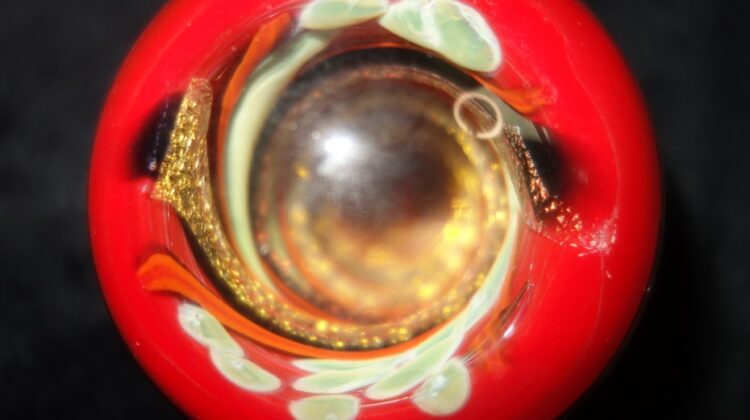
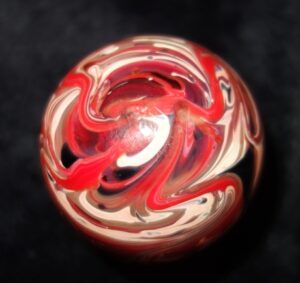
We also learned that this vortex marble, signed “Kane / HI” on the back pole, which you can see in the photograph above, originates from the Kaua‘i–O‘ahu Ocean‑Palette school of Hawaiian borosilicate torch-workers.
Even in today’s digital world this community stands apart, preserving a craft that can’t be downloaded or automated—only felt, shaped, and taught through lived experience. It keeps its roots in the islands, blending ancestral knowledge with contemporary glass work to create a practice that is both modern and deeply Hawaiian.
Hawaiian vortex artists like Kane rarely maintain public websites or digital contact channels; instead, their work circulates through local galleries, craft markets, and direct studio sales, making signed pieces the primary vehicle of provenance. Hawaiian vortex artists frequently sell exclusively through local galleries, and Simply Wood Studios in Honolulu is one of the few that consistently carries vortex work.
The marble’s oceanic and volcanic palette, tight vortex geometry, and minimalist back pole align with the established traits of Hawaiian vortex construction. The inclusion of “HI” is a regional identity marker used by island torch-workers to distinguish their studio output from mainland vortex makers.
Because Hawaiian artists work in limited batches and distribute locally, marbles bearing this signature are comparatively scarce in mainland collections. And our giant is more of a gallery piece than anything regularly produced by Kane or others in the islands.
This marble represents a regionally distinctive form of contemporary Pacific material culture, shaped by the visual vocabulary of Hawai‘i—ocean depth, refracted light, and minimalist design—and preserved through the collector networks that sustain the island’s small but influential vortex tradition.
Kane Takayama: Hawaiian Vortex Maker Extraordinaire
We’re confident that you probably have a vortex or two in your collection. If not, you have probably gazed into any number of them. Well, Hawaiian vortex are different!
A vortex marble contains a conical interior cavity lined with fumed color stripes (silver, gold, aqua, teal). Our Kane is principally gold, but it also has bright reds. When the artist heats and spins the glass, those stripes of color stretch downward into a spiral. Once encased under a clear lens, the viewer sees a descending tunnel which is the vortex[1].
Hawaiian vortex makers (including Kane) use borosilicate torchwork with these steps:
First they fume to vaporize mineral-based borosilicate color rods, and not metallic vapor in the flame, depositing a microscopic metallic film onto the interior wall. This creates the shimmering blues, greens, and teals typical of Hawaiian palettes.
Hawaiian colors include: cobalt blues (cobalt oxide); copper greens (copper oxide); iron‑based ambers (iron oxide); reds like the ones in our Kane (Cadmium‑selenide reds, iron‑oxide reds, and borosilicate reds); chrome aquas (chromium oxide); manganese purples which use manganese dioxide; and whites which are tin oxide opacifiers[2].
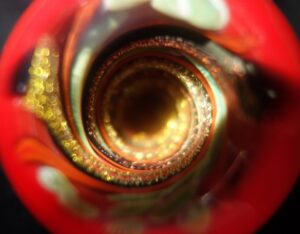
And gold! As you can see in this photograph, Kane was not skimpy the gold.
Our search confirms this directly: multiple vortex marbles list “24k gold fume” or “gold fume backing” as the source of that shimmering gold depth!
Gold fuming is the process of heating a fragment of 24k gold until it vaporizes. That vapor drifts through the flame and condenses onto the surface of hot glass as a microscopic metallic layer. When drawn into a vortex, the film becomes a spiraling, magnified glow—warm, electrum-like, and unmistakably Hawaiian[3].
Comparison Hawaiian & Mainland Vortex Geometry
|
The Enigma of Kane Takayama
Kane Takayama occupies one of those liminal spaces in marble history where provenance blurs into folklore. The name appears in collector circles but not in any Japanese kōgei registry[4], lampwork guild, or glass‑artist directory. Instead, the trail leads to Hawaii, where small‑studio lampworkers often blend Japanese surnames with Hawaiian naming traditions. In Hawaiian, kane means “man,” “husband,” or “male deity,” making the name as much a cultural marker as a signature.
Marbles attributed to Kane Takayama typically show hybrid technique: Japanese tonbo dama[5] influence in the layering, Hawaiian studio flair in the color palette—ocean blues, lava reds, dichroic shimmer. These spheres circulate quietly, sold through island craft markets, tourist shops, and small galleries that rarely document individual makers. As a result, Kane’s work sits at the intersection of folk production and collector mythology.
For marble historians, the Kane attribution is a reminder that not all makers leave paper trails. Some leave only glass.
What Is The Value Of Our Kane?
Remember how excited we were to see the $35.00 price? And remember that our vortex is created with real gold fume. And remember that ours is a very large 2.55” in diameter.
Well, Kane sits in mid‑tier Hawaiian vortex category, which typically prices:
- Standard (1.25–1.5″) — $85–$125
- Mid‑tier (1.5–1.75″) — $125–$175
- Large (2″+) — $200–$300+
Our marble’s 2.55″ diameter and this puts it in the premium size bracket since the vortex is clean and the signature and “Hi” are crisp.
Conclusion: The Hawaiian Vortex Identity
Our first conclusion is for you to keep a keen eye out at every antique shop, thrift store, and, especially every estate sale that you visit. Most of the authentic Hawaiian marbles, marked with a name and a “HI”, are bought in Hawaii at galleries and small studios and then they are brought to the mainland.
Kane and Rae Grout work on O‘ahu. Blue Lava Studio is on Hawaii. Kaua‘i Flame Collective works on Kaua‘I and the Collective is a loose group of makers; oceanic spirals; gallery‑only distribution. Kai Glass is on Maui. And work in the Hawaiian School and all distribute their work in Galleries or the island gallery conduit.
Recall that Hawaiian vortex marbles are special and that they stand apart not because they reject mainland techniques, but because they refine them into a regional language of color and depth. By relying on mineral‑based borosilicate rods instead of gold or silver fume, artists like Kane Takayama create spirals that feel calm, centered, and ocean‑born. Their geometry is tight, their palette deliberate, and their backs minimalist—an aesthetic shaped by island studios, small‑batch production, and a craft culture that values clarity over flash.
In a collector’s world dominated by dramatic, metallic, galaxy‑style tunnels, Hawaiian vortex makers offer something rarer: a deep descent that feels like water, not fire. Their work is a reminder that the vortex is not only a technical achievement but a regional expression—one that carries the quiet signature of the islands in every spiral.
References
- You can watch a vortex being made at Standing Waves Vortex Marble Twist – Start to Finish Construction Episode 34 7/10/2026 ↑
- An
Pacific
- is any additive—mineral, metal oxide, or chemical compound—that disrupts light transmission in molten glass. When added in small, controlled amounts, it creates opacity, milkiness, or dense color, depending on the formula and temperature. ↑
- Silver & Gold Fuming: Step-by-Step Glass Fuming Technique (2026) 7/12/2026 ↑
- The kōgei registry is a cluster of formal Japanese systems that document recognized traditional craft artists. It isn’t a single database but a network of overlapping institutions that collectively define who is officially acknowledged in Japan’s world of traditional arts and crafts. ↑
- Tonbo dama (とんぼ玉) are Japanese lamp worked glass beads, a craft tradition with deep historical roots and a huge influence on modern marble‑making. They’re one of the most important ancestors of contemporary art marble. ↑