Introduction: Hiram Codd — Engineer, Inventor, and Carbonation Pioneer
Hiram Codd (1838–1887) was an English mechanical engineer whose inventive mind reshaped the global soft‑drink industry worldwide. His 1872 American patent for a marble sealed bottle solved the persistent problem of keeping carbonated beverages fresh and secure.
His United States Patent No. 129,652 is dated July 23, 1872. It was the first of dozens he and his business partner Ben Rylands filed both in America and in Great Britain. We read in the literature that Rylands eventually took out 90 patents in the United States and in England!
The partnership between Rylands and Codd transformed a clever invention into a global industrial product. Codd supplied the engineering vision; Rylands supplied the manufacturing muscle. Together, they built Hope Glass Works, the factory that mass produced both Codd bottles and the glass marbles inside them.
But the Rylands partnership was still in the future when Codd patented the marble bottle in 1872. And Codd’s past informed his invention with years of practical experience in the bottle cork business. Codd’s years working in the cork trade taught him exactly where and why cork stoppers failed under carbonation pressure — leaking, blowing out, drying, shrinking, and requiring skilled labor to fit properly. Those firsthand frustrations directly shaped his decision to abandon cork entirely and engineer a self-sealing, pressure‑activated glass closure: the marble-and-gasket system of the Codd bottle[1].
The Cork Years (1850s–1870s)
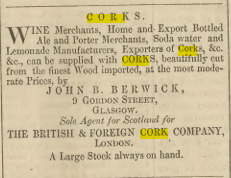
The Glasgow Free Press, Saturday, August 30, 1862. Scotland.
Codd’s father was a carpenter, but Hiram became a cork man. Years before he became an inventor, he worked at the British & Foreign Cork Company. This placed him inside the supply chain that fed Britain’s exploding mineral water industry. During this era, cork was the universal closure — organic and traditional. Yet it became increasingly inadequate for the high-pressure world of aerated drinks[2].
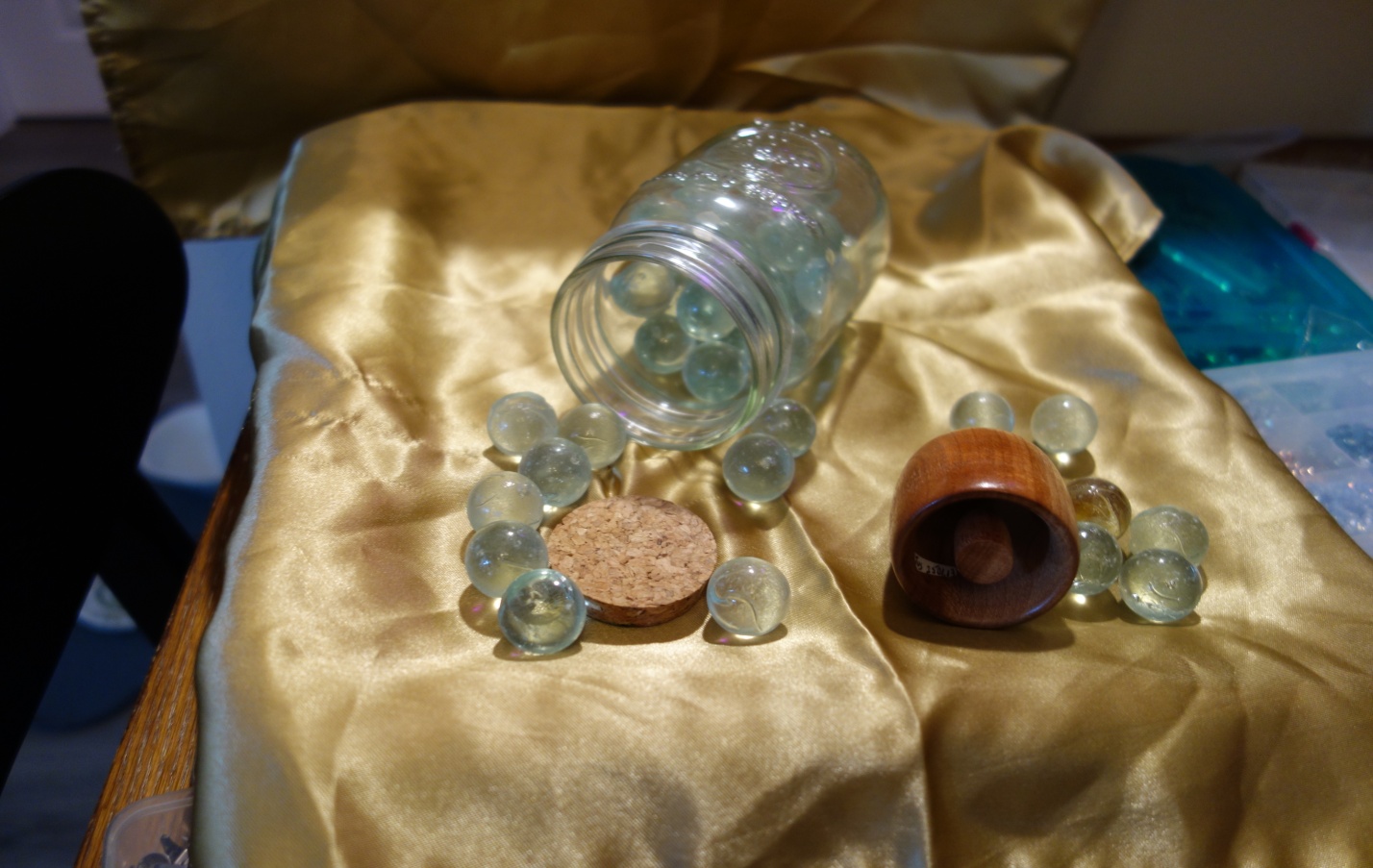
Photograph by Jo Garrett
“British & Foreign Cork” certainly doesn’t roll off the tongue, but as we see in this trade news advertisement, they sold cork domestically and exported beverages. We have also read in the literature that they imported expensive cork from Spain and Portugal.
Codd started work at the age of 23. When he started Britain was experiencing an exploding mineral water industry. Cork was the universal closure — organic, traditional, and increasingly inadequate for the high-pressure world of aerated drinks. Traveling between bottling works, Codd witnessed cork’s limitations not as theory but as daily operational failures. No two corks behaved alike. Density, grain, and elasticity shifted from tree to tree, batch to batch. There were intolerable pressure failures because aerated waters blew corks out or leaked gas, costing bottlers product and reputation.
Cork required labor-intensive preparation. They had to be soaked, trimmed, compressed, and inserted by skilled workers. And cork could decay. It dried, shrank, molded, or crumbled, especially in reused bottles. These weren’t minor annoyances. They were structural weaknesses in the closure system itself.
Codd’s marble-stopper bottle is best understood as the culmination of his cork apprenticeship. The failures he observed became the design criteria for a new closure system — one that used pressure as an ally rather than an adversary.
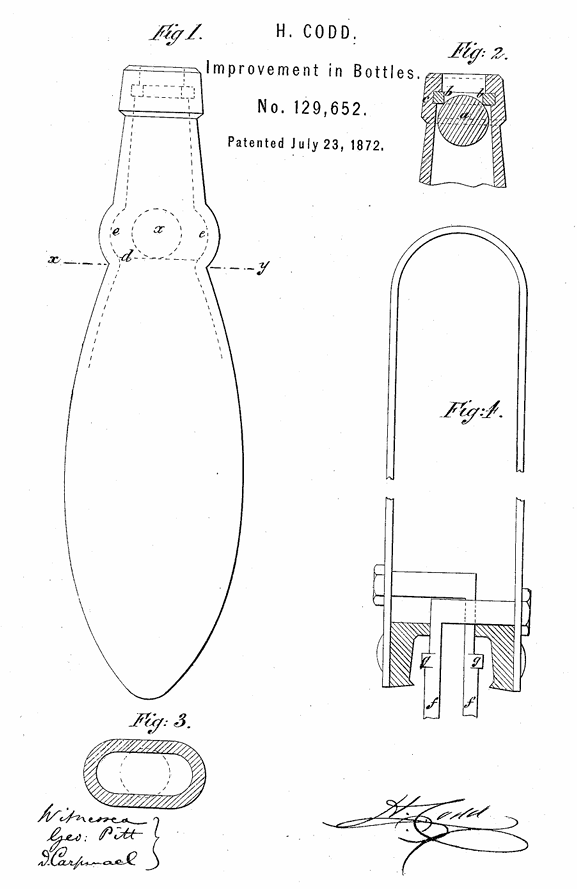
Improvement in Bottle H. Cobb US Patent 129652 July 23, 1872
Codd & Rylands — A Working Partnership in Glass (1873–1881)
When Hiram Codd patented his pressure sealed marble bottle in the early 1870s, he had the concept but not the industrial muscle to scale it. Enter Benjamin Rylands of Barnsley, a glassworks innovator with a reputation for aggressive improvement and rapid production. Their partnership joined Codd’s closure system with Rylands’s manufacturing capability, creating the first reliable pipeline for Codd bottles.
Codd worked up a pressure-activated closure which address all of the failures of cork. Rylands engineered improvements in bottle design, neck geometry, and mass production techniques. The two men filed joint patents especially around the groove, rubber searing gasket, and marble retention. Their collaboration
Tensions & Divergence
By the late 1870s, Rylands’s ambition began to overshadow the partnership. He pursued independent patents, including the “improved” Codd bottle variants that edged close to Codd’s original claims. Their relationship shifted from collaboration to competition.
Codd Bottle Marbles
Ever considered where the aqua, blue, and red marbles in the bottles came from? Well, the marbles inside Codd bottles were not made by the bottlers themselves. They were produced by specialized glassworks, most famously Hope Glass Works of Barnsley, and by several regional manufacturers across Britain, Europe, India, and Australia as demand exploded.
When Hiram Codd partnered with Ben Rylands in 1877, Hope Glass Works became the world center for Codd‑bottle production. They didn’t just make bottles, they made millions of marbles! Hope Glass Works operated dedicated marble furnaces. Marbles were hand gathered, cut, and rounded in small batches. Early marbles show pontil scars, shear marks, and color impurities typical of late Victorian hand work. By the 1880s, Hope was exporting marbles to India, Australia, South Africa, and Japan.
Because demand for Codd bottles was enormous, multiple firms produced compatible marbles. These companies included Rylands & Codd (Barnsley). Before Hope Glass Works reached full production, Rylands produced early marbles in small quantities.
Nuttall & Co. (St Helens) was a glass bottle manufacturer that also produced marbles for regional bottlers. Kilner Brothers (Thornhill Lees & Wakefield) made both Codd bottles and marbles, especially for northern English mineral water firms. Wood Brothers (Barnsley) was known for distinctive pale green marbles found in Yorkshire excavations.
Indian firms made marbles for local soda works. “Goli soda” bottlers often sourced marbles from Firozabad Glassworks (the center of Indian glass production). Smaller regional furnaces produced hand rounded marbles. Marbles were also made in Japan and in Australia.
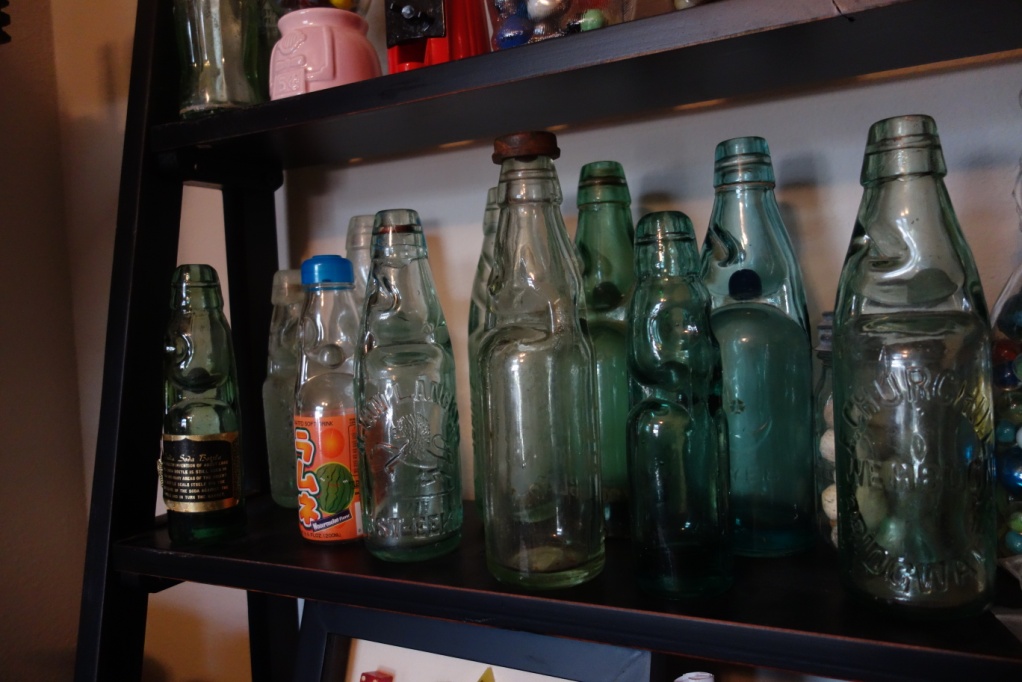
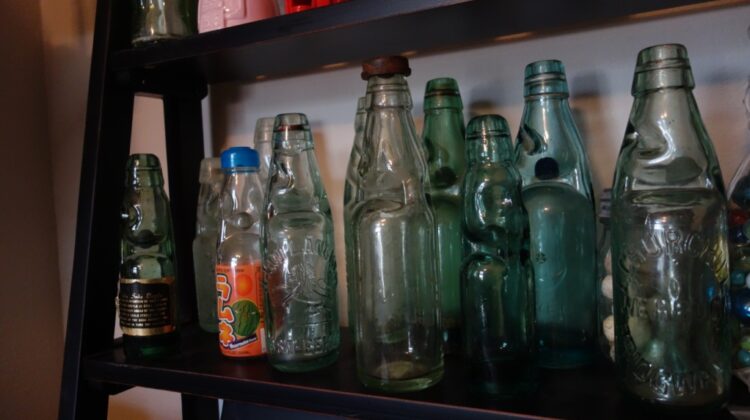
Photographs of all bottles by Jo Garrett. Note the blue-capped bottle from Japan
- About the Bottleswell Bristol and Churchill Wembdon Bridgewater. Embossed as part of the mold. Wembdon is a village immediately west of Bridgette, historically tied to the same commercial district. Many late‑Victorian bottlers listed two adjacent localities on their Codd bottles to signal their delivery range. There are visible shear or mold marks on this 9 inch tall bottle.
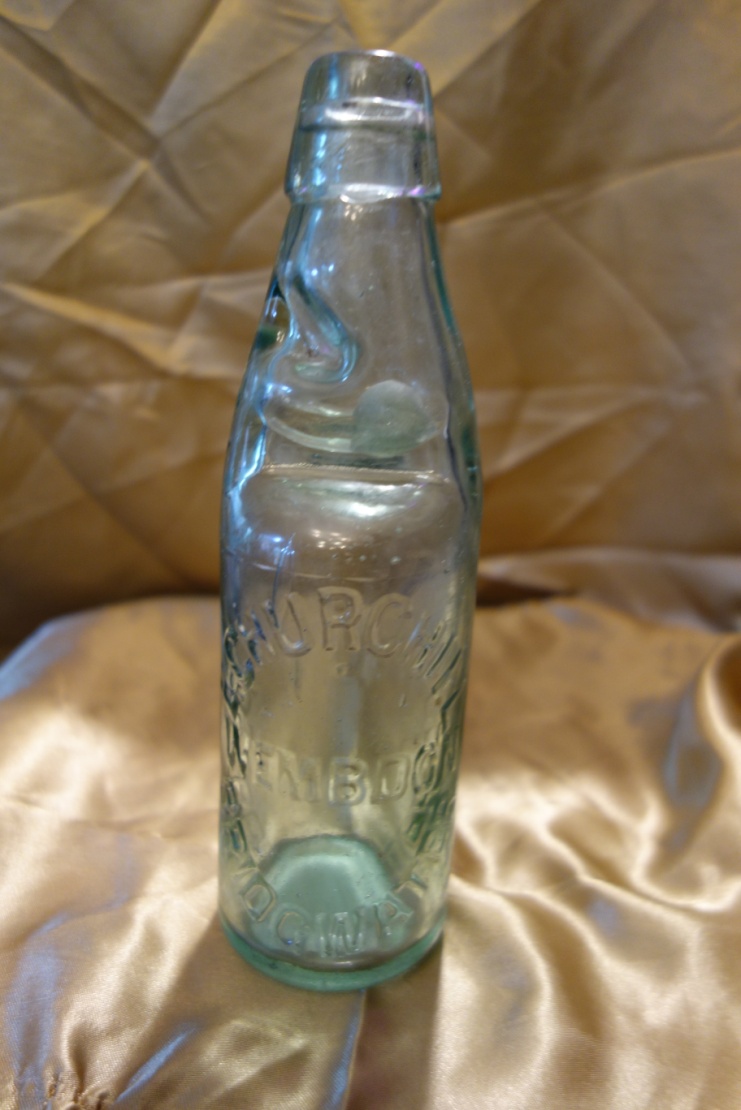
Agricultural base: The village remained small (population 244 in 1801) and orchard‑rich, supplying produce to Bridgette’s markets. Wembdon Parish Council
Transport link: Located on the “Pilgrims Route,” Wembdon sat on a feeder road into Bridgette, making it a natural satellite community. Wembdon Parish Council
The embossing refers to William Powell, partner in the long‑running Ricketts family glass firms of Bristol. After the death of Richard Ricketts in 1856, Powell continued running the operation, which produced Codd‑stoppered bottles until 1923. secure-sha.org
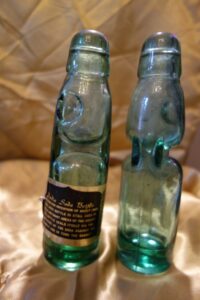
2. “India Soda Bottles” are an English invention of about 1860. This soda bottle is still used in India and many areas of the Orient. The bottle seals itself via the pressure of the soda against the marble and in turn the gasket.” 7¾” X 2” Has a blue marble. We learned some time ago that some companies commissioned blue and some red marbles. This way, the story goes, each company could easily find their bottles in the “returns” at the retailer. One with and one without paper label. These are modern bottles with crisp mold lines and modern lips.
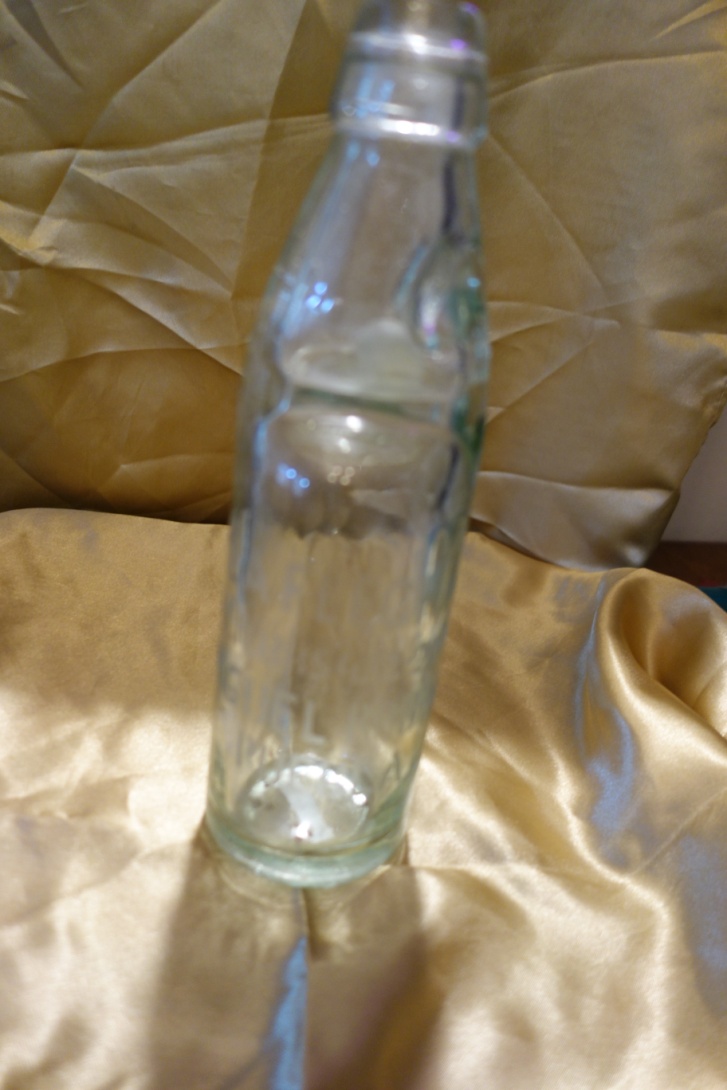
3. We bought this at the Fall Barn Sale near Purvis, Mississippi. We had never seen one like it and neither had the seller. We had no idea that Codd bottles were ever used in Mexico. The bottle is 9” tall X 2½”. Unlike all of the antique Codds we have seen, this one is etched or scratched rather than embossed!
The maker’s mark is “Laflecha M.I-20-9.R.8541213 Miguel Robina Puebla.” This appears to reference a Mexican glass manufacturer or bottler, likely based in Puebla, Mexico. Laflecha is possibly the brand name or company name. “La Flecha” means “The Arrow” in Spanish, which could be a symbolic or trademark name.
M.I.R.85412-20-913: This looks like a registration or patent number, possibly tied to a Mexican industrial registry while Miguel Robina is likely the name of the manufacturer or proprietor. Puebla refers to the city in Mexico, known for its rich history and industrial production, including glassworks
Codd bottles are rarely associated with Mexico, which makes our find especially intriguing! Microsoft Copilot tells us that “Unfortunately, there’s no definitive public record tying the “Laflecha M.I.R.85412-20-913 Miguel Robina Puebla” mark to a specific bottling date.” However, here’s what we can infer:
Microsoft Copilot: It looks like there just isn’t any publicly available information online about that specific bottle mark — “Laflecha M.I.R.85412-20-913 Miguel Robina Puebla.” That’s not unusual for rare or regionally produced antique bottles, especially from underrepresented markets like Mexico.
Still, the lack of online records might actually make your bottle more valuable to collectors who specialize in obscure or international Codd bottles. It could be a rare piece that hasn’t surfaced often in auctions or databases. So, if not rare, the bottle is very unusual, Mexican, and possibly 70 – 90 years old.
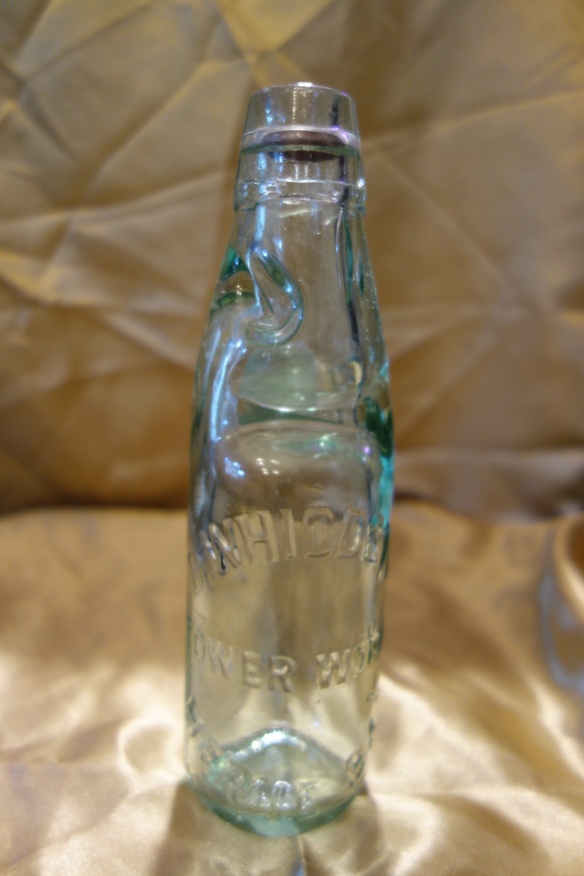
4. Larry’s sister Lynn Howell, who collected marbles like we did, gave us a Codd bottle which she bought in Cartersville, Georgia, in 2018.
This new bottle is small at <>7½” and it is in remarkably good condition, is bright and shiny. It is embossed “D. Whiddett Tower Works Herne Bay” on the face and “The Rylands 4 Barnsley” on the back. The soda green bottle also has a soda green marble. It has an applied bottom and was made in a 2-piece mold. The lip looks like a copper ring. However, while there is evidence that Ryland’s experimented with rubber closures, pressure, and Codd bottle necks, the ring in this bottle’s neck must be hard rubber There are both large and small air bubbles.
We can confirm that David Whiddett did bottle in Herne Bay, Kent, England, in the late 19th century. He used stoneware as well as glass. This is what we learned about Herne Bay: Herne Bay grew from a quiet Kent shoreline into a brisk Victorian seaside town, its identity shaped by piers, steam packets, and the steady flow of holidaymakers seeking sea air and gentle promenades. By the 1860s it was a modest but lively resort: bathing machines along the shingle, lodging houses facing the Channel, and a pier that functioned as both a transport hub and a social stage. For Codd’s era, Herne Bay mattered as one of those coastal towns where mineral‑water bottlers, glass merchants, and traveling salesmen regularly passed through.
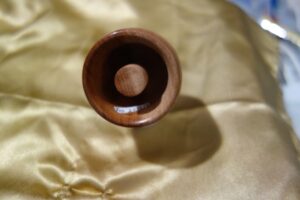
5. A Codd opener is a short, turned wooden tool — usually boxwood, sycamore, or beech — with a flat or slightly domed end sized to fit inside the bottle’s mouth. Pressing downward forces the marble off its rubber washer, releasing the gas and opening the bottle. Most were pocket‑sized, cheap, and often branded by mineral‑water firms.
The opener was purchased 16 August 2020 Antiques on North Main, Ellijay, GA We have enjoyed visiting this shop for many years. The owners may be English. At any rate before Covid-19 they traveled to England almost every summer to buy antiques for their shop. We have bought one or more Codd bottles from them, and we asked that they look for a Codd bottle opener for us this summer in England. Because of the pandemic, they could not travel. We have communicated with them for some time and learned that they asked a local wood worker to make an opener to specifications. Well, he did and today we bought an opener for us and one for Larry’s sister Lynn Howell. While Lynn’s was priced more expensive, we got both for $30.00 each. The owners had three and all of the openers are different. Ours is made of red oak; is gorgeous; and it looks somewhat like an acorn! The “acorn” is a thumb rest to help the user apply pressure against the rubber gasket. These are custom made for us on consignment and we are positive that there will never be any more like this.
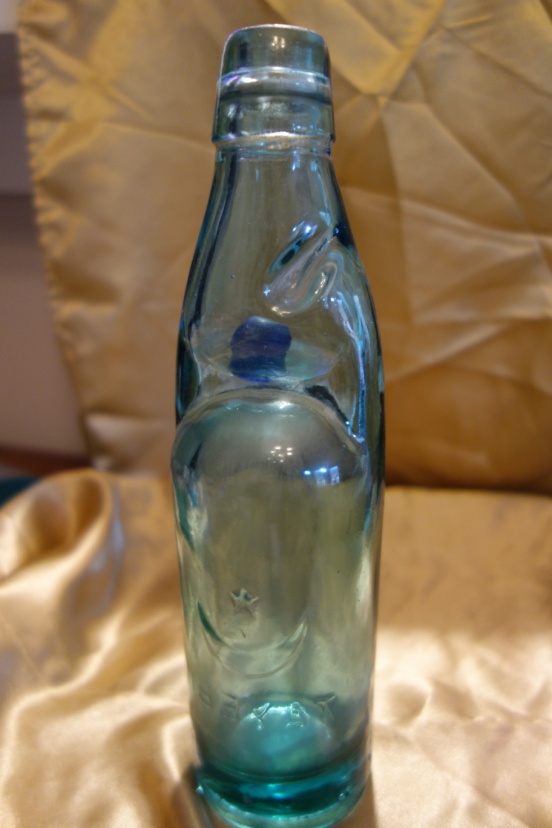
6. Ginger and Pickles Antiques, Gurley, AL Today we found a very large one with a different color blue marble. Codd bottle that was used by a soda/carbonated drink street vendor in India. While this technology was invented in the 1800s, India is one of the only countries in the world that still uses the Codd bottle. This bottle is made from thick light green glass and has a the words TAYEBI and features a crescent moon & star. Our bottom is either too badly worn or simply too faint to read. There is a crack on the base, but it would probably not prevent refills. It is 9½” tall! Later, we found dozens of these India bottles in Mobile County, Alabama, for $5.00!
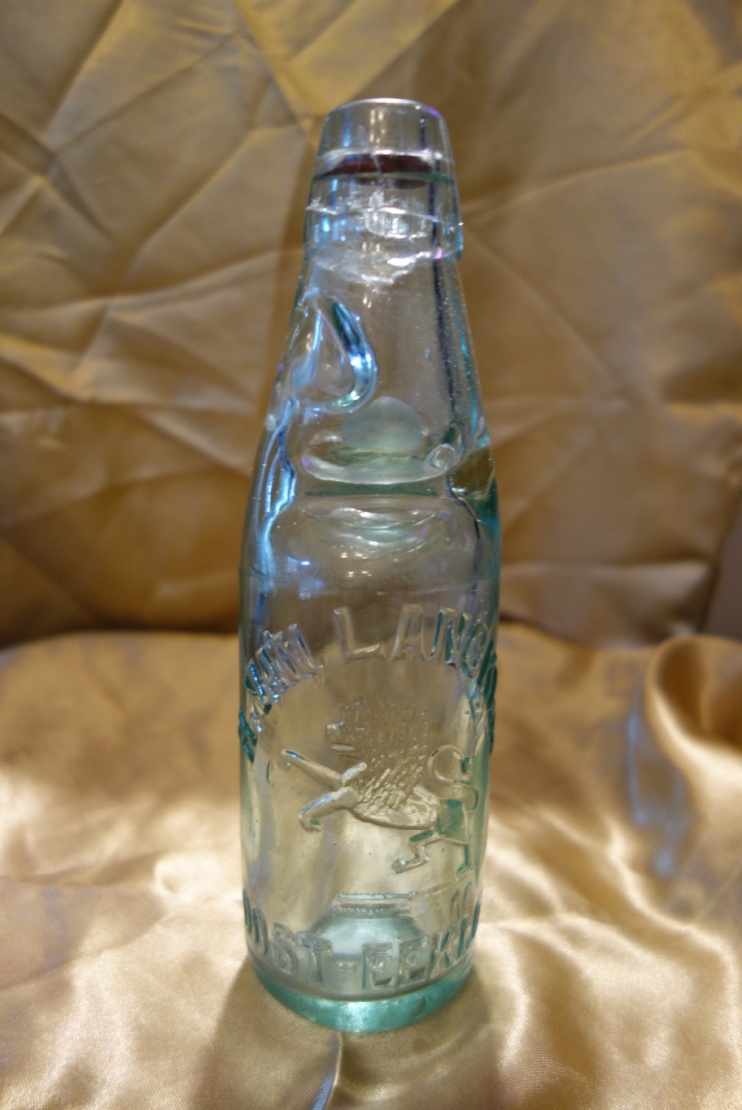
7 . This is a very rare bottle! The “H. Van Lancker” Codd bottle is a rare antique soda bottle from Oost-Eeklo, Belgium, likely dating to the late 19th or early 20th century. It features classic Codd-style construction with a marble stopper and embossed branding.
- Origin: Oost-Eeklo, Belgium (spelled “OOST-EEKLOO” on the bottle) The English manufacture paired with a Flemish brand hints at cross-border industrial networks.
- Maker’s Mark: Embossed with H. VAN LANCKER and MADE IN ENGLAND, indicating it was manufactured in England for a Belgian soda or mineral water company WorthPoint.
- Design:
- Made of green glass
- Codd-neck style with a marble stopper and rubber gasket
- Embossed lion emblem on the front—a symbol often used to convey strength or national pride WorthPoint.
- Approximate height: 8 to 8.5 inches
- Some examples have a number like 3452 embossed on the base WorthPoint.
- Condition (in known examples):
- Marble and gasket often intact
- No chips or cracks reported in well-preserved specimens
- Some bottles show light wear consistent with age
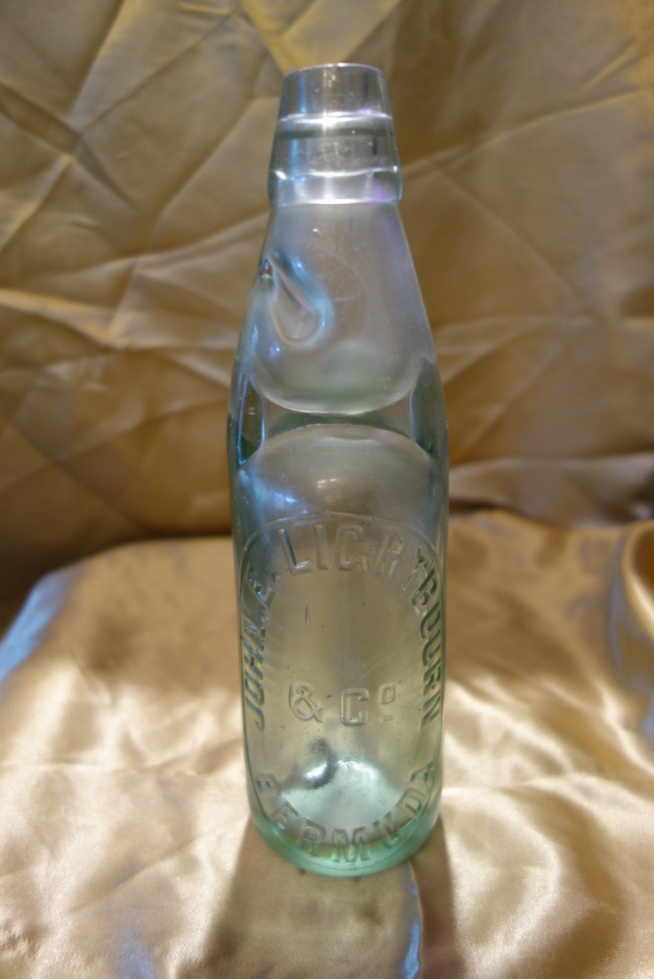
8. This one was purchased February 2018 at the 45th Annual Antique Bottle & Collectibles Show and Sale, Rome, GA John E. Lightbourne & Co., Bermuda.. This bottle dates to about 1880, is 2¼” in diameter, 9” tall; and it weighs 668g or <>24oz. It was blown in a two piece (leaf) mold by (we believe) Codd/Ryland, England and the glass has air bubbles in it. It is embossed as shown above with the Company name. There is no mold mark on the base. The seams run from the top of the applied cup base (with irregular thicknesses) to the applied (not tooled) lip. A worn and broken gasket is in the bottom of the bottle. It is apparently older than the Hudson bottle.
We do know that Lightbourne also used a Hamilton-style bottle (torpedo) with a Codd closure. While not rare, these bottles are known among collectors as Hybrid Codds and these Lightbourne can sell for $300 or more. We were very interested that the old bottle came from Bermuda which is a British Overseas Territory in the North Atlantic Ocean. It is approximately 1,070 km (665 mi) east-southeast of Cape Hatteras, North Carolina; 1,236 km (768 mi) south of Cape Sable Island, Nova Scotia; and 1,759 km (1,093 mi) north of Cuba. The capital city is Hamilton. Bermuda is self-governing, with its own constitution and its own government, which enacts local laws, while the United Kingdom retains responsibility for defended and foreign relations.
Lightbourne bottles are far from rare. However, rather than bottle diggers in Bermuda, many collectors are bottle divers! Thousands of these old bottles were thrown into the ocean when empty — at least the bottles were not broken for the marble. This one may have been recovered from the Atlantic.
Conclusion
In the end, the Codd bottle story is not simply about a marble trapped in glass; it is the record of a problem solved with unusual clarity. Hiram Codd took the everyday failures of cork and reimagined them as design criteria, turning pressure from an adversary into an ally. Ben Rylands transformed that insight into manufacturable reality, refining molds, tolerances, and production until the bottle became a global standard. Together, inventor and glassmaker created an object that reshaped the mineral‑water trade from Herne Bay to Bombay, from Barnsley to Adelaide.
What survives today—marbles in the neck, grooves worn by use, specialized openers, regional variants—is the material culture of a system that worked. The Codd bottle stands as proof that small, well‑reasoned engineering can ripple outward into commerce, geography, and everyday life. Its story is ultimately one of persistence: a cork problem inverted, a partnership forged in glass, and an invention whose simplicity carried it farther than either man could have imagined.
We highly recommend that you add a few Codd-Rylands to your marble collection. We have found over the years that you can easily expand your collections—whether they be rocks, doorknobs, bricks, marbles, insulators, or gems—when you learn a bit more about them. It isn’t easy to find Codd bottles. But we recommend that you haunt antique shops, thrift stores, and flea markets and add a few to your collections. As you learned in this story, there are many variations on a theme!
References
- See “Hiram Codd” @ Hiram Codd – Wikipedia 8/13/2026 ↑
- An aerated drink is any beverage into which carbon dioxide gas is dissolved under pressure, creating fizz when the container is opened. Aeration (or carbonation) gives the drink its bubbles, slight acidity, and characteristic tingle. Common examples include soda, sparkling_water, and champagne. ↑