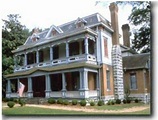
The Myrtles, St. Francisville, Louisiana
Image Courtesy of The Myrtles
Marbles, Memories, and Watermelons[1]
William Ballard and the other slave children used to play hide-the-switch, marbles, and several other games on their South Carolina plantation. But … “De only game I ever played wuz marbles,” remembered John Smith of North Carolina. “I played fer watermelons. We didn’t hab any money so we played fer watermelons.”[2]
We have been collecting marbles for 29 years, been to swap meets all over the South, written two books and over 100 stories about marbles, and spent time with contemporary marble makers, but we had never imagined playing marbles for watermelons!
Here’s more flavor of plantation life as told by David K. Wiggins: “’Us tho’owed horse shoes, jumped poles, walked on stilts, an’ played marbles.” (page 24).
Plantation Ghost Marbles
The most popular game of these boys throughout the South was marbles. It was a game that required very little playing gear. A match could be arranged anytime two boys came together who were anxious to demonstrate their “shooting” abilities. The playing of marbles, furthermore, appeared to be one activity in which slave boys could experience a temporary feeling of ‘power.’ The collection of marbles was one instance in which they could acquire objects of material worth; no matter their monetary value. ‘Us boys played marbles,’ recalled James Southall of Tennesse. “I got to be a professional. I could beat em all.” Charles Coles of Maryland said that he ‘had many marbles and toys that poor children had then’ and that his ‘favorite game was marbles.’ (page 27) We will explore the ideas raised by William and the professional marble player James throughout this story.
The Myrtles is an historic 1796 antebellum estate in St. Francisville, Louisiana, which is widely known as one of America’s most haunted homes. It is one of the most beautiful plantations in the American South. In exchanging emails with staff, we learned about a story associated with Kate Winter, a child spirit. Over the years guests have reported experiencing marbles rolling across the floor, most often in the Ruffin Stirling Room and the William Winter Room.
The story has become well enough known that guests bring marbles with them when staying in those two rooms. The ghost prefers green marbles! Staff do point out that the Kate Winter stories are a part of the lore rather than documented history.
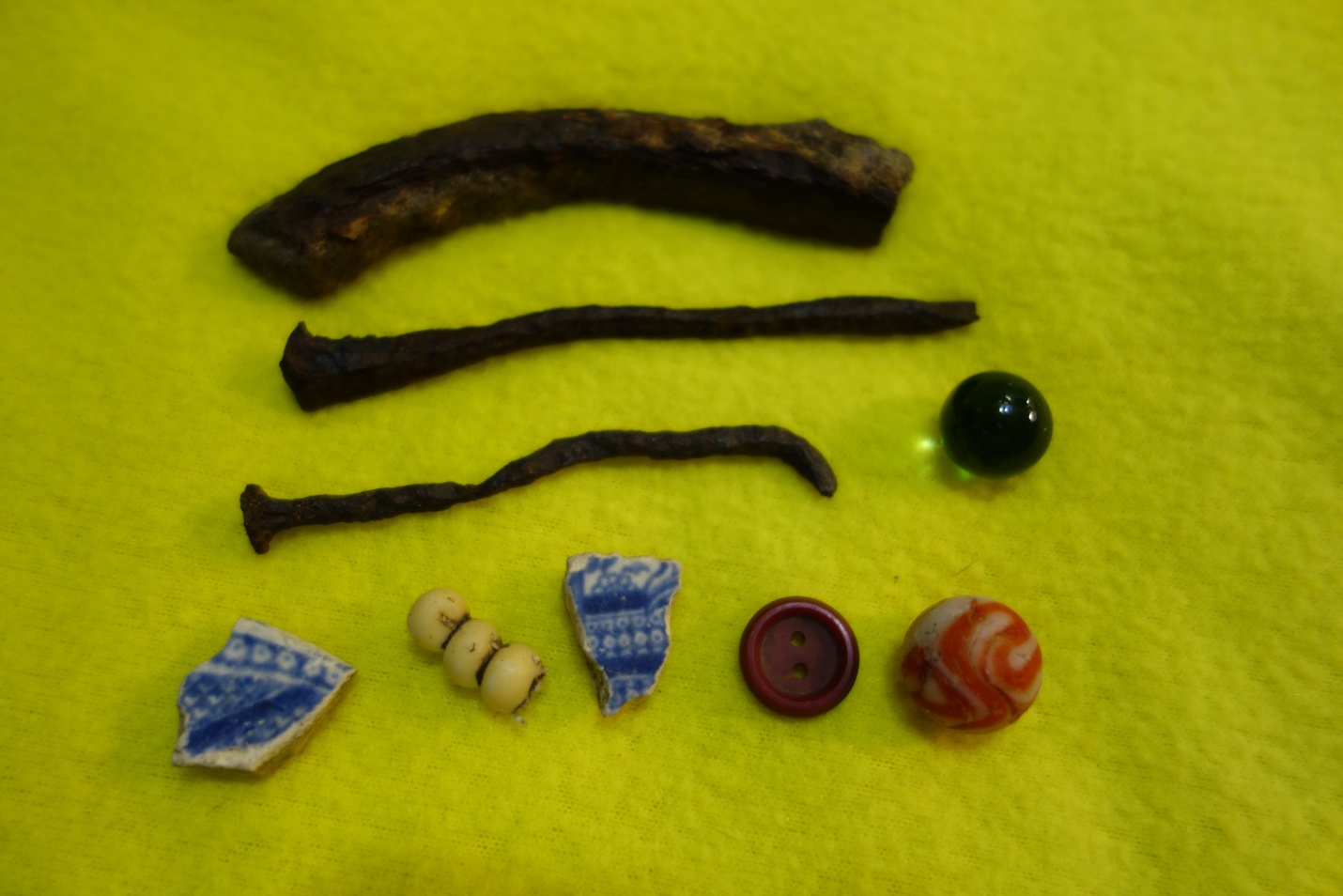 Photograph by Jo Garrett
Marbles, Memory, and Social Cohesion in Plantation Communities
We have written about how all too often toy marbles appear in the archaeological record as small incidental objects. Yet it has become obvious to us as we researched this topic that within plantation communities, these modest artifacts carried social weight far beyond their size.
A plantation was a coercive, interdependent social world built around large‑scale agricultural production. Typical crops included indigo, sugar, cotton, coffee, tobacco, or rice. In these communities, which were found across the Caribbean and the American South. Enslaved Africans and their descendants formed families, cultural systems, labor networks, and survival strategies within and against the plantation’s hierarchy.
Inside these communities, Black enslaved children played with marbles which were tools of cohesion, continuity, and childhood autonomy in a world structured by surveillance and constraint. Remember Wiggins told us that marbles gave enslaved children a sense of power. They also provided the children with a feeling of control and, at least temporally, a sense of control.
In slave quarter yards from the Gulf Coast to the Carolina low country, marbles helped children form peer groups, negotiate status, and learn the rules of reciprocity that under-girded community life. Stone, clay, and glass marbles served as quiet anchors of identity, tucked into pockets, hidden beneath floorboards, or traded in the shaded margins between dwellings where enslaved families carved out moments of self‑directed sociality.
Plantation landscapes, such as the spatial relationship between the “big house” and the slave quarters. The slave quarters themselves were arranged to regulate movement and visibility, yet children’s play often unfolded in interstitial spaces—the edges of yards, the lee of outbuildings, the informal paths between cabins[3].
These were places where the rhythms of labor loosened just enough for children to gather, invent games, and build relationships. Marbles, as low‑surveillance objects, fit seamlessly into these micro‑worlds. Overseers rarely concerned themselves with children’s play unless it disrupted labor; thus, marbles became instruments of social learning that operated beneath the notice of plantation authority. Through them, children practiced competition, cooperation, and conflict resolution—skills essential to the maintenance of community under duress.
The evidence that we have studied proves that marbles are not trivial artifacts. They are material witnesses to how enslaved communities built cohesion, preserved cultural knowledge, and nurtured childhood resilience within the constraints of plantation life. Through case studies, archaeology, oral histories, and comparative material culture, we will trace how these small spheres helped sustain the social worlds that slavery sought to fracture.
Photograph by Jo Garrett
Marbles, Surveillance and Control on a Plantation Landscape
In her 2002 article “Descendant Communities, Narrative, and the Historical Archaeology of the Plantation South” in Historical Archaeology (Vol. 36, No. 1, pp. 32–45), Carol McDavid examines how descendant communities (people who trace cultural and genealogical ties to the enslaved and free populations of the American South) can be studied through narrative and historical archaeology. Her paper argues that these communities are not static “remnants” of the past but active, evolving groups whose identities, histories, and material cultures are shaped by both continuity and change.
Material culture theory helps illuminate why such small objects like marbles matter in the overall plantation community. Marbles are attention‑capturing technology, objects that invite touch, focus, and shared rules.They create structured interactions: knuckling, setting, breaking, trading, wagering. These repeated actions generate the shared mental and social space through which children learn to read one another, trust one another, and belong. In plantation contexts, where adults relied heavily on mutual aid networks to survive, children’s play mirrored and rehearsed the social logic of the broader community.
This is not to say that marbles created social cohesion within the plantation community nor between slave and free.
David K. Wiggins[4], whom we introduced above, writes that
“… play experiences were eagerly looked forward to by the slave children because it gave them opportunities to frolic and socialize with their peer group under conformable conditions. The fellowship attained during these occasions seems especially significant because it furnished individual slave children with a feeling of security they might not experience under any other circumstances. Moreover, the constant reinforcement, common language, and strong positive sanctions that normally characterized these events helped to succor the slave children in their struggle to discover their personal identities. This did not mean that slave children ever felt any sense of community with the white children and their family. It is true that mutual enjoyment of various play activities did much to develop friendships among the children. But simply sharing in the excitement of popular pastimes was never influential enough to erase the intrinsic differences that existed between the children. To develop a true feeling of community requires at least a common life-style, common interests and problems, or a common philosophical approach to the world. It would be historically misleading to say that participating in … the same play activities was responsible for developing these sentiments between the children….. This is not to argue that mutual participation in play activities did not temporarily eliminate the usual propriety between the races….[Italics Added]
Still, marbles are not trivial artifacts. They were never trivial to the Black and White children who played together with them on the plantations. They are material witnesses to how enslaved communities built cohesion, preserved cultural knowledge, and nurtured childhood resilience within the constraints of plantation life. Through case studies drawn from archaeology, oral histories, and comparative material culture, we explore how these small spheres helped sustain the social worlds that slavery sought to fracture.
Marble Caches And Keepsakes
Photograph by Jo Garrett
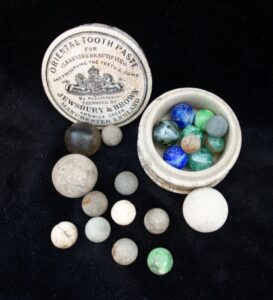
A Typical Marble Cache [5]
Hidden marble caches were wrapped in cloth, tucked beneath floorboards, or stored alongside carved wooden toys. These caches offer rare glimpses into the emotional state of enslaved childhood. These assemblages reveal how children invested meaning into their material worlds.
The building and the keeping of caches gave children a feeling of empowerment and self-direction within in a constantly surveiled environment. We have visited numerous plantations over the years and we were astonished to learn that “the spatial layout of the slave quarters in relation to other buildings may signify the way that slave owners regarded their enslaved workers and strove to exercise control over them. A spatial organization ensured that enslaved workers were less likely to gain power and to participate in any kind of insurrection. [The very] arrangement promoted supervision, control, and function.[6]” Evidence supports the idea that the Black perception of being constantly watched was almost as oppressive as the supervision itself[7].
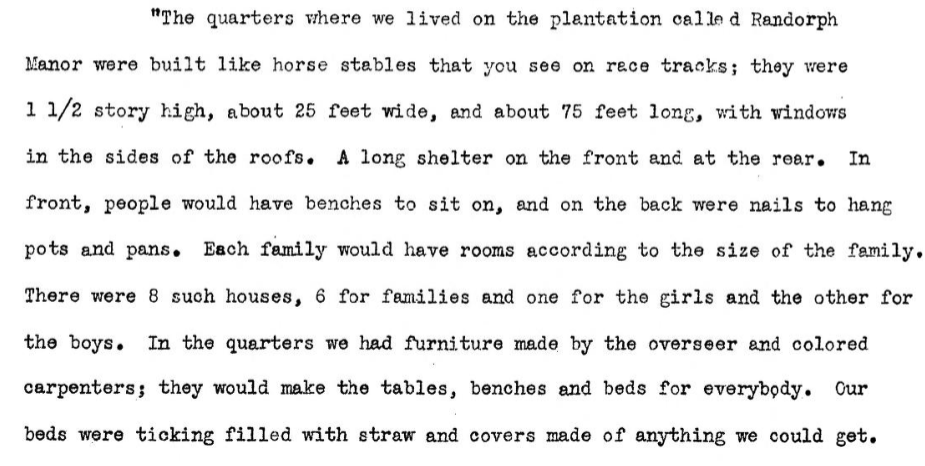
The “Black Landscape” Image 40 of Federal Writers’ Project: Slave Narrative Project, Vol. 8, Maryland, Brooks-Williams
l
This excerpt from, the Federal Writers’ Project: Slave Narrative Project provides, in former slave’s own words, how difficult it might be to slip away and play marbles, hold onto winnings, and build a cache without being observed.
So, caches were especially important to the Black children. They afforded a quite space for the children in what was all too often a tumultuous and dangerous place where they were powerless and had no control. Quiet agency is the subtle autonomy enslaved children exercised through marbles—choosing favorites, hiding caches, shaping shooters, and carving out protected spaces of play. These small acts reveal how children created identity, comfort, and belonging beneath the plantation’s surveillance architecture.
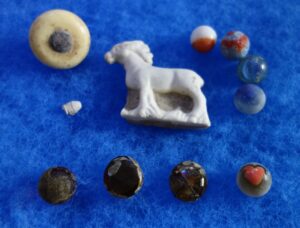
Children built caches quietly and in secret and the very process itself, not to mention the “treasures” themselves, gave Black children feelings of power and control.
Bits and Bobs
As we get ready to wrap it up, at least for now, we want to share a few snippets of information we learned along the way. Like the watermelon story we opened this post with, there are a few other things we learned.
- “Marbles were common toys amongst Black enslaved children and they were made out of a variety of materials. In fact, the report released by The National Archives of the United Kingdom expounds upon the story of Lindsey Moore, a young enslaved child. He “details a marbles tournament his master took him to where he competed against slave children from other plantations.[8]” We cannot imagine such a lenient “Marse”!
- “Adults did not need to be involved in the procurement of marbles because children had the ability to make and win their own. Because adults were not necessarily the ones providing boys with marbles, marbles had less of a direct role in the socialization of boys when compared to the role dolls and toy dishes played for girls. … The increase in the number of marbles does suggest that by the 19th century, boys were spending more time playing, as adults began to view play as intrinsic to childhood and important for shaping future adults[9].”
- Evidence from slavery-related sites in the Digital Archaeological Archive of Comparative Slavery (DAACS; see Suggested References… demonstrates that formal toys in the form of porcelain dolls, toy dishes, marbles, and military toys were not uncommon possessions for enslaved children in the American South. The recovery of formal toys in living quarters used by enslaved people is especially surprising given that their intended socialization messages did not align with the future gendered labor roles of enslaved children. These toys thus reveal the complicated socializing forces and messages about gendered labor that enslaved children encountered through play. [Emphasis Added]
Small Things: A Conclusion
It’s impossible to end a story like this one. Since there is so much more to say, we have added some references which will lead you in the right direction if you, like us, want to learn more.
Still, this story has confirmed a principle that we have come to appreciate more and more. A single marble can anchor an entire interpretive chain. It’s durable, portable, and unintentionally honest—an object that records touch, habit, and context without editorializing. When you recover one from an abandoned home’s yard, a school site, or a gravesite, you’re not just finding a toy; you’re locating evidence of human practice.
Marbles matter because they collapse distance. They link domestic life to trade routes, childhood play to community identity, and ritual placement to grief traditions. Marbles were instrumental in building social cohesion within the plantation community.
Marbles show how people used what they had, valued what they could carry, and expressed meaning through small, repeatable gestures. In regions like the Gulf Coast—where storms, soil, and time erase so much—these tiny artifacts become some of the most reliable witnesses we have.
They matter because they persist. And persistence is the archaeologist’s best friend. So, the next time you dig up a marble or find one where it was dropped or left generations ago don’t just look at seams, swirls, and ribbons. Look at the history, the secrets and the mystery that each little marble holds.
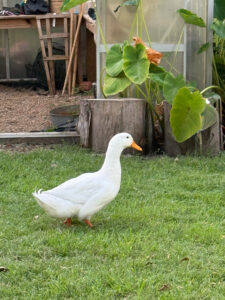
“Marbles” the Duck roams the grounds at The Myrtles St. Francisville, LA.
“We had many marbles & toys that poor children had, in that my favorite game was marbles.” Charles Coles, Ex-Slave. Image 7 of Federal Writers’ Project: Slave Narrative Project, Vol. 8, Maryland, Brooks-Williams
Suggested Readings
Baxter, June Eva. The Archaeology of Childhood Children, Gender, and Material Culture. Bloomsbury Publishing PLC @ The Archaeology of Childhood: Children, Gender, and Material Culture – Jane Eva Baxter – Google Books
Betti, C. (2022). “They Gave The Children China Dolls.” Toys, Socialization, and Gendered Labor on American Plantations” Journal of African Diaspora and Herritage. 11(2), 97-129.
Digital Archaeological Archive of Comparative Slavery @ Digital Archaeological Archive of Comparative Slavery – DAACS
Francis, B. “Gender, Toys, and Learning. Osford Review of Education, 36(3), 325-344.
Heath, B.J., Bennett, A. “The little spots allow’d them”: The archaeological study of African-American yards. Hist Arch 34, 38–55 (2000). https://doi.org/10.1007/BF03374312
Lee, Samantha Jane. The Archaeology of Enslaved Children in Antebellum America. PhD diss., University of Tennessee, 2024.
McKee, Larry. “The Archaeology of Slave Life in the Gulf Region.” In The Archaeology of Slavery and Plantation Life, edited by Theresa A. Singleton, 95–118. Carbondale: Southern Illinois University Press, 2015.
“Resource Pack—Objects of emotion and stories of feeling.” The National Archives UK @ https://www.nationalarchives.gov.uk/professional-guidance-and-services/our-research-and-academic-collaboration/research-events/research-routes/resource-pack-objects-of-emotion-colonial-legacies-and-stories-of-feeling/#heading-histories-of-enslavement-in-the-national-archives-collections-bcc06dc4-c733-4d5d-8cea-31374ab9975f 8/9/2026
The State Historical Society of Missouri. George P. Rawick Papers (S0630). Pdf
Upton, Dell. “White and Black Landscapes in Eighteenth-Century Virginia.” Places 2(2), 1984. PDF
References
- Please note that when we reference a source which uses vernacular then we do not attempt to change the text. You will find such vernacular in this story. Also, we use the term “Black” when referencing Black adults and children in a plantation community. We use “Black” because it feels more encompassing of the entire diaspora, including individuals from the Caribbean, South America, and Europe. ↑
- David K Wiggins, “The Play of Slave Children in the Plantation Communities of the Old South, 1820-1860.” Journal of Sport History, Vol. 7, No. 2 (Summer, 1980), page 27. See also Rawick, ed., Vol. XVI, No. 3, Maryland Narratives, p. 2 & Charles L. Perdue, Jr., Thomas E. Barden, and Robert K. Phillips, eds., Weevils in the Wheat: Interviews with Virginia Ex-Slaves, p. 84. George Philip Rawick (1929–1990) was a pioneering historian of American slavery whose work fundamentally reshaped the field. His scholarship centered on enslaved people’s own voices at a time when most histories still referenced privileged White owner planter records. Rawick is best known for editing the monumental 41‑volume The American Slave: A Composite Autobiography, drawn from the Federal Writers’ Project interviews of the 1930s. That’s right—41 volumes! The Library of Congress collection “Born in Slavery: Slave Narratives from the Federal Writers’ Project, 1936–1938” is the largest body of first-person testimony from formerly enslaved Americans. It contains over 2,300 interviews and more than 500 photographs, recorded during the New Deal by WPA fieldworkers. We have spent hours reading these interviews and highly recommend that you give them a look. @ Born in Slavery: Slave Narratives from the Federal Writers’ Project, 1936-1938 | Library of Congress 8/6/2026↑
- David K. Wiggins, Journal of Sport History, Vol. 7, No. 2 (Summer, 1980) The Play of Slave Children in the Plantation Communities of the Old South, 1820-1860. ↑
- Archaeological and museum records place Oriental Tooth Paste in the Victorian period, specifically circa 1850–1910. It was made & marketed by Jewsbury & Brown, 113 Market Street, Manchester, England. It was a soft dentifrice paste, packaged in ceramic pots with printed lids. ↑
- “Surveillance and Control on a Plantation Landscape” Monocacy National Battlefield @ Surveillance and Control on a Plantation Landscape (U.S. National Park Service) 8/5/2026 ↑
- “A panopticon is a place from which total surveillance of the surrounding area is possible; crucially, the panopticon at the same time obscures the presence or absence of an observer from those who may be observed. …Uncertainty about whether they were being observed at any one time …might lead them to monitor their behavior as if they were being watched even when, in actuality, [they were not being watched]. Archaeologists working at plantations have applied the idea of a panopticon to understand how an owner’s house or an overseer’s residence could act as an actual vantage point to surveil enslaved people while also suggesting the possibility of surveillance at all times, thus causing enslaved people to monitor themselves and participate in their own subjugation even when in reality they were unwatched by overseers or enslavers.” Lydia Wilson Marshall (2022) Slavery, Space, and Social Control on Plantations, Journal of African Diaspora Archaeology and Heritage, 11:1, 1-4, DOI: 10.1080/21619441.2022.2079251 ↑
- “10 Toys and Games Enslaved Black Children Played with Growing Up” Posted byBy Olivia | Published on: July 29, 2015 Atlanta Black Star @ 10 Toys and Games Enslaved Black Children Played with Growing Up 8/2/2026 ↑
- Betti, C. (2022). “They Gave The Children China Dolls.” Toys, Socialization, and Gendered Labor on American Plantations” Journal of African Diaspora and Herritage. 11(2), 97-129 ↑