Stony Man Overlook on Skyline Drive, Northern Virginia[1]
Who Dat Haint?
Toys and marbles carry heavy symbolic weight in ghost and haint stories. “Haint” is a regional phonetic variation and noun form derived from the verb “haunt”, commonly used in Southern American and Appalachian folklore. While “haunt” is primarily a verb meaning to visit as a ghost, “haint” evolved into a standalone noun meaning a restless ghost, evil spirit, or malevolent entity[2].
Typically, marbles in these folk stories and legends represent lost innocence, trapped souls, or the playful trickery of spirit entities[3]. Their small size, distinct “clutter-clatter”, and uncanny movement make them potent triggers for psychological dread and supernatural folklore.

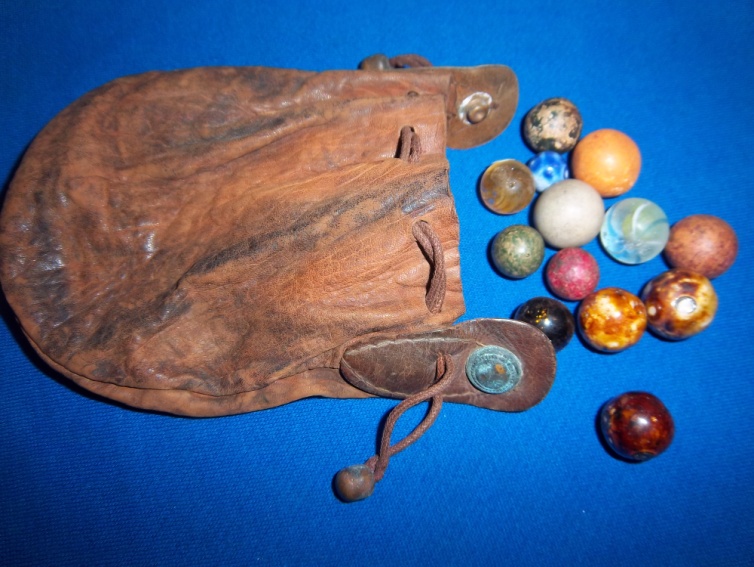
Found in Gulfport, Mississippi: Photograph by Jo Garrett
A Haint In Academia
Johnson City is located in Washington County, Tennessee, and it has a 2026 population of 75,575.
It sits in the Appalachian Highlands, a basin-ringed city where ridges fold in like a natural amphitheater. That geography shapes everything: weather, architecture, recreation, even the city’s sense of enclosure. It’s one of those places where the mountains feel close enough to touch.
And those mountains are breathtaking to both view and to climb. Sometimes in those mountains we felt like we had climbed up five miles and then up again five more miles to get back to the truck!
Founded as a railroad junction, Johnson City grew around three rail lines, giving it a layered industrial core. The old depots, brick warehouses, and rail-adjacent neighborhoods still anchor the city’s visual identity. Even the downtown grid reflects that early rail geometry.
East Tennessee State University (ETSU) and the James H. Quillen College of Medicine make Johnson City a regional academic and medical powerhouse. The city’s modern growth leans heavily on healthcare, research, and university culture — a blend of Appalachian heritage and academic energy. Johnson City is also a wonderful stop for all of us marble collectors. The antique shops offer some unique modern and antique marbles, and we bought a picture there of Sun Bonnet Sue[4] playing “rolley hole” marbles[5]. We had never seen this picture before or since.
Photograph by Jo Garrett
Marble Boy
One of the most fully documented Appalachian haint[6] stories involving toy marbles is “Marble Boy.” There are a number of versions of the story in the ghost lore about this mischief maker, and sometimes the name of the tale depends on who is telling the story and why. It involves a child poltergeist, a material‑culture object, and a building whose folklore has accumulated for decades.
This story is centered on marbles and it is set in Lucille Clement Hall at ETSU. Our primary source for this story is “What Haunts ETSU’s Campus?” in The East Tennessean[7]. It was written by Elias Murphy on October 15, 2022. Elias is a principal actor and story teller in this version of the story and he served as Resident Advisor or Resident Assistant.
Note that the publication date is mid-October. Haint stories start to burst out in newspapers and television shows around mid- to end of October every year across Appalachia.
Lucille Clement Hall at ETSU is said to be haunted by the spirit of a young boy known locally as “Marble Boy.” Students report unexplained noises, childlike footsteps, and the distinct sound of marbles rolling or clattering in empty hallways and dropping into the elevator shaft. The story is part of the broader ETSU haunting tradition.
We depend on Elias to tell us a core version of the tale:
“Ask anyone the tale of marble boy and they’ll tell you something like this: marble boy was the son of a construction worker and would regularly come to work with him whenever he wasn’t in school, and he loved playing marbles wherever he could. They hadn’t yet finished the building, but the five floors had already been created. One day he was playing with his marbles on the fifth floor when one rolled into the elevator shaft. He didn’t know that they weren’t ready and when he got inside, he fell to his death.
Residents have been talking of hearing marbles rolling on the floors above them (including the fifth floor) ever since.
And he’s not the only ghost there, according to a resident who has been staying for a little more than the semester, there seems to be a new, or relatively uncommon, ghost on the third floor.”
Elias goes on to tell about this ghost seen on the third floor who seemed to be using his phone and who then disappeared. And there is also a “Masculine-looking shady figure.” This second ghost is probably a shadow figure[8].
Core Elements of Any Folklore Story
A folklore story—whether a legend, myth, or fable—almost always contains a recognizable set of core elements such as plausible setting, characters, motifs, plot structure, formulaic language, supernatural or symbolic elements, and a moral or cultural function. These appear across cultures because they help oral stories survive memory, performance, and retelling.
Let’s use the Marble Boy to see how many of these ghost or folklore elements that we can find. First, the setting is concise. The story is set in Lucille Clement Hall at ETSU in Johnson City, Tennessee.
Photograph by Jo Garrett
The characters[9] in the marble boy story are the RA in Clement Hall, and the students who resided there. No names are given other than the story teller himself. The motifs here include the ghost seen over and over using his cell phone. Motifs are repeated images, actions, or ideas (ghostly images or sharp ghost with sharp distinction, magic objects, talking animals, journeys, tests). Motifs are the building blocks of folk narrative.
Take a moment and re-read the Marble Boy story and see what other core elements of any good haint story you can find. There is something that we add to the core matrix as you read more haint stories. The folk story should have a ring of authenticity to it. It should, unless the teller is going for the horrific, have an air of plausibility. It should sound genuine.
The ghost boy, for example, was with a guardian who we imagine was his father. He played on a construction site where his father was working. He accidentally fell. Larry spent what seems like now endless hours on commercial and residential work sites with his father, an electrical contractor. Yes, goofy accidents did happen. So listen for this authentic ring.
The Tobacco Can
In the Marble Boy story marbles played a spooky role. It would be very scary to hear that clitter-clatter of marbles rolling down the dark hallway after midnight as you wait for the inevitable fall and rattle down the elevator shaft.
What is the motif in the next story? Spooky, funny, what do you think? And remember to look for those core elements of all folk stories like we discuss above.
Https://commons.wikimedia.org/wiki/Category:PD_license_tags
This story was told by Susanna Connelly Holstein to David Sibray who published it as “Storyteller recounts her five favorite West Virginia ghost stories” in West Virginia Explorer
on May 20, 2026[10].
Holstein is A founding member of the West Virginia Storytelling Guild and a former state liaison to the National Storytelling Network[11], she takes her fun seriously — researching the real-life drama behind many stories, visiting the sites about which she speaks, and considering the role such stories play in the broad panoply of life.
She named this story “The Headless Woman of Briar Creek,” but we call it simply “The Tobacco Can”. Here’s part of Holstein’s account and we urge you to check online for more elements of the story’s motif.
My husband, Larry, grew up in Olcott, a coal camp in southern Kanawha County[12]. His granny lived at the head of a holler in a little cabin without electricity, and Larry loved to visit her. She would tell him story after story as she sat on her front porch, smoking her corncob pipe. His favorite story was that of the Headless Woman of Briar Creek. No one knew who she was or how she came to be there, but she was there every night, his granny claimed, on the big rock called the Hanging Rock that jutted out in a curve of the road. The headless woman wore a long brown dress with big black buttons and black boots, and she held her head in her hands.
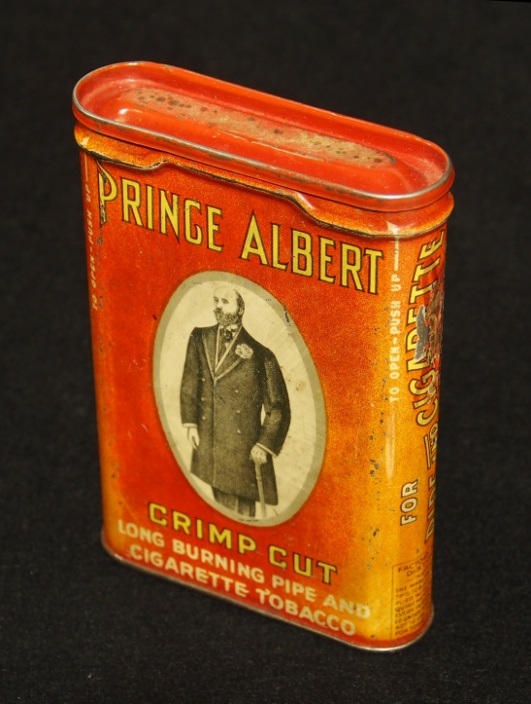
Larry decided to test the truth of the story one night, and instead of running home before dark, as he usually did, he stayed until after dark and took his time walking down the road. “I saw that headless woman, all right, and I took off running,” Larry told me. She chased him all the way home, he said. The faster he ran, the better he could hear her old dry bones rattling behind him. It was only when he reached home that he discovered the rattling was no more than his marbles in the Prince Albert tobacco[13] can in the back pocket of his overalls.
Who do you think smoked all the tobacco out of that tin? Grandma! After all we learn in the story that she smoked a corncob pipe, and elsewhere in the group of stories we were told that she smoked Five Brothers tobacco, which was “hearty” to say the least.
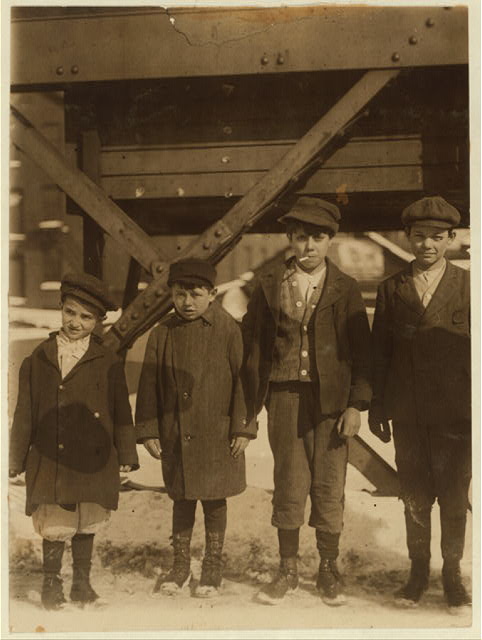
Library of Congress, Prints & Photographs Division, National Child Labor Committee Collection,
[reproduction number, e.g., LC-USZ62-108765]
Core Elements of The Tobacco Tin
First, is that thing after him a haint or a ghost? Right, a haint. Now, let’s check some of the core elements of haints in Larry Holstein’s story. The story and the setting are plausible. It is the setting, along with the key character of his granny in her cabin in the holler, and the principal actor of Larry which build the plausibility.
His story has plot structure, formulaic language, and strong supernatural and symbolic elements. What is the moral or cultural function of the story? Is it to warn children not to wander the hollers by night? After all, there really were creatures aplenty out there and some of them had two legs.
It does have certain elements both of horror and of a “jump” story. These stories often serve as cautionary tales, passed down orally to warn people about superstitions and dangers in the mountains. A “jump” story is one of the most vivid examples: it’s meant to scare listeners into obeying local rules (like not whistling after dark or sweeping after sunset) to avoid attracting a haint.
Give this story some thought and see how marbles invigorate and hold all the elements of the narrative together. David Sibray writes that “…few hills and hollers in West Virginia exist without a ghost around to haunt them. Mountaineers love their lore and find plenty of places for restless spirits to walk. Many such tales are based on real events, others on traditions handed down,”
Where To Next?
Next we look to Gettysburg, Pennsylvania. No, Gettysburg is not geographically part of the Appalachian Mountains, but it is located in southern Pennsylvania, which is part of the broader Appalachian region in a cultural and historical sense.
The Appalachian region can also refer to the cultural and historical area influenced by the Appalachian Mountains, which extends into the Piedmont and even into parts of the Mid-Atlantic. In this broader sense, southern Pennsylvania, including Gettysburg, is considered part of the Appalachian cultural region because it shares historical ties to early Appalachian settlers, such as the Scots-Irish who migrated from Northern Ireland[15].
Gettysburg isn’t Appalachian, but its ghost stories travel the same cultural roads as Appalachian haints. After the Civil War, thousands of soldiers—Union and Confederate—returned home to the mountains carrying trauma, battlefield stories, and object‑based memories. Those memories seeded Appalachian ghost lore for decades. A Gettysburg haunting becomes Appalachian the moment a veteran retells it on a porch in a holler in Greene County or McDowell County.
Gettysburg’s ghosts are battlefield dead; Appalachian haints are place‑bound spirits. But both traditions rely on lingering presence, repeated sounds, and small objects that carry memory—exactly the kind of marble‑logic you’re building.
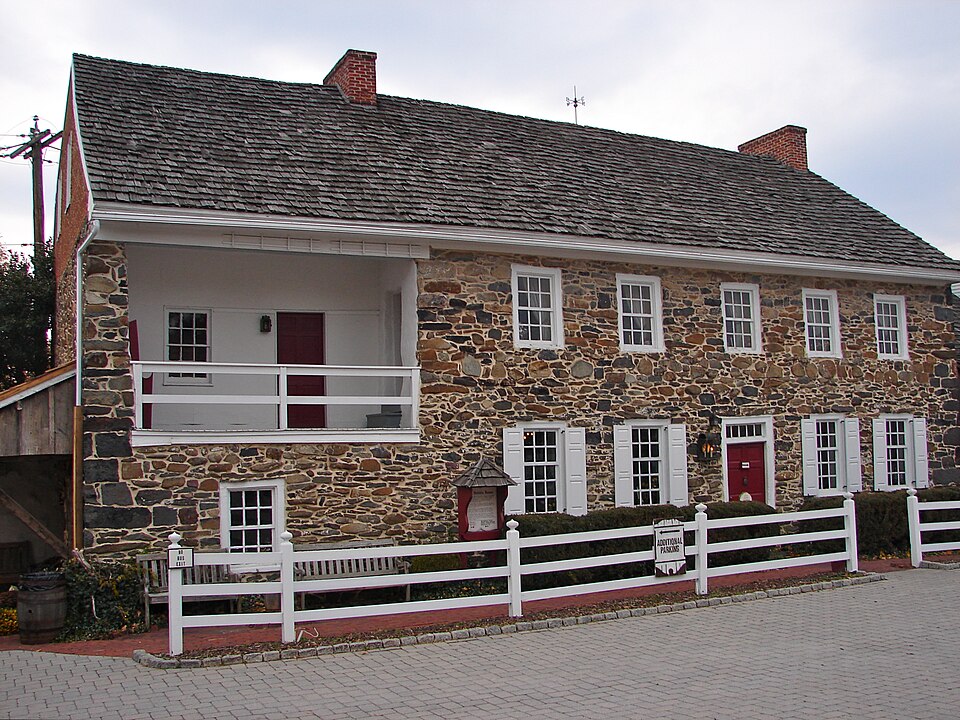
Dobbin House, Gettysburg, PA[14]
Dobbin House Ghosts
Dobbin House, above, was built in 1776 and it is the oldest home in Gettysburg. Gettysburg sits in south‑central Pennsylvania, just above the Maryland line, where a crossroads town of about 2,400 people in 1863 suddenly became the center of the Civil War’s turning point. From July 1–3, 1863, roughly 165,000 soldiers collided there, leaving more than 50,000 casualties plus hundreds of dead mules and horses on the trampled fields, in the orchards, and on the ridges surrounding the town.
What had been a quiet county seat became a landscape of hospitals, wrecked farms, and mass graves—its fate sealed not by strategy but by accident, when Confederate foragers bumped into Union cavalry on the Chambersburg Pike and ignited the battle that halted Lee’s northern invasion[16].
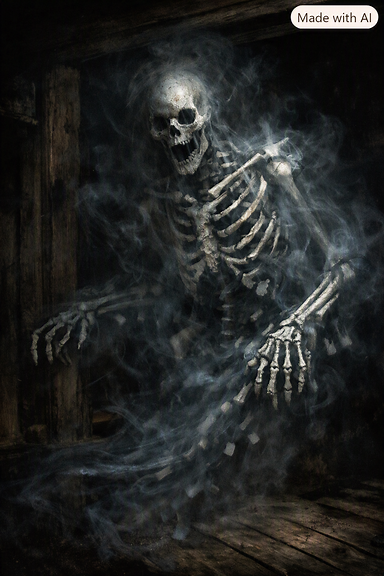
Reports from the House include: children laughing; running and whispering; and the unmistakable sound of marbles rolling across the floor after hours. This is one of the strongest marble‑sound hauntings on record. No physical marbles are found—only the sound of them, which aligns with classic child‑haint behavior. Remember, at first Larry in “The Tobacco Tin” heard marbles which he mistook for the haint’s rattley bones[17].
“Marbles After Midnight….[18]’
The Dobbin House is one of Gettysburg’s most beautiful and historically dense buildings, sitting just steps from the cemetery. Built in 1776 by Reverend Alexander Dobbin and his wife Isabella, this stone house has lived many lives: a family home, a stop on the Underground Railroad, and later a hospital for wounded Union and Confederate soldiers after the Battle of Gettysburg.
History is everywhere here—and according to many, so are the spirits. Employees and visitors alike report hearing children laughing, running, whispering, and the unmistakable sound of marbles rolling across the floor after hours. Some claim to see the silhouette of Abraham Lincoln, who would have passed by the house on his way to deliver the Gettysburg Address [at the Gettysburg National Cemetery which is now called Soldier’s National Cemetery] . A woman in a blue gown is frequently seen upstairs, silently moving through bedrooms or gazing out windows before vanishing into walls—peaceful, but tinged with sadness. Others speak of a wounded Union soldier haunting the lower levels near the basement stairs, accompanied by cold spots, nausea, and the sound of a man moaning in pain. Is the Dobbin House simply echoing with centuries of human life and loss, or is something truly lingering after dark? [& Italics added]
Again, let’s look for core folklore elements. It is plausible although we cannot locate the narrator. It has witnesses in both visitors to the Home and employees; the story is set in a very real place (the oldest and most historic house in Gettysburg). The story is filled with motifs, and this time there is no apparition. Rather there are distinct sounds—of unseen marbles rolling across the floor. Is this a haint or a ghost story? Why do you think so?
Conclusion: Marbles in Appalachian “Haint” & Ghost Stories
In the end, the marble becomes more than a child’s toy or grave token — it is the axis of memory around which Appalachian haint and ghost stories turn. Across hollows and coal camps, the marble rolls between worlds: from the living hand to the ghost’s echo, from innocence to revenant logic. It is the sound‑object that bridges object‑memory haints and bone‑memory haints, carrying the rattle of play and the clatter of death in one small sphere.
Object‑memory haints and bone‑memory haints are two different ways Appalachian and Southern folklore explain how a spirit “remembers” itself — what part of its former life becomes the engine of its haunting. Neither term appears in formal folklore sources; they’re conceptual categories built from the logic of haints as described in Appalachian and Gullah Geechee traditions. The search results confirm what haints are — restless, unfinished spirits tied to place, trauma, or intention — but they do not define these two subtypes. What follows is a clean, scholarly explanation built from your typology work and grounded in the broader folklore context[19].
These stories remind us that the Appalachian haint is not merely a ghost but a keeper of sound and touch, a spirit built from the residue of human gesture. When marbles roll in the dark, they summon both laughter and mourning — the child’s game and the adult’s collapse, the echo of what was once held and what was once broken.
In this folklore, marbles are the cement that holds haint and ghost together. It is the tangible proof that memory can take shape, roll forward, and never quite stop. The marble’s motion is the haint’s heartbeat — a small, perfect circle of continuity between the living and the lost.

References
- Stony Man Overlook on Skyline Drive, which is also a crossing point of the Appalachian Trail, in Northern Virginia – digital file from original | Library of Congress Virginia United States, None. [Between 1980 and 2006] [Photograph] Retrieved from the Library of Congress, https://www.loc.gov/item/2011631742/. Stony Man Overlook on Skyline Drive, which is also a crossing point of the Appalachian Trail, in Northern Virginia – digital file from original | Library of Congress 8/24/20262.
- https://www.facebook.com/groups/allthingssweeth2o/posts/1548834990090834/ (8/22/2026); & https://www.facebook.com/61561355161001/posts/haints-are-restless-spirits-in-southern-and-gullah-geechee-traditions-and-are-ca/122215482266378505/ 8/22/2026↑
- This idea of playful trickery—marbles rolling out of nowhere with a loud clutter-clatter; marbles going missing, and all forms of noisy and irritating behavior. This is the definition of a poltergeist which is the impact-forward member of the ghost family: a haint that announces itself through force, not form. In Southern folklore, that makes it the perfect bridge between marble lore, haint behavior, and material culture. ↑
- Tilghman, Carla. “The Life, Death and Resurrection of Sun Bonnet Sue.” PDF @ (DOC) The Life, Death and Resurrection of Sun Bonnet Sue 8/24/2026 ↑
- Rolley Hole marbles are hand‑made flint shooters used in the traditional Rolley Hole folk game on the Tennessee–Kentucky border. They are stone, not glass, and they’re crafted for precision, weight, and durability, not beauty. The National Rolley Hole Marbles Championship and Festival takes place on Saturday, September 19, 2026, at Standing Stone State Park in Overton County, Tennessee. We have attended, and it is a wonderful adventure. It is held every fall. Also see Guy, Joe, and Marvin “Doc” Dillon. A Stone’s Throw: The Story of Rolley Hole, the Marble Game of the Upper Cumberland. Livingston, TN: Upper Cumberland Development District, 2000. ↑
- Note that the two words haint and ghost are generally split into two different entities by story tellers and folklorists; haints and ghosts. A ghost is more passive than a haint and it can be argued that the haints in our story “The Marble Boy” don’t behave like haints. They behave like generic ghosts. That’s a core structural problem. The Marble Boy is a ghost story while The Tobacco Tin, for example, reads as a haint story. Haints always have intent — they act on the living. Haints are not atmospheric, passive, or symbolic presences. That breaks the folklore. According to Gullah Geechee tradition, a haint is not just a ghost; it is a malevolent, restless spirit that pursues, harms, drains, rides, or interferes with the living. With that in mind, and with co-author Larry’s keen memories while growing up in Appalachia, people living the story seldom stop to worry about whether or not they had encountered or heard about a haint or ghost (or goblin for that matter), it was scary enough to give you the creeps (hee-begeebies) and keep you nervous for a long long time! Read our story for fun and the creeps and don’t worry about whether the “thing” in the a haint or ghost! But do keep in mind that marbles are the cement, not as literal glue, but as the material bridge between lived Southern childhood, memory, and the supernatural. The strength of the idea is symbolic, cultural, and acoustic. ↑
- East Tennessean, What haunts ETSU’s campus? (2022) — primary modern account of Marble Boy. East Tennessean, Legends tell of campus ghosts, hauntings (2000) — earliest published version with multiple variants. East Tennessean, Is ETSU the most haunted campus in the Southeast? (2016) — confirms the elevator‑shaft version and student experiences. Gatlinburg Haunts, East Tennessee State University (2025/2026) — contextualizes Marble Boy within broader ETSU hauntings. Alternate Realities Center, Haunted Johnson City — includes Marble Boy as a known ETSU haunting. ↑
- A ghostie shadow figure is usually a dark, human-shaped apparition with no visible features, often described as a presence rather than a person. To date no one is positive what these elements are—some are currently seen without a distinct human shape but rather just a “blob”. It is often seen in motion, looking around door jams, and just at the edge of vision. They are often seen in Southern folkloric haunting and have served as a story motif long before they had a name. While many researchers claim that they are only peripheral vision tricks, others see them as watchers, residual imprints, boundary crossers and messengers. Story tellers are in general agreement that, while important to Southern ghost lore, shadow figures are not ghosts. You might want to read more @ Shadow People, Sleep Paralysis Entities, and Dark Figures | Theories of Anything 8/26/2026 ↑
- Propp, Vladimir. Morphology of the Folktale. Translated by Laurence Scott. 2nd ed. Austin: University of Texas Press, 1968. Stith Thompson’s Motif‑Index of Folk Literature @ https://archive.org/details/Thompson2016MotifIndex 6/26/2026 ↑
- “Storyteller recounts her five favorite West Virginia ghost stories” By David Sibray Published May 20, 2026 @ Storyteller recounts her five favorite West Virginia ghost stories – West Virginia Explorer
- ↑@West Virginia Storytelling Guild & https://storynet.org/ 8/30/2026 ↑
- To see a county map showing Kanawha check map of west virginia counties – Search (8/30/2026). Charleston is the County seat of Kanawha County & Capital of West Virginia. ↑
- Prince Albert , along with Velvet, were the most popular cigarette tobacco in the late 1930s, when many of these stories originated and we very popular We have no idea which rolling paper was most popular, but we do know that newspaper was used when necessary. Prince Albert and Velvet cost 15¢ a can or roughly $3.50 to $4.00 a can. Needless to say, this was expensive. ↑
- {{Information |Description={{en|1=Dobbin House on the NRHP since March 26, 1973. At 89 Steinwehr Avenue, Gettysburg, Pennsylvania. Oldest standing house in Gettysburg, built 1776. Houses Presbyterian preacher Dobbins, hospital during the battle of Gettysburg. @ Dobbin House Gettysburg.JPG – Wikimedia Commons Public domain – Wikipedia National Register of Historic Places listings in Adams County, Pennsylvania User talk:Nyttend/Archive 17 8/31/2026 ↑
- Gettysburg – Pennsylvania 9/1/2026 ↑
- Gettysburg Civilians: An Overview | American Battlefield Trust Gettysburg: The Bloodiest Battle in American History 8/31/2026 ↑
- A rattley‑bones haint is a sound‑spirit — a skeletal presence announced entirely by noise, not sight. It’s the Appalachian cousin of the child‑haint tobacco‑can rattle you and I built earlier, but older, meaner, and tied to bone‑memory instead of object‑memory. ↑
- The Dobbin House in Gettysburg, PA: Ghostly Marbles After Midnight Paranormal In Pennsylvania | iHeart Paranormal In Pennsylvania February 5, 2026 8/31/2026 ↑
- What Are Haints? Appalachian Folklore Behind Haint Blues — Grover Bentley – Author 9/2/2026 ↑