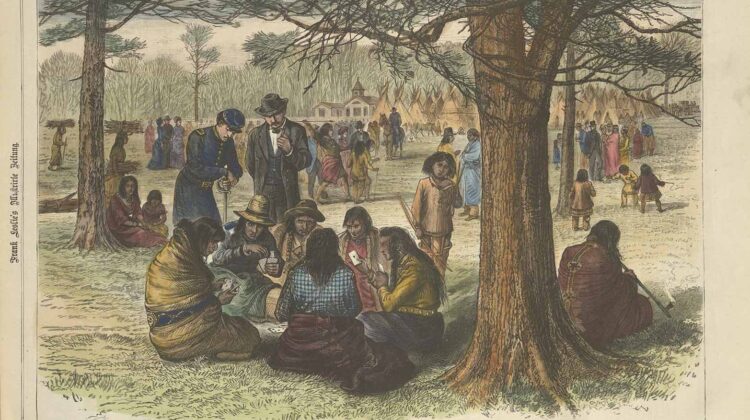
“Illustration of captured Nez Perce Indians at Fort Leavenworth” KU Libraries Exhibits,
accessed October 16, 2026, https://exhibits.lib.ku.edu/items /show/8874. Courtesy of Spencer Research Library, Lawrence. KS
When many of us hear “Fort Leavenworth” we think of the military prison which has been a part of the Fort since 1875. However, the prison is in reality The United States Disciplinary Barracks (USDB), colloquially known as Leavenworth[1], a military correctional facility located at Fort Leavenworth. The Fort is in Leavenworth County, in the Missouri River Valley, Kansas.
USDB is one of two major prisons at Fort Leavenworth, the other being the Midwest Joint Regional Correctional Facility, which opened on 5 October 2010. Together the facilities make up the Military Corrections Complex, which is under the command of its commandant.
Although Fort Leavenworth is often associated with its military prison, the prison represents only a small part of a much larger frontier community. The marbles recovered by archaeologists speak not of incarceration but of family life, childhood, and of the pursuit of normality at one of the nation’s principal gateways to the West.
…But Fort Leavenworth Is So Much More
“Colonel Henry Leavenworth and the 3rd Infantry Regiment established Fort Leavenworth on bluffs along the west bank of the Missouri River in 1827. The U.S. Army built the fort to protect settlers and merchants traveling along the Santa Fe Trail. Throughout the nineteenth century, Fort Leavenworth played a significant role in furthering U.S. westward expansion, providing crucial support during the Civil War and other armed conflicts, and implementing the federal government’s policies regarding indigenous peoples.
Fort Leavenworth is the oldest permanent settlement in Kansas, the oldest active military base west of the Mississippi River, and one of the oldest continuously active military bases in the United States.[2]”
Marbles On The Frontier
Fort Leavenworth and trails west is not the first Western Fort and route that we have explored through archaeological and anecdotal research for marbles. Archaeologists have recovered marbles from forts separated by hundreds of miles and serving very different purposes. At Fort Vancouver on the lower Columbia River, marbles appeared amid one of the most important trading centers in the Pacific Northwest.
At Fort Hoskins, established during the aftermath of the Rogue River conflicts, marbles emerged from deposits associated with families living alongside soldiers. At nearby Fort Yamhill, another outpost of frontier administration, small glass and clay spheres surfaced among the ordinary debris of daily life. Far to the east, at Fort Leavenworth, gateway to the Santa Fe, Oregon, and California Trails, archaeologists uncovered marbles from contexts linked to officers’ quarters and family occupations.
The history of Fort Leavenworth fills shelves of books. Here, however, our interest lies not in generals or campaigns, but in the fragments of daily life left behind in the soil. Few discoveries are more evocative than children’s toys recovered from archaeological deposits, for they transform a military post into a community and a frontier outpost into a home.
Established in 1827, Fort Leavenworth became the Army’s principal gateway to the trans-Mississippi West. Situated on the Missouri River, it occupied a strategic position at the threshold of the Great Plains and served as a major supply depot and staging point for military expeditions, emigrants, traders, and freight companies moving toward the frontier[3].
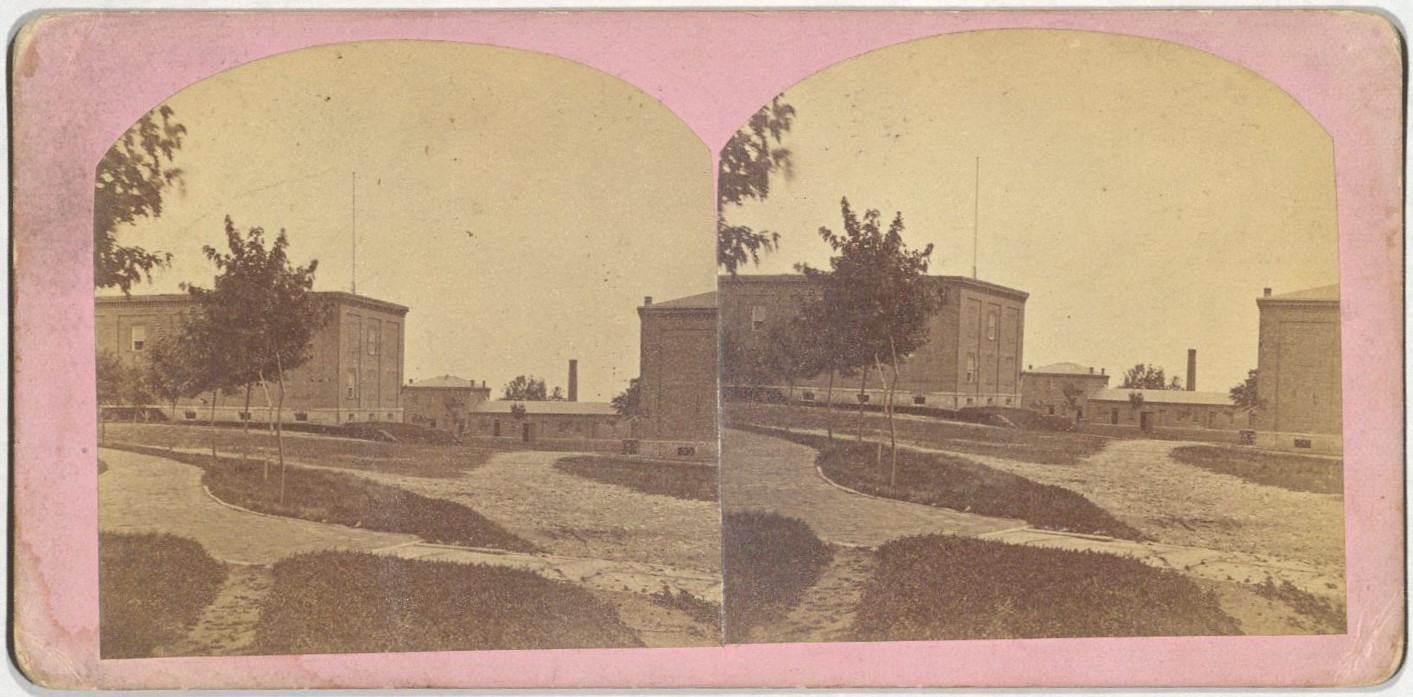
Arsenal buildings, undated [circa 1870-1880]. Photo by E. E. Henry. KU Libraries Exhibits,
accessed October 19, 2026, https://exhibits.lib.ku.edu/items /show/8874. Courtesy of Spencer Research Library, Lawrence. KS
The fort stood near the convergence of several of the great overland routes that carried Americans westward during the nineteenth century. Although not itself a trail terminus, Fort Leavenworth was closely associated with traffic moving along the Santa Fe Trail, Oregon Trail, California Trail, and other western migration corridors.
Wagon trains frequently provisioned in the vicinity. We are confident that marbles were, sometimes, among those provisions. Military escorts departed from the post to protect travelers and trade routes. The installation became a critical logistical hub in the vast transportation network linking the Missouri Valley with the frontier beyond[4].
Archaeological investigations conducted throughout Fort Leavenworth have documented numerous nineteenth-century building sites and occupation areas dating to the fort’s earliest decades. Excavations revealed subsurface features, domestic deposits, and artifact assemblages associated with soldiers and civilian residents. These materials provide a rare glimpse into everyday life at one of the nation’s most important frontier posts[5].
Among the small finds typical of such military communities are marbles. Archaeologists regard marbles as some of the most common toys recovered from nineteenth-century North American sites. Their appearance at frontier forts reflects the presence of children and family life within military settings. Whether made of clay, stoneware, porcelain, or glass, marbles tell stories rarely recorded in official military reports: children playing between quarters, games unfolding in dusty yards, and families building ordinary lives on an extraordinary frontier[6].
At Fort Leavenworth, every marble recovered from the ground offers a counterpoint to the grand narratives of western expansion. While wagon trains rolled toward Washington, Oregon and Santa Fe, and while soldiers marched and rode out onto the Plains, children knelt in the dirt and played games familiar to generations before and after them. The marbles they lost became small archaeological witnesses to the human side of America’s westward movement.
The Archaeology of Normal
Historians often describe frontier forts in terms of battles, troop movements, and westward expansion. Children experienced them differently. Archaeologists have spent the last forty years moving away from studying only forts, battles, and famous people toward studying daily life, households, children, play, and ordinary experiences[7].
Photograph by Jo Garrett
To a child growing up at Fort Leavenworth in the 1840s, 1850s, or 1860s, the fort was not principally a military installation nor a hub to the far west. It was home.
The parade ground was a place to run. The roads were paths to friends’ houses. Officers’ quarters and enlisted family residences formed neighborhoods. School, chores, games, pets, and friendships filled the days just as they did in towns throughout the United States.
When archaeologists recover a marble from a military post, they recover evidence of normality. The marble suggests that, despite the surrounding uncertainty of frontier life, children attempted to create a world that felt stable and familiar. They played games inherited from previous generations. They competed, traded marbles, argued over rules, and searched for lost shooters in the dirt.
For the child who dropped it, a marble was not an artifact. It was simply part of an ordinary afternoon.
Courtesy of Spencer Research Library, Lawrence. KS
The Nez Perce Illustration
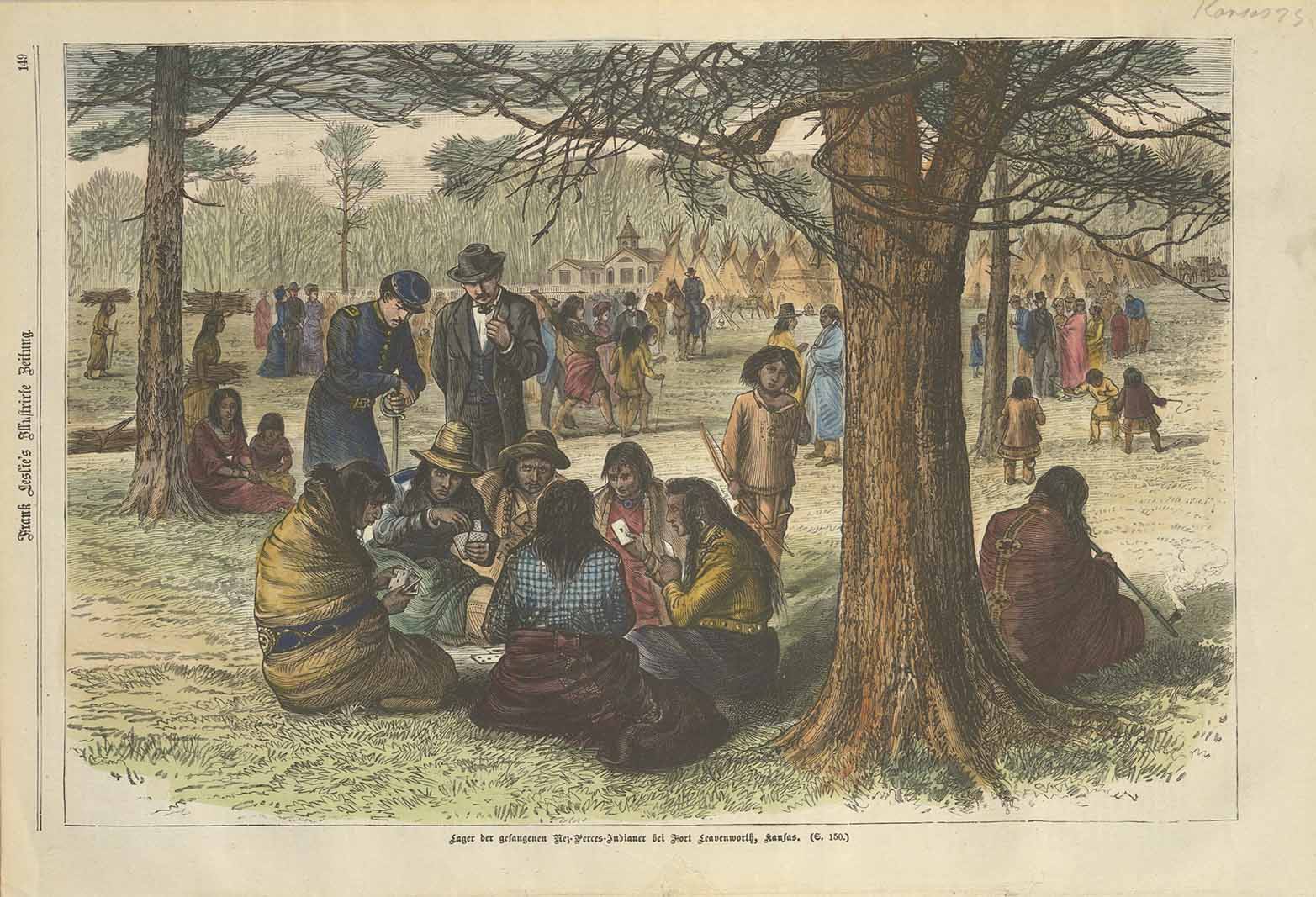
To see a remarkable example of “Normal,” as we introduce the concept in The Archaeology of Normal, study our feature photograph which illustrates a group of Nez Perce prisoners. This illustration…
…is clipped from Frank Leslie’s Illustrated Newspaper, February 23, 1878, page 425. The caption reads, “Kansas – the Nez Perces prisoners, captured by General N.A. Miles, amusing themselves in their temporary village on the old race-course, near Fort Leavenworth. – From a sketch by F.J. Howell, Leavenworth.” [Emphasis added][8]
After the Nez Perce War of 1877, the band led by Chief Joseph surrendered near the Bear Paw Mountains in Montana, only a short distance from the Canadian border. It was at this surrender that Joseph delivered the words later remembered as, “I will fight no more forever.[9]”
Rather than being returned, or being allowed to return, to their homeland in present-day Oregon, Idaho, and Washington, roughly 400 Nez Perce men, women, and children were transported by rail to Fort Leavenworth, Kansas, as prisoners of war in late 1877.
What Happened To Members Of The Band at Leavenworth?
The Nez Perce, who called themselves The People (Nimiipuu), were not housed inside the fort’s main barracks. Instead, the Army established a camp near the Missouri River, on the site of a former racetrack, where more than a hundred tents were erected for their confinement[10].
For about eight months, from late 1877 into 1878, the Nez Perce lived there under military guard. Orders regarding guard details and oversight of the prisoner camp survive in archival records from Fort Leavenworth[11].
The “normal” established by the First Americans in the camp on the old race course is not the Nez Perce’s traditional way of life. But the image is fascinating. It is one of those rare contemporary glimpses suggesting daily activities continuing despite captivity.
It is an image of resilience and strength. The illustration contains visual clues about: camp layout—note the tents in the background; children—one holds a bow and arrow while others play in a group; games including the adults playing a card game; domestic activities such as a mother and child together; social interaction; and the effort to maintain ordinary life under extraordinary circumstances. Finally note how casual the guard and civilian are as they observe the card game.
While this illustration contains many elements of the archaeology of normal, we cannot claim it as such. We have not found an archaeological report for the Nez Perce camp itself.
We do not know if the site has been dug. We have no idea how much evidence of the normal we would find here since the cards are ephemeral, the bows and arrows may not stand the test of time, and so on. Still, we believe it would be a fascinating dig[12].
After about eight months at Leavenworth, the survivors were removed to the Indian Territory in present-day Oklahoma rather than being returned to Idaho or Oregon. Conditions there were also difficult, and additional deaths occurred from disease and climate-related hardships.
Why Marbles Mattered
Adults viewed Fort Leavenworth as a gateway to the American West. Soldiers departed for patrols; supply trains rolled toward distant post; and emigrants passed on their way to Oregon, California, and Santa Fe. Yet children living at the fort often perceived a very different world.
Most military children were not thinking about national expansion or military strategy. Their concerns were immediate and familiar: finding friends, avoiding chores, attending school, and discovering places to play. The fort’s walls, roads, stables, and open spaces became the geography of childhood. What adults regarded as a frontier outpost, children transformed into a neighborhood.
This is why marbles matter. Archaeologists recover military equipment because forts existed to support military missions. They recover marbles because life continued between those missions. A lost marble reflects a child expecting tomorrow to be much like today. It represents routine and normal rather than crisis.
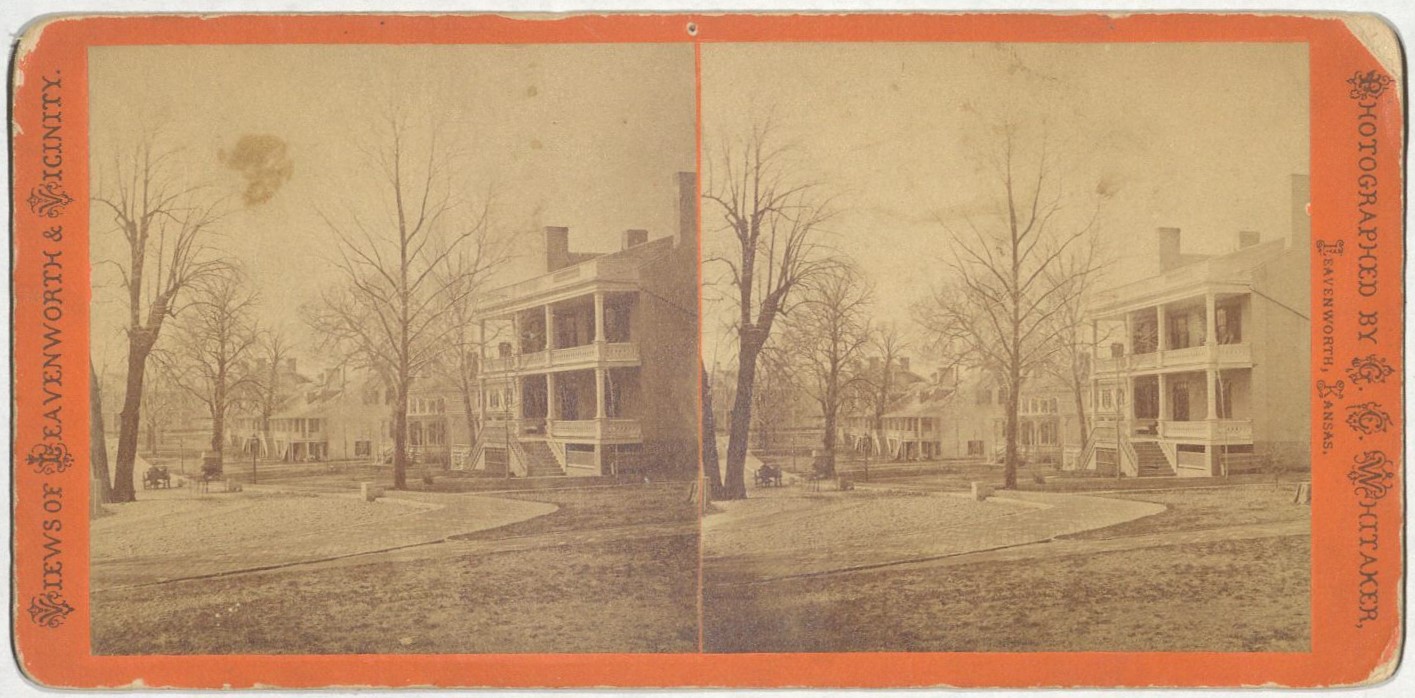
North side view of the garrison, from Whitaker’s Birds-Eye Views of Leavenworth from the Tower of the New Court House, Summer of 1874.
Photo by E. E. Henry. KU Libraries Exhibits, accessed October 19, 2026, https://exhibits.lib.ku.edu/items /show/8874. Courtesy of Spencer Research Library, Lawrence. KS
The children of Fort Leavenworth lived amid dramatic historical events, but they sought the same comforts children seek everywhere. They played games, formed friendships, and established daily rhythms that made an uncertain place feel secure. The act of shooting marbles across a dusty yard helped convert a remote military post into something more meaningful: home.
In that sense, the greatest significance of a marble from Fort Leavenworth is not that it was lost on the frontier. It is that its owner probably never thought about living on the frontier at all. To that child, the fort was simply where life happened. The marble reminds us that even in places remembered for movement, conflict, and expansion, children were striving for something remarkably ordinary: normal life.
Marbles Dug At The Fort
Fort Leavenworth is one of those places where marbles appear not as isolated curiosities, but as part of a richly documented military community.
Archaeological investigations at the fort have recovered nineteenth-century domestic artifacts from officers’ quarters, enlisted men’s areas, dumps, and building sites dating back to the 1830s. The formal reports describe extensive nineteenth-century artifact deposits from fort occupations, providing the sort of contexts where children’s toys, including marbles, are commonly encountered on military posts of the period[13].
Photograph by Jo Garrett
Diggin’ Holes
To substantiate the archaeology of the Normal evidenced at Fort Leavenworth, we rely on the archaeological report “Phase II Archaeological Investigations At Fort Leavenworth, Kansas.” Principal Investigators were Mark J. Wagner and Michael J. McNerney. The report has five authors. The 402 page report was prepared for the Kansas City District Corps of Engineers in June 1993.
This report is difficult to read in part because of the quality of the 1993 typing and the photocopy quality. Photographs are in black and white, grainy and mostly of poor quality. Therefore, we will rely on our written notations taken directly from the report.
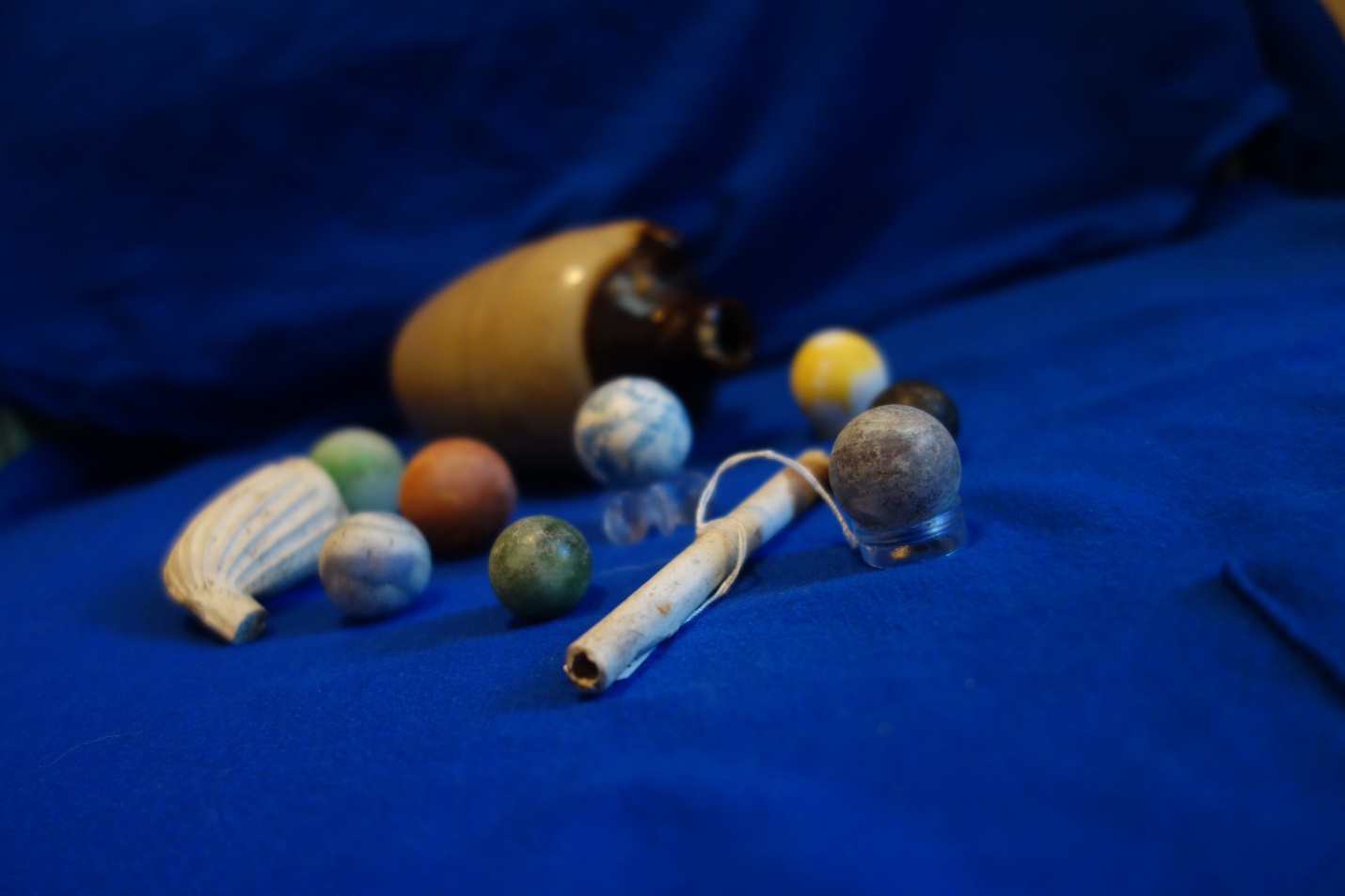
To compensate for the lack of marble photographs, we have included a photograph with artifacts taken from our collections. Artifacts shown above represent each type marble dug at Fort Leavenworth and other domestic artifacts which are also reported dug at various sites of the archaeological dig site. Each is a type found during the Phase II Fort Leavenworth dig.
Our first note is that the report uses the contraction HBS. This stands for historic building sites. Fort Leavenworth produced multiple marbles in these HBS. We look first at HBS 5.
HBS 5. The location of HBS 5 was determined through archival research. The 1866 Mitchell map shows that a separate water closet [14]was located behind Thomas (HBS 39) and McPherson (HBS 10) during that time. As noted in the project area 5 discussion, each of these water closets had six separate rooms. The map also shows that the southern edge of the Thomas Hall water closet was located precisely 160 ft north of the northern edge of the McPherson Hall water closet. Once the location of the HBS 39 water closet (HBS 38) had been determined, a theodilite was set up over unit A within the center of HBS 38. A line was then run north for 160 ft from this point to what–assuming the information on the 1866 map was correct-should have been the approximate center of the Thomas Hall water closet. A 1 m x 1 m test unit (unit A) was then placed over this location. [Emphasis added]
Marble Occurrences in the Report
Note: The Report Page Numbers come from the actual page number typed on the report page.
| Page | Context | Description |
|---|---|---|
| 73 | Figure 19A | Illustration of a machine-made glass marble recovered from HBS 5, Unit A, Level 11. The figure caption identifies it as “Machine made glass marble.” |
| 95 | HBS 38 | Describes one decomposed clear glass marble with white, orange, and blue swirls recovered from the vault fill. The authors state it was “likely a machine-made marble” dating after 1901. |
| 110 | HBS 5 | Reports one reddish-brown and colorless layered glass machine-made marble from the undisturbed privy fill. The report notes that machine-made glass marbles postdate 1901. |
| 117 | HBS 40-41 | Reports one undecorated white clay marble, 0.57 inches in diameter[15], recovered with a toy teacup and slate pencil. The authors explicitly interpret these artifacts as evidence for the presence of children. |
| 124 | Interpretation | The report states that “The marble, slate pencil, and toy teacup base suggest the presence of children, and indirectly, women in this section of the post.” |
Summary by Marble Type
Glass Marbles include:
- Machine-made marble illustrated in Figure 19A (p. 73).
- Clear glass marble with white, orange, and blue swirls (p. 95)
- Reddish-brown and colorless layered glass marble (p. 110).
One clay marble is also reported:
- Undecorated white clay marble, 0.57 in. diameter (p. 117).
Unfortunately, the “glass marble” illustrated in Figure19A looks more like a button to us! The caption reads “Glass and metal artifacts, HBS 5 and 46. A. Machine made glass marble, HBS 5, unit A, level 11; B. Embossed pewter button, HBS 5, unit B, level 6; C. .45/70 caliber centerfire rifle cartridge, HBS 46; D. Brass key, HBS 46.”
At any rate, this assemblage (19A) does establish the archaeology of the normal at Fort Leavenworth. The cartridge shows the purpose of the fort while the embossed pewter button speaks to class and the marble illustrates that children were hard at work with a normal day at the Fort. Note that there is no attempt made at dating the glass button.
Why the Clay Marble Matters
Of the four marbles referenced in the Report, the white clay marble from HBS 40-41[16] is arguably the most important for this story. HBS 40-41 is an area containing higher-status domestic refuse associated with officers’ occupations. The assemblage also included decorated ceramics, stemware, and alcohol bottles that the authors believed reflected officer-family use rather than purely enlisted contexts.
This is important because it links a marble directly to:
- military-family occupation
- children on post
- officers’ residential area
- late nineteenth-century domestic life
The investigators directly connect the clay marble with a toy teacup and slate pencil and interpret the assemblage as evidence of children’s activities at the post. That’s unusually explicit language in a military-site report and provides a strong citation for discussions of families and childhood at Fort Leavenworth.
In fact, that sentence on page 115 is almost sidebar-ready: “The marble, slate pencil, and toy teacup base suggest the presence of children, and indirectly, women in this section of the post.” That is one of the clearest archaeological statements tthat we have seen linking a marble find at Fort Leavenworth to family life rather than purely military activity.
Summary
The report described 1866 privy vaults at HBS 5 and HBS 38 and one of the glass marbles came from the fill of one of those vault deposits. The report specifically discusses a glass marble from the vault fill assemblage[17]. So in Leavenworth’s case, the very marble that caught our attention came from exactly the kind of feature historical archaeologists love: an old privy vault that later accumulated household debris.
A privy tells you what people threw away. A water closet tells you what people engineered.
Conclusion: The Archaeology of Normal at Fort Leavenworth
The history of Fort Leavenworth is most often told through soldiers, campaigns, treaties, and the movement of armies and wagon trains moving westward. Those stories are important, but archaeology offers another perspective.
Buried beneath the evidence of military operations are traces of everyday life: children’s marbles, clay pipes, buttons, tablewares, gaming pieces, and the countless objects of routine existence. Together they tell a quieter story. A story of the normal.
These artifacts remind us that the fort was not simply a military installation. It was a community. Officers and enlisted men lived there with wives and children. Civilians worked there. Visitors passed through. Travelers followed the roads west. Even prisoners, including the Nez Perce held near the post in 1877 and 1878, sought moments of familiarity amid uncertainty and displacement. Across these different experiences runs a common thread: the human desire to create normality.
Photograph by Jo Garrett
A marble recovered from the soil is a small thing. Yet it speaks of play, curiosity, friendship, and childhood, and common bonds. It suggests that somewhere within a landscape often associated with duty and conflict, a child paused to enjoy a game.
Similar discoveries at Fort Yamhill, Fort Hoskins, and Vancouver Barracks reveal that this was not unique. Across the nineteenth-century West, children carried their games with them, and families reproduced the routines of home wherever circumstance placed them.
This is the essence of the archaeology of normal. The most powerful stories are not always found in monuments or battlefields. They are found in the ordinary objects that illuminate daily life and reveal how people adapted to changing and often difficult circumstances.
At Fort Leavenworth, marbles and other humble artifacts remind us that history was lived one day at a time. Behind every military report stood families sharing meals, children inventing games, friends gathering in conversation, and individuals striving to make unfamiliar places feel familiar.
The greatest lesson of Fort Leavenworth may be that normality itself leaves an archaeological record. In the fragments of toys, household goods, and personal possessions, we find evidence not merely of survival, but of humanity. Long after the voices have faded, these small objects continue to testify that even on the edge of a continent in motion, people sought the same comforts, routines, and moments of joy that define ordinary life today. And perhaps that is why a marble matters. Small enough to fit in a child’s pocket, it carries within it one of archaeology’s largest truths: history is not only made by great events, but by ordinary people living ordinary days.
References
- For more information see https://en.wikipedia.org/wiki/United_States_Disciplinary_Barracks 10/16/2026 ↑
- “Fort Leavenworth” Photographic Treasures of Historic Leavenworth, Kansas.” University of Kansas Library @ ↑
- “Frontier Army Museum” @ Frontier Army Museum (U.S. National Park Service 10/18/2026 ↑
- “Frontier Army Museum” @ Frontier Army Museum brochure_APR 2026.pdf 10/19/2026 ↑
- See “Phase II Archaeological Investigations At Fort Leavenworth, Kansas” @ DTIC ADA311236: Archaeological Investigations at Fort Leavenworth, Kansas. Phase 2. : Defense Technical Information Center : Free Download, Borrow, and Streaming : Internet Archive (10/19/2026) & “Oregon –California Trails Association” @ https://octa-trails.org/ 10/20/2026“
- ↑
- We recommend d that you check James Deetz. His entire argument in In Small Things Forgotten is that ordinary objects reveal aspects of life that grand historical narratives overlook. A marble, a doll fragment, a slate pencil, or a button can illuminate: routine, family life, childhood,household organization, social expectations, & community identity. These are precisely the themes we’re exploring at Fort Leavenworth. James Deetz, In Small Things Forgotten: An Archaeology of Early American Life, rev. ed. (New York: Anchor Books, 1996); Jane Eva Baxter, The Archaeology of Childhood: Children, Gender, and Material Culture (Walnut Creek, CA: AltaMira Press, 2005). ↑
- Newspaper clipping – Kansas Memory 10/21/2026 ↑
- “Nez PerceNative Americans” @ Nez Perce Native Americans | Leavenworth, Kansas (10/20/2026) & “Discover Lewis & Clark” @ https://lewis-clark.org/ 10/20/2026 ↑
- “Nez Perce—A Hard Fight For Their Homeland” @ https://www.legendsofamerica.com/na-nezperce/ 10/20/2026 ↑
- The Kenneth Spencer Research Library at the University of Kansas appears to hold a small but potentially significant manuscript collection directly related to the Nez Perce confinement at Fort Leavenworth. [archives.lib.ku.edu] General orders regarding Nez Perce prisoners at Fort Leavenworth, Kansas Call Number: RH MS P106 Date: November 28, 1877 [archives.lib.ku.edu] ↑
- After about eight months at Leavenworth, the survivors were removed to the Indian Territory in present-day Oklahoma rather than being returned to Idaho or Oregon. Conditions there were also difficult, and additional deaths occurred from disease and climate-related hardships. ↑
- “Phase II Archaeological Investigations At Fort Leavenworth, Kansas” @ DTIC ADA311236: Archaeological Investigations at Fort Leavenworth, Kansas. Phase 2. : Defense Technical Information Center : Free Download, Borrow, and Streaming : Internet Archive PDF, “The Trails” @ The Trails – OCTA (10/21/2026), & Search tDAR 10/21/2026 ↑
- When an excavation report says “privy vault,” it generally implies an outdoor toilet feature. When it says “water closet vault,“ the feature may belong to a more sophisticated plumbing system associated with officers’ quarters, hospitals, or later-period buildings. We discuss privy vaults, which may contain a wealth of information about a site, in a number of our stories such as “You Dug It Up Where?” ↑
- Randall, Mark E. 1971 “Early Marbles”. Historical Archaeology 5:102-105 ↑
- In reference to the loci’s containing the remains of HBS 5 (Dragoon Peivy Vault). HBS 41 (Officer’s Quarters Outstructure) Dragoon: A horse-mounted soldier of the early U.S. Army who combined the mobility of cavalry with the ability to fight dismounted. For a Fort Leavenworth audience, I’d favor the second version. It is simple, accurate, and immediately understandable. Fort Leavenworth was home to the 1st U.S. Dragoons and 2nd U.S. Dragoons, making dragoons among the most important military occupants of the early post. Point: the clay marble is associated with the Dragoons. ↑
- Oregon-California Trails Association (OCTA) ↑