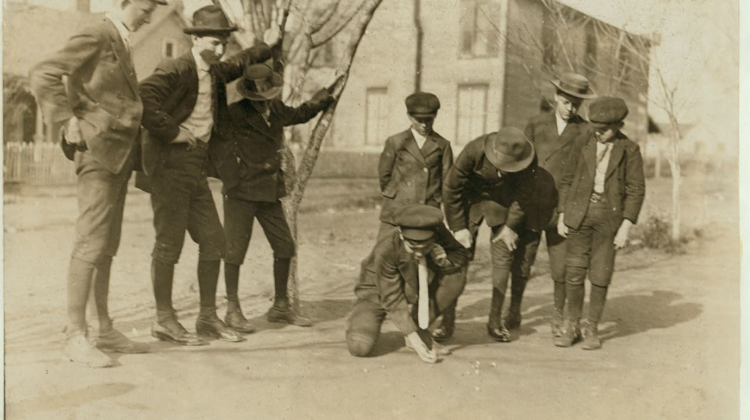
A quiet game of Marbles[1]
We love newspapers.
For too many years we have lived in places without a local paper, and that absence has made us appreciate old newspapers all the more. It also left us wondering: what became of the mountains of yellowed editions that generations of publishers accumulated in small and large cities nationwide? When a newspaper closed or modernized, where did all those old stories go? Did the paper keep a morgue somewhere?
As it turns out, they did.
Forgotten Louisiana Newspaper Tales, 1890-1900
Long before searchable databases and digital archives, newspapers maintained vast collections of clipped articles, photographs, biographical files, background notes, and unfinished stories. Once an article had appeared in print, it was no longer “alive” as current news. It was then filed away in the newspaper’s morgue, waiting for some future reporter to resurrect it.
The term morgue entered American newspaper jargon during the late nineteenth and early twentieth centuries. The comparison was a grim but practical one: old stories were laid away until someone had reason to bring them back to life.
We have written before about our interest in the Library of Congress’s Chronicling America collection, part of the National Digital Newspaper Program, a partnership between the Library of Congress and the National Endowment for the Humanities. The collection contains thousands of digitized newspapers from across the United States, preserving millions of pages that might otherwise have vanished into attics, basements, landfills, and forgotten storerooms.
In a sense, the Library of Congress has become America’s largest newspaper morgue.
For marble historians, collectors, and curious wanderers, that is a wonderful thing. Every forgotten anecdote, every child’s game, every mention of a marble tournament or schoolyard wager has lain dormant for more than a century, waiting patiently for someone to find it again.
That, in a small way, is what we are doing here. We are bringing a few very old marble stories back to life.
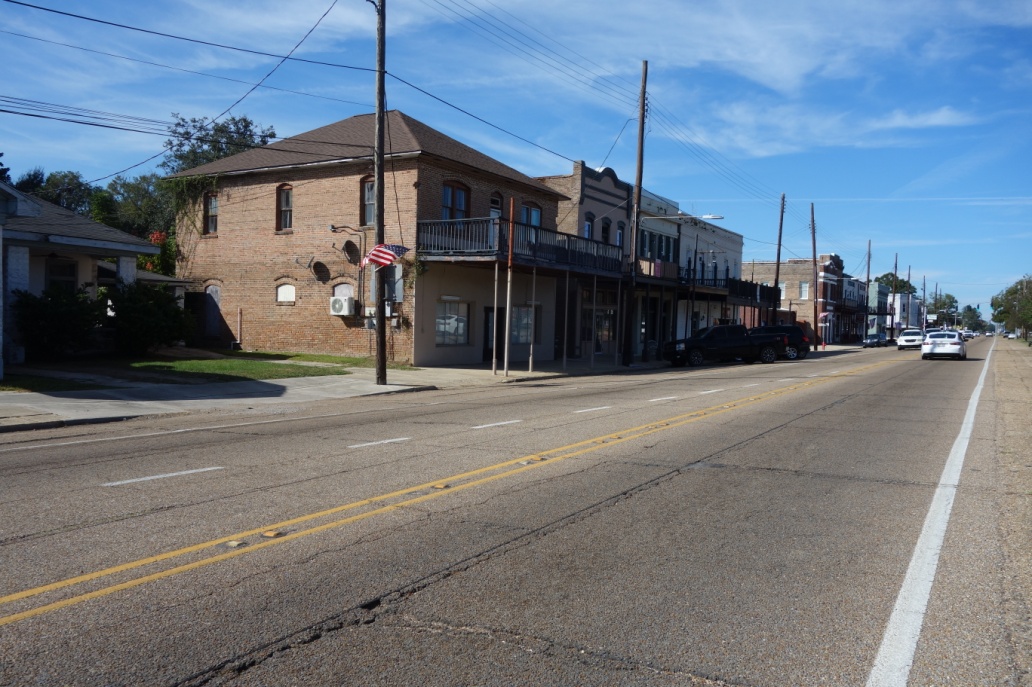
Independence, LA Photo by Jo Garrett
Rolling Through Ponchatoula & Southeast Louisiana
Few outings are more enjoyable to a marble collector than an unhurried drive through southeast Louisiana with no destination beyond old stores, dusty shelves, and the possibility of an unexpected discovery.
Nestled in Tangipahoa Parish, Ponchatoula is exactly that kind of place.
Known today as the “Strawberry Capital of the World,” its historic downtown is lined with antique shops, flea markets, and collectibles dealers housed in storefronts that seem purpose-built for treasure hunting. A visitor may arrive in search of marbles but find himself distracted by cast-iron cookware, advertising tins, fishing tackle, old photographs, or some other relic of a vanished age. That is part of the charm. The hunt is rarely direct.
Unlike the bayou towns farther south, Ponchatoula occupies the transition zone between Louisiana’s Florida Parishes and the marsh country below Lake Pontchartrain. The setting is more pine forest than swamp, though bayous, rivers, and wetlands lie nearby. The town remains a favorite stop for collectors, pickers, and anyone who believes the best journeys begin by taking the wrong turn.
On a recent ramble through Ponchatoula, Abita Springs, Hammond, Tickfaw Village, Amite, and Kentwood, we found ourselves returning once again to our favorite shops and favorite people in Ponchatoula.
As always, the search began with marbles.
After scanning display cases and shelves, we asked what is perhaps the marble collector’s most important question:
“Do you have any marbles?”
The answer is often no.
But every collector knows the response occasionally changes. “Well… I might have a few in the back.”
That is when the adventure really begins. Just recently in Ponchatoula the store keeper found antique Akro marbles even he didn’t know he had!
Not every marble hunt ends beneath the bright lights of an antique mall. Some of the best roads lead through places like Tickfaw, where old homes rest beneath sprawling live oaks and family possessions linger for generations. A coffee can in a shed, a cigar box at an estate sale, or a fruit jar beneath a flea-market table may contain marbles untouched since local children played in dusty yards beside the railroad.
Just recently in Tickfaw Village we found a gentleman and his wife and Loretta their puppy Blue Heeler overseeing a yard sale out of a commercial garage. Marbles still packed in plastic tubs, but did have two 1950s hand-held pinball machines! The plunger, which was still strong, had been repaired once with a 1942 nickle!
The collector’s secret is simple: never overlook the small towns and the good souls who live there.. That is where the stories are still hiding. And sometimes, so are the marbles.
Between & Betwixt
We had a great time on our latest Louisiana foray, and we fully intend to return as soon as possible.
Until then, we can indulge another favorite pastime: searching America’s attic at the Library of Congress.
With Louisiana still on our minds, we wondered whether the state’s newspapers preserved any marble stories from the years just before the great glass-marble boom of the late nineteenth century. As we drove through the countryside, passing handsome old homes shaded by live oaks draped in Spanish moss and surrounded by fig, pear, and apple trees, a simple thought occurred to us.
Children played marbles here. We know that because there are still antique marbles in the shops. They played marbles in these yards, along these roads, and beneath these very trees.
If marbles were truly part of everyday life, surely some trace of them found its way into the newspapers of the day. Could stories of marbles and childhood in old Louisiana still survive?
We knew where to look. So we went to the morgue. And we struck pay dirt.
The stories that follow spent more than a century tucked away in newspaper files before finding their way into digital archives. Many survive only on fragile paper, and some were printed with fading ink long before anyone imagined scanners and searchable databases. In a few cases, age and digitization have left the text imperfect.
For that reason, we have transcribed the articles as faithfully as possible, preserving them much as they originally appeared when Louisiana readers first encountered them in print more than a century ago.
Easter Marbles
German children have a game of marbles played only at Easter. The Easter eggs are cut off squarely, perhaps one-third of the distance from the broad end. They are then set up, say, three or four feet from the wall and in triangular positions. Three or four may be set at once. Sides are chosen if there are more than two players. Then the children roll their marbles with a deft thud against the wall or baseboard. If in the rebound a marble touches one of the eggs it becomes the [unreadable] to which the marble belongs. The opposite side much “set up” and the game is only won when all the eggs are captured by one side. Candy animals and cake people who are able to stand along [alone?]are often the victims in this war of marbles. We have read about, witnessed, and watched many many different marble games over the years, but we had never heard anything about this German game. Have you?
This story was published in the The Lafayette Advertiser on April 1, 1893. Vermilionville is in Lafayette, Louisiana, right in the heart of Cajun Country. Today it is a living-history museum and folk life park, but the name comes from the original settlement that eventually became modern Lafayette. Vermilionville sits directly on the banks of Bayou Vermilion (also called the Vermilion River). The entire historic village was intentionally placed beside the waterway because the bayou was central to settlement, travel, fishing, farming, and daily life in the region[2].
Untitled
So much for the amusing; now for the perplexing. A little boy came to me to get some information about a sum he was working.
I began by saying “two and two makes four”; why does “two and tow make four,” he inquired.
I looked up and looked around, and finally saw a little tow headed urchin whose pockets were always full of marbles, called him to me, and borrowed four marbles. Placing two in one hand and two in the other, I then put them together and said now you see two and two makes four. The little fellow accepted the situation, but to this day I do not know whether he accepted my elucidation. The fact that two and two made four was evident, but why it did it, was the conundrum you can each work out for yourself.
This appeared in the weekly Thibodaux Sentinel and Journal of the 8th Senatorial District (Thibodaux, Lna. [i.e. La.]), on August 25, 1894,
Thibodaux (pronounced roughly “TIB-uh-doe”) is in southeastern Louisiana, about 60 miles southwest of New Orleans. It is the parish seat of Lafourche Parish and home to Nicholls State University. Lafayette grew beside Bayou Vermilion. Thibodaux grew beside Bayou Lafourche. Both are Cajun, but Thibodaux feels more like the bayou and swamp country of southern Louisiana, while Lafayette sits closer to the prairie heartland of Acadiana.
He Didn’t Stay
Just before he reached the corner he consulted his watch and the bells at the same time struck 3. H gazed up and down, looked into a store window, and wore away fivc minutes. Then he turned to a boy trying to play marbles alone in the grass and cautiously asked:
“Bub, have you seen a lady standing on this corner within a few minutes?”
“Yaas, was the prompt reply. “She was here about ten minutes ago.”
“And where did she go?”
“Down that way. Man come along and she went off with him.”
“Did, eh?”
“Yaas, but you needn’t feel bad. I heard the man say he’d come back with a shotgun and shoot the blue blazes outer some one. If you’ll wait he’ll certainly come back.”
A car was passing and the man made only three jumps to reach it, and, as he sat down, the passengers, noticed that he appeared like a man suffering great mental anxiety—lost his dog, perhaps.
While this story was first published in Detroit, it was “picked up” or re-published in Thibodaux. It was common practice for newspapers to pick up and print stories from other papers.
This next story was said to take place in London, but it was published in a Louisiana paper.
How They Came To London
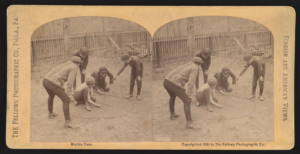
Marble Time[3]
The next story was published in the Thibodaux Sentinel and Journal November 27, 1897. The following conversation took place between two gentlemen in a crowded London club room. They had been talking about the condition of things when they first came to London. Mr. Rawson said:
“When I first came to London, I had only a ragged coat, with a knife and a few marbles in my pocket.”
“You were better off than I, then, for I had neither a coat nor a waistcoat, nor a knife, nor even marbles.”
“Nonsense!” was the reply. “How could that be?”
“Well, I will tell you. When I came here I was a baby in long clothes.”
The roar of laughter that arose could have been heard miles away.—Tit-Bits
It was not a grand city or a military post. It was a courthouse town where people ran stores, attended school, printed newspapers, raised families, buried their dead, and worried about freight costs. The sort of place where marbles, buttons, clay pipes, broken dishes, and ink bottles tell more of the story than famous names do[4].
We offer a couple of explanations from this clip. A waistcoat is a sleeveless garment worn over a shirt and under a coat or jacket. Traditionally, it forms part of a three-piece suit: Coat or jacket; Waistcoat or vest; and Trousers.
In the 19th century, a waistcoat was common everyday wear for many men, from merchants and clerks to military officers and gentlemen. It often had pockets for a watch and could be quite colorful, even when the outer coat was plain.
Secondly, there is the matter of long clothes. In 18th- and 19th-century usage, “long clothes“ usually referred to the long gowns or garments worn by young infants before they were breeched or dressed in shorter clothing.
A baby in “long clothes” wore a long, skirt-like garment extending well below the feet, often for the first months of life. As the child grew, he or she would be put into “short clothes,” which allowed greater movement.
No Title
What is to become of the old-fashioned boy who fished, swam and climbed trees and fought hornets’ nests? He had stone bruises on his feet, sunburn on his back, gravel in his hair, warts on his fingers, a live snake in one pocket and four “aggy” marbles in the other. He played “hookey” and was licked at both ends of the line, home and school, and the only effect of the licking was to arouse him to new and more original methods of making trouble for everyone.
This story brings back clear memories for us. Where indeed is that boy or girl who played all over Louisiana in the 1890s. Will we ever return to even a tiny bit of this clip? That’s the sort of passage that convinces us that marbles occupied a much larger cultural space than their size would suggest. They show up again and again as literary shorthand for childhood, freedom, and ordinary life.
Opelousas, Louisiana is one of the oldest European-founded settlements in the Louisiana Purchase territory and serves as the parish seat of St. Landry Parish. A few highlights that might interest a student of Louisiana material culture:
- The town takes its name from the Opelousa people, an Indigenous group who lived in the region before European settlement.
- It lies about 25 miles north of Lafayette, in the prairie section of Acadiana rather than the bayou country.
- During the 18th and 19th centuries, Opelousas was an important trading center linking south Louisiana with Texas and the western frontier.
- For a brief period during the Civil War, Opelousas even served as the capital of Louisiana when the state government fled advancing Union forces.
Finally, let’s take a look at the next story.
Deceptive Sensibilities
The evidence of our senses is correct in nearly all cases in which two of them are called into play, so that the testimony of one is checked by that of the other. But when we have to rely upon one sense alone, we are sometimes curiously deceived. The experience of those who have lost a limb are familiar. For some time afterward, they feel pains in the member that is gone. This is because the nerve which used to convey feeling to the lost extremity is affected. Another experience in deceptive senses may be made by crossing the second finger over the first and then placing a marble between the tips of the fingers, when it will be almost impossible to convince one’s self that there are not two marbles. This is because two points in the fingers are touched simultaneously, which in the ordinary position could only be touched at the same time by two marbles. Acting upon its previous knowledge, the brain infers there are two. Detroit Free Press as republished in the St. Tammany farmer (Covington, La.), November 19, 1898
Covington, Louisiana is the parish seat of St. Tammany Parish, located on the north shore of Lake Pontchartrain, across the lake from New Orleans. Covington was founded in 1813 and developed as a small river town on the Bogue Falaya River. Before modern highways and the Causeway, New Orleanians often traveled to Covington by steamboat and rail to escape summer heat and yellow fever outbreaks.
A Marble in the Pocket
Newspapers of the late nineteenth century often used marbles as a shorthand for boyhood. One Louisiana writer described the “old-fashioned boy” as having “a live snake in one pocket and four aggy marbles in the other.” The observation is humorous, but it reveals something important. Marbles were not merely toys. To contemporary readers, they were so closely associated with childhood that a few agates in a pocket instantly identified the character of the boy who carried them.
Archaeologists rarely recover evidence of swimming holes, hornets’ nests, fish caught in a creek, or afternoons spent playing hookey. What they do recover are the objects left behind: marbles, buttons, pocketknives, clay pipes, and fragments of everyday life. A single marble from a military post, a frontier settlement, or a Louisiana courthouse town may represent the same carefree world celebrated in newspaper columns and remembered in memoirs. Long after the boy is gone, the marble remains.
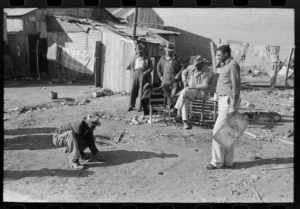
First Warm Day of Spring[5]
References
- Hine, Lewis Wickes, photographer. A quiet game of marbles. All the boys work in the Salisbury N.C. cotton mill. The boy shooting is Henry Dedman, a warper. Been in mill 5 years. His grandmother said “I don’t like to have ‘ em play marbles on Sunday, but when can they play?” “Yes he stands the mill work pretty well. Early getting’ up is the making’ of ’em.” Location: Salisbury, North Carolina. December. Photograph. Retrieved from the Library of Congress, <www.loc.gov/item/2018674749/>. ↑
- Vermilionville | Vermilionville; Events in Lafayette, LA | Festivals, Food & Fun Activities; ↑
- Fellows Photographic Co., Publisher. Marble Time. Photograph. Retrieved from the Library of Congress, <www.loc.gov/item/2006675917/>. ↑
- Bossier Parish Libraries History Center: Bellevue 1875 10/28/2026 ↑
- Oklahoma. Feb. Photograph. Retrieved from the Library of Congress, <www.loc.gov/item/2017741706/>. Lee, Russell, photographer. Negro playing marbles on the first warm day in the spring. In this game the players shoot from hole to hole, the same idea as in golf or miniature golf. Eufaula, ↑